

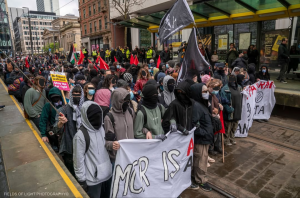
Free Palestine Coalition protesters on Westminster Bridge, 6 January 2024. Credit: Steve Eason/Flickr.
Palestine solidarity protesters face down police repression in London
rs21 members •After mainstream media reports of “clashes” and “skirmishes” between police and protesters on the Free Palestine Coalition march in Central London on 6 January, rs21 members who attended the demonstration report on what actually happened. With photographs by Steve Eason.
Saturday 6 January marked the first action of 2024 by the Free Palestine Coalition, a set of groups including Sisters Uncut, BLMUK, London for a Free Palestine, rs21, and many others organising for a ceasefire, end of arms sales to Israel, and an end to the Israeli occupation of Palestine.
Several hundred people started gathering at the St James’ Park drinking fountain around midday. Soon, speeches began from various groups to the growing crowds, including interventions from Health Workers for a Free Palestine, who are organising across healthcare services in solidarity with their fellow workers facing the genocidal attack in Gaza. Speakers from the Palestinian Youth Movement linked the Palestinian struggle to the global revolutionary struggle for freedom.
The police had arrived early, attempting to intimidate the activists present. At one point demanding that the sound system be moved out of the park. As soon as the initial speeches had finished and the crowd was lining up behind the banners to begin marching, the police struck. Around 20 officers in a block formation attempted to charge through the crowd to arrest the speakers and disrupt the sound system. They elbowed and pushed their way through the crowd in an attempt to prevent the protest.

Free Palestine Coalition protesters, 6 January 2024. Credit: Steve Eason/Flickr.
This quickly backfired, as these police found themselves surrounded by the larger crowd, squaring up to them and chanting ‘Shame’. The officers were forced, after sadly securing some of their targeted arrests, to retreat and form a police line.
From this point the march began, as intended, in the opposite direction to the newly created police line. The crowd started walking alongside St James’ Park, led by activists in ‘Ceasefire Now’ T-shirts, linking arms. From St James’ Park, the march, now numbering in the low thousands, walked towards Parliament Square and past Downing Street.
It was at this point when the Met Police once again decided to attack the crowd. As activists marched alongside Parliament towards Westminster Bridge, they suddenly had flurries of yellow bibs in their peripheral vision. On either side of the crowd, lines of police were attempting to run past and form a line, blocking the march’s path towards Westminster Bridge.

Free Palestine Coalition protesters on Westminster Bridge, 6 January 2024. Credit: Steve Eason/Flickr.
Precisely why such a manoeuvre was attempted is unclear, perhaps as a police tantrum at the coalition’s refusal to share the march’s path. There were simply too many marchers for this police line to function. Marchers continued to push through the police line, and succeeded in briefly creating a gap for a few hundred to make it closer to the bridge.
These few hundred then immediately faced the sight of several police vans rapidly parking across Westminster Bridge, as officers barrelled out to form another blocking line. This created a stand-off between the Met Police, who were pushing for an excuse to be violent towards protesters, and the marchers.
Westminster Bridge was entirely blocked by several vans and a line of police officers, in front of them were several hundred marchers. Behind them, closer to Westminster Station, was a second, reinforced police line, and behind that the majority of the marchers. This effectively shut down Westminster Bridge, the wider Parliament road system, and it was painfully clear that the police were operating without a plan beyond a desire for confrontation.
The police attempted to manage the pavement traffic, to keep the two groups of protesters separate, but also allowing tourists and others to continue walking. The results were a striking display of police racism and misogyny. Unless people were wearing a keffiyeh or carrying Palestine protest materials, there was no way for the police to distinguish between a protester and a tourist. So they simply would harass, stop, and get in the face of many non-white and non-male pedestrians, demanding they explain what they were doing – bare-faced racist filtering of the crowd by the police.
After a period of chanting, the police line near Westminster station retreated to the side of the road, allowing the crowd to be reunited. People hugged each other, chanting, ‘The people, united, will never be defeated!’ The crowd held a die-in, lying down while chanting for a free Palestine, and calling for an end to supplying arms and beginning sanctions on Israel. After successfully shutting down Westminster Bridge and occupying the space for a few hours, the crowd began to disperse safely in groups.

Free Palestine Coalition protesters on Westminster Bridge, 6 January 2024. Credit: Steve Eason/Flickr.
What should be the key takeaways from this action? First, despite the hopes of the political right and the British state, the Palestine solidarity movement continues to mobilise in 2024. The meeting location was kept secret in anticipation of the police harassment, only being revealed at 10am, but still thousands came to the demonstration, in addition to several thousands joining local demonstrations and other actions across London and the country. Masses of people continue to mobilise in solidarity with Palestine and against settler colonialism.
Secondly, the Met Police are emboldened in their anti-democratic, racist, and misogynistic action. At every step of the protest, Met officers attempted to target predominantly racialised activists and initiated physical confrontations with the crowd. Whether this is part of the wider crackdown on protest by the British state, was a reaction to not being ‘told’ where the protest would march, their conduct revealed their true nature.
Reports emerged this weekend that John Woodcock, the disgraced former MP who resigned from the Labour Party amid allegations of sexual harassment only to be made a Lord after supporting the election of Boris Johnson, is recommending that the government charge protesters for the cost of their policing. This makes it clear that the police have an interest in escalating tensions on demonstrations in order to justify their presence and impose financial discipline on protest organisers.
The struggle for liberation, from Palestine to Britain, is inseparable from the struggle against the police. From harassing Palestine solidarity activists, to the day-to-day racist and misogynistic acts they commit against the working-class, the Met has no legitimacy, and acts as an anti-democratic force in London. This was made ever clearer to marchers today.
Finally, the Coalition demands were not simply for a ceasefire, but also for an end to British arms to Israel. This demand, as well as the widespread chanting for sanctions against Israel, speaks to a longer-term orientation emerging in the Palestine solidarity movement. This movement is not just developing to push for an urgently needed ceasefire, but for an end to the imperialist links between Britain and Israel. If these links can be undone, so too may the racist Zionist settler-colonial project – that is the hope and the challenge. If you want to get involved in future Free Palestine Coalition actions, sign up here.
- Attend the Protect the Right to Boycott – Rally for Palestine event outside Parliament on Wednesday 10 January at 5pm.
- Join the National March for Palestine – Ceasefire NOW! demonstration on Saturday 13 January. Assembles 12 noon at Bank junction, Central London.



0 comments