
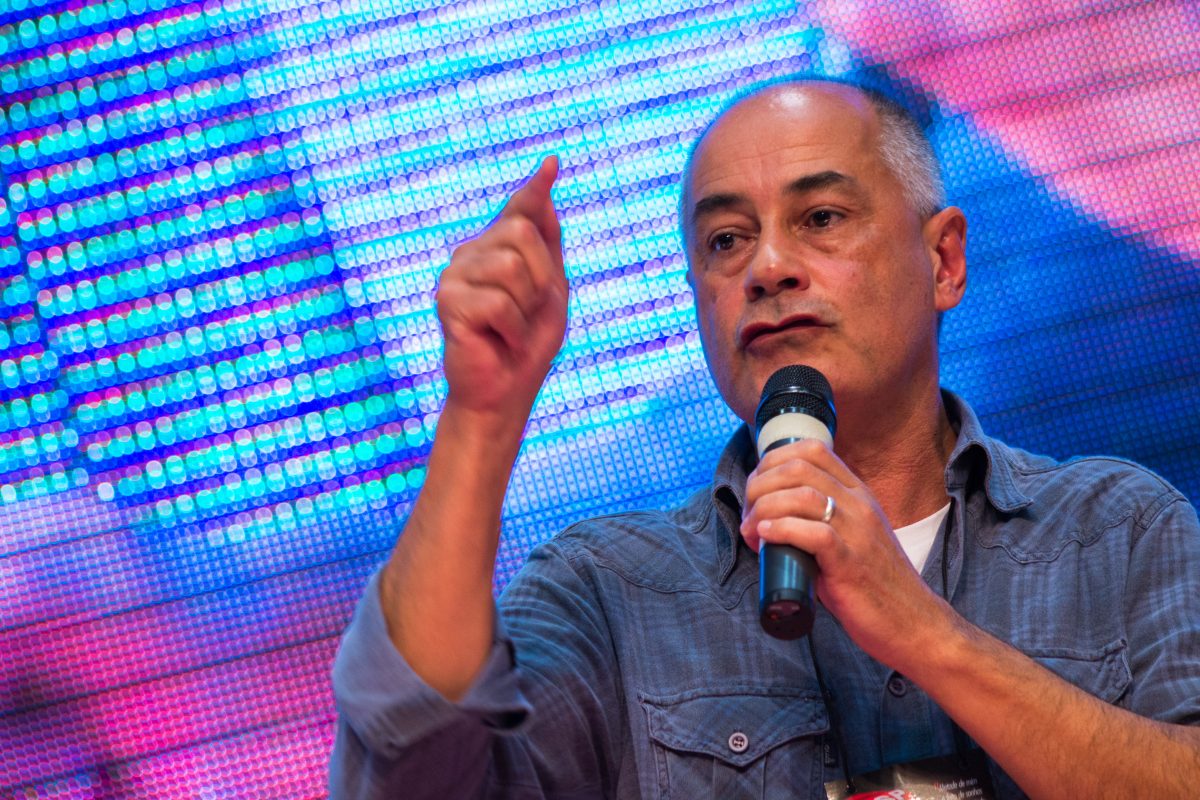
The Price of Saying ‘Free Palestine’: Zé Maria and International Repression
Florence Open and Martin Ralph •Florence Open and Martin Ralph write on the incarceration of the Brazilian trade unionist, and how to show solidarity.
Two years in prison for a union leader who dared to say ‘from the river to the sea.’ Over 1,600 people were arrested under terrorism laws for holding a cardboard sign in London. From São Paulo to South London, states are developing a new legal language—one that criminalizes solidarity with Palestine as a threat to public order. The labour movement must recognize this for what it is: an increasingly coordinated offensive against internationalist solidarity.
A metalworker before the court
On April 28, a federal court in São Paulo sentenced José Maria de Almeida—known to Brazil’s labour movement as Zé Maria—to two years in prison for racism. His crime was a speech delivered at an October 2023 rally in solidarity with Palestinians, in which he denounced the Israeli state and invoked the slogan: ‘Free Palestine, from the river to the sea.’
The complaint was not filed by a public prosecutor defending democratic norms. It came from the Israeli Confederation of Brazil (CONIB) and the Israeli Federation of the State of São Paulo (FISESP)—pro-Israel organisations acting as private prosecutors. The court accepted their argument that anti-Zionism constitutes antisemitism. (Read the full court ruling here)
Zé Maria is no fringe figure. He is a veteran of Brazil’s labour struggles—a metalworker first arrested in 1977 for distributing May Day pamphlets under the military dictatorship, and again in 1980 during the historic ABC region strikes alongside Lula. He helped found the Workers’ Party (PT) before breaking with it over its accommodation to ruling-class alliances. In 1992, he went on to build the PSTU (United Socialist Workers’ Party), of which he is today the President, and later, in 2001, CSP-Conlutas, a union federation representing over two million workers committed to political independence and internationalist solidarity.
That such a figure can now be criminally prosecuted for a political speech signals a shift in terrain. What is at stake is not simply the policing of rhetoric, but the imposition of new legal limits on the forms of internationalism the labour movement is permitted to express.
Why a union leader? Why this slogan?
The choice of target is revealing. CSP-Conlutas has consistently supported the Boycott, Divestment and Sanctions (BDS) movement and participated in solidarity initiatives with Gaza. Its support for Palestine is not a peripheral stance but integral to its political orientation—an internationalism that links workplace struggles to global questions of empire and genocide.
Zé Maria’s 2010 presidential campaign, run when Lula’s popular approval was at its peak, was the only one to confront the PT head-on over its neoliberal record. His 2014 campaign refused funding from banks, corporations, or contractors—relying solely on contributions from militants. The PSTU’s position was clear: ‘Only the workers, through their own strength and mobilisation, can change the country.’
This is the tradition that now faces criminal sanction. Zé Maria represents a current of labour politics that refuses to subordinate class struggle to electoral projects. And for that, the Brazilian state—like its counterparts across the West—is determined to make an example of him.
The court’s ruling collapsed the distinction between criticism of a political project (Zionism) and an attack on a people (Jewish people). In the court’s reasoning, the State of Israel was treated as representative of a ‘Jewish collectivity.’ Zé Maria himself put it directly, writing in Folha de S. Paulo: ‘Antisemitism is racism, which I repudiate with all my might. Zionists make up a political movement—Zionism, whose racist and colonialist ideology is the basis of the State of Israel.’
By redefining political criticism of a state as an attack on an ethnic or religious group, the ruling establishes a mechanism through which specific political positions can be recast as forms of racism—and therefore subjected to criminal sanction.
The British front: from proscription to mass arrest
What is happening to Zé Maria in Brazil has already arrived in Britain—and it is escalating.
On July 5, 2025, the Labour government proscribed Palestine Action under the Terrorism Act 2000. Membership of or support for the group became a criminal offence punishable by up to 14 years in prison. The proscription followed a protest in which activists spray-painted two RAF Voyager planes at RAF Brize Norton, causing an estimated £7 million in damage.
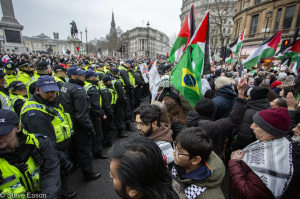
The consequences have been staggering. According to Home Office data published in December 2025, 1,886 people were arrested for terrorism-related offences in the year to September 2025—a year-on-year increase of 660 percent. Of these, 1,630 arrests were linked to the Palestine Action ban. Most were arrested for holding placards reading ‘I oppose genocide. I support Palestine Action’— an offence under section 13 of the Terrorism Act, which prohibits displaying support for a proscribed organisation.
As the UK Human Rights Blog noted, the Divisional Court below was told that over 2,000 people had been arrested under section 13 by November 2025, of whom approximately 700 had been charged and none yet convicted. The Morning Star reported in April 2026 that over 500 people were arrested at a single protest in Trafalgar Square, bringing the total arrested since the ban to more than 3,300.
To cap it all off, the High Court found the proscription unlawful in February 2026.
The Nineham and Jamal convictions: political speech as incitement
On March 31, 2026, Ben Jamal, director of the Palestine Solidarity Campaign (PSC), and Chris Nineham, vice chair of the Stop the War Coalition, were found guilty following a trial at Westminster Magistrates’ Court. District Judge Daniel Sternberg found both guilty of failing to comply with protest conditions. Jamal was additionally convicted on two counts of inciting fellow protesters to breach police conditions. The judge handed Nineham a 12-month conditional discharge and Jamal an 18-month conditional discharge.
The case arose from a protest on January 18, 2025 where Jamal and Nineham led a small delegation toward the BBC’s Portland Place headquarters, intending to lay flowers in protest at what they described as the corporation’s biased coverage of the Gaza genocide. Prosecutors said crowds began to follow, and footage showed people moving toward a police cordon that ‘eventually buckled under the pressure of large numbers of people moving forward.’
In a speech played to the court, Jamal had declared:
This week the police tried to impose upon us a route for a march which had been approved by the Board of Deputies of British Jews. We, the Palestine Solidarity Movement, decide where we protest, not the Board of Deputies, not the Chief Rabbi, not the Community Security Trust, not any Zionist group that has supported Israel’s genocide and its 76 years of apartheid.
The case demonstrates the narrowing space for political speech in Britain. As Nineham said outside court:
It is an extraordinary and shocking decision, and a huge setback for civil liberties in this country. It is an attempt to send a chilling message across society that people shouldn’t be protesting.
The wider infrastructure of repression: prevent, universities, and the Charities Commission
The crackdown on Palestine solidarity extends far beyond protest policing. Britain has developed a sophisticated multi-agency infrastructure for suppressing dissent, and the Palestine movement has become its primary target.
The government’s Prevent duty, established under the Counter-Terrorism and Security Act 2015, requires universities, schools, local authorities, and health bodies to report individuals deemed at risk of ‘radicalisation’. Since October 2023, there has been a sharp increase in Prevent referrals related to Palestine solidarity activity. Students who share BDS campaign materials or attend Palestine society events have been referred to Channel—the government’s ‘deradicalisation’ programme—with formal assessments taking place in dozens of cases.
Meanwhile, the Charities Commission has opened multiple regulatory compliance cases against Palestine-focused charities, including the Palestine Solidarity Campaign and Medical Aid for Palestinians, subjecting them to intensive monitoring and threatening their operational status. While formally framed as concerns about ‘political activity’ or ‘due diligence’, these investigations have a clear chilling effect on organisations that criticise Israeli state policy.
This infrastructure—Prevent, university risk management, charity regulation, and IHRA adoption—operates alongside the criminal law to create a hostile environment for Palestine solidarity. As the University and College Union (UCU) has documented, academics who speak out risk both institutional discipline and referral to Prevent. Students face investigation for ‘non-crime hate incidents’. This is the everyday reality of repression in Britain.
The global framework: IHRA and the legal weaponisation of antisemitism
Behind these national cases lies an international legal framework: the IHRA working definition of antisemitism. While presented as nonbinding, its accompanying examples—including those that equate certain forms of anti-Zionism with antisemitism—have been incorporated into law and policy in 47 countries.
The legal reasoning that led to Zé Maria’s conviction—collapsing the distinction between the State of Israel and Jewish identity—is consistent with interpretations promoted by the IHRA framework. In Brazil, Bill 1424/2026 would formally codify the IHRA definition and treat the State of Israel as a ‘Jewish collectivity.’ If enacted, activists involved in boycott campaigns could face up to five years in prison.
Even Kenneth Stern, who drafted the IHRA working definition, has warned against its use as a regulatory tool. More than 300 scholars developed the Jerusalem Declaration on Antisemitism as an alternative framework, explicitly stating that criticism of Israeli state policy and Zionism is not inherently antisemitic. More than 700 Jewish faculty members have signed statements rejecting the IHRA definition, arguing that ‘criticism of the state of Israel, the Israeli government, policies of the Israeli government, or Zionist ideology is not—in and of itself—antisemitic’.
The IHRA framework has helped furnish states and institutions with a language for treating Palestine solidarity as suspect or discriminatory. It is not the cause of the crackdown, but it has become its preferred lexicon.
Universities have also adopted the International Holocaust Remembrance Alliance (IHRA) working definition of antisemitism, often under pressure from the Office for Students. Its accompanying examples include treating anti-Zionist speech as potentially antisemitic. This has been used to suspend Palestine solidarity societies, discipline student activists, and cancel academic events critical of Israel.
Within the labour movement itself, pro-Israel factions have used the IHRA definition to challenge Palestine solidarity motions, accuse union leaders of antisemitism, and push for disaffiliation from the Palestine Solidarity Campaign. The UNISON rule book now contains explicit guidance on antisemitism—hotly contested by the left—that treats certain forms of anti-Zionism as discriminatory.
The terrain of struggle is not only the street but also the union branch, the conference floor, and the workplace.
The ideological core: internationalism as crime
What connects the conviction of Zé Maria in São Paulo with the arrest of pensioners in Trafalgar Square is not a conspiracy but a structural logic. The capitalist state, faced with a mass movement expressing solidarity with victims of a genocidal war, is redefining that solidarity as a threat to public order—even as a terrorist offence.
The legal mechanism varies by jurisdiction. In Brazil, there is an anti-racism law applied to political speech. In Britain, terrorism legislation is applied to political associations. But the effect is identical: to criminalise internationalism.
The labour movement has always understood that solidarity is not charity—it is the recognition that our struggles are connected. A victory for Palestinian workers is a victory for British workers. A defeat for Brazilian metalworkers who refuse to abandon Palestine is a defeat for us all.
Zé Maria himself has framed the case in collective terms, writing in Folha de S. Paulo:
I call on everyone, to political and popular organisations, regardless of whether they agree with the PSTU or not, to unite to defend basic things: the democratic right of every citizen to express their opinions.
And he closed his op-ed with words that now resonate across borders: ‘They will not silence us. And Palestine will be free, from the Jordan River to the sea.’
How You Can Stand in Solidarity
The appeal against Zé Maria’s conviction is pending before the Federal Court of São Paulo (TRF3). Bill 1424/2026 is pending in Brazil’s Chamber of Deputies. Meanwhile, in Britain, the mass arrests continue—with over 1,600 people criminalised under terrorism laws for protesting genocide.
Here is what you can do right now:
1. Sign and share the international petition calling for Zé Maria’s acquittal and the repeal of Bill 1424/2026.
👉 change.org/abaixo-assinado-ze-maria
2. Send solidarity messages from your union, branch, or organisation to CSP-Conlutas:
📧 internacional@cspconlutas.org.br
3. Build the BDS movement in your workplace and community. Visit BDS Movement UK for resources and campaign materials. Every boycott of Israeli goods, every divestment campaign, every solidarity action puts pressure on the states waging this war on protest.
4. Defend the right to protest in Britain. Support the Palestine Solidarity Campaign. Oppose the proscription of Palestine Action. Demand the release of those arrested for holding signs. Support the legal challenges—the High Court has already ruled the ban unlawful once.
5. Fight back institutionally. Pass a resolution in your union rejecting the IHRA definition. The UCU and NEU have model motions available. Challenge Prevent referrals in your workplace or university. Build the internationalist current in your branch.
6. Organise. Host a teach-in using resources from Labour for Palestine. Bring together trade unionists, students, and community activists. The state wants us isolated. We win through collective action.
The state wants us afraid. It wants us to believe that standing with Palestine is a crime.
We will not be silenced. And Palestine will be free.



0 comments