
Re-igniting direct action for Palestine
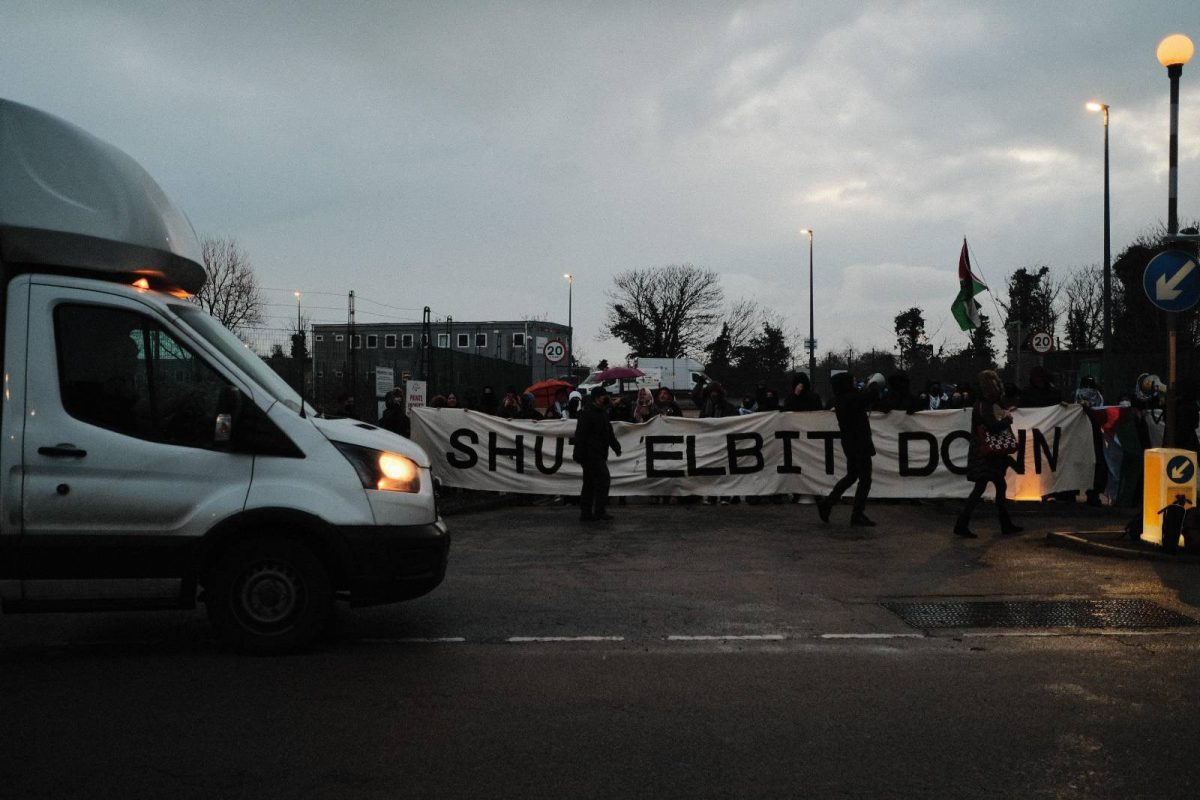
Arms Embargo from Below •Arms Embargo From Below have restarted large factory blockades at a moment when general mobilisation in the movement is slowing down. Their first two actions took 150 activists to an arms factory in Kent. Since then, they have been trying to build the structures that make such actions sustainable. Two members of the group answer rs21’s questions and argue for rebuilding a disruptive anti-imperialist movement through factory blockades, worker organising and collective action.
rs21: The Palestine solidarity movement in Britain has seen enormous growth since October 2023, but also increasing fragmentation and pressure. There’s a declining intensity of street mobilisation, the proscription of Palestine Action, prosecutions of organisers, and a government that has shown it is willing to criminalise dissent. How did Arms Embargo From Below emerge out of this landscape, and how did your organising trajectory lead you to specifically focus on an arms embargo?
Arms Embargo From Below started as a conversation around this fragmentation. A handful of activists came together to discuss the mounting pressure and fear hanging over us as a movement. How can we build power and resilience against repression through wider involvement, as well as grow confidence and collective political consciousness through shared struggle? How can we build capacities to act directly in a post-proscription environment, and better connect that to mass activity? Organising around the demand of an arms embargo – through a combination of mass blockade actions, worker agitation, and community organising – gives us a promising way forward to this horizon of mass and disruptive action.
Selling arms to Israel connects with the moral outrage that has driven the Palestine movement quite directly. The call for an arms embargo politicises this outrage – it has broad popular support, yet hasn’t been implemented, pointing to the undemocratic nature of the state and the need for struggle from below to enforce our demands.
It also allows us to do locally rooted organising around material targets and connect to the wider movement that has built up around them, while using tactics that already bring people together in collective disruptive struggle at a low enough risk level that we can expand participation beyond a small committed group. There are thousands of people who have marched for Palestine over and over and want to do more, but aren’t ready to sacrifice years of their lives to harsh sentencing. These are the people we’re trying to bring into our arms factory blockades – we brought hundreds of people out to our first two, disrupting production with no arrests.
Finally, bringing people together to shut down an arms factory, even just for a day, builds people’s confidence in collective action. At a time when demoralisation is rife and confidence in the movement is low, the feeling of those small wins with your comrades can go a long way.
rs21: Your first public actions were a blockade of Instro Precision near Sandwich, a subsidiary of Elbit Systems UK, which makes imaging and targeting technology used in Israeli drones. Can you explain why you chose this as your opening target? What did you learn from it, and what does it tell you about the strategy going forward?
Targeting an Elbit site was our initial draw. Elbit is Israel’s largest arms producer – they describe their drones as ‘the backbone’ of Israel’s drone fleet. This makes Elbit an obvious target in trying to weaken the Israeli state from our position in Britain and move the struggle for Palestinian liberation forward in Britain.
We landed on Instro Precision because it is ‘the Elbit site in the UK most connected to goods used by the IDF’, notably producing the SpectroXR imaging system for Israeli drones, including the Hermes 900. The Hermes 900 has been used extensively in the genocide in Gaza, as well as in the US-Israeli war on Iran.
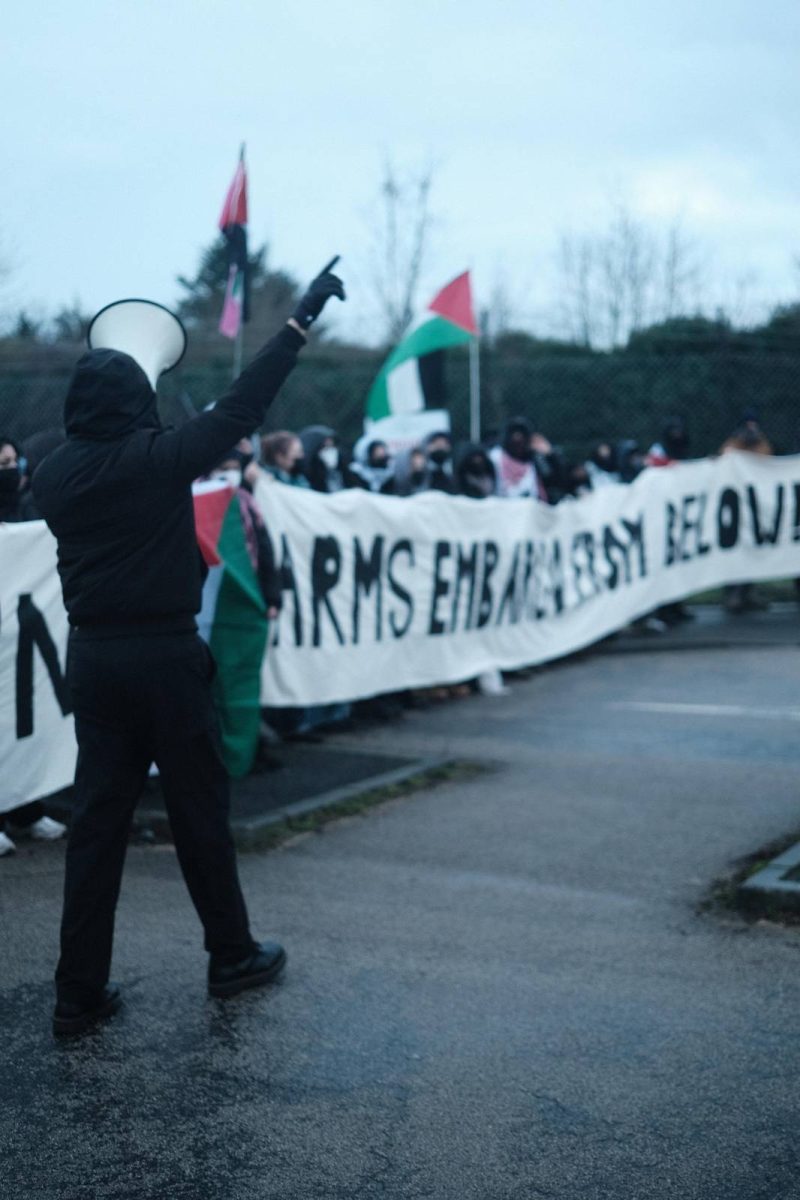
We also wanted to work with Thanet4Palestine, who are a community action group campaigning in the area for a free Palestine. Building connections to resistance rooted in local communities and the movement is an extremely important part of our strategy of being able to escalate with the strength to stand against repression when it comes, to apply pressure from multiple angles and to get real mass involvement. Building that relationship has been helpful in sharing ideas, experiences and knowledge.
Finally, the lack of any visible workplace organisation or dissent and the deep connection Elbit has with the Israeli state makes resistance to the factory’s involvement in genocide coming from the workforce itself particularly unlikely. For us, this implies a need for an emphasis on tactics of disruption from the outside against this target in particular.
rs21: The banning of Palestine Action and the prosecutions of movement organisers hang over anti-imperialist organising in Britain. How does the group think about the question of criminalisation both as a threat to your own members and as something that affects the wider movement’s willingness to take action? Does your model deliberately try to occupy a different legal or tactical space?
Banning Palestine Action definitely changed the landscape of organising. Anyone trying to organise post-proscription needs to prepare for similar repression if their activity becomes seriously disruptive.
One way we’ve been looking at this is by examining the scope of direct action and how that affects involvement. Not just for the limitations around mass participation, but also the limitations around relationship building. Taking a risk together can be a formative, bonding experience, but when you’re embarking on very illegal, high-stakes direct action, that can sometimes have the opposite effect – to protect the identity of your comrades, no one can really know how things operate or who is part of the organisational structure, which can make members feel isolated.
With factory blockades, there is room to get around this point of vulnerability. We can blend mass mobilising with direct material impact, and get people who have never been involved in this sort of thing to feel like they can take action. There is a certain level of discretion required, but it is also possible to build a sense of community around what we’re doing. That is the most important way we can make this as low risk as possible: to build power with our numbers, and turn those numbers into people that can be part of a big organisation. Of course, nothing will stop the cops from being dickheads and arresting people when they want, but having a solid large number of people who feel involved and committed will make it harder for the state to directly repress us.
Even if repression forces you to tactically adjust, building an organisation that can handle tactical adjustments will mean that you can still make it to the end goal, and things don’t all fall apart. This is what we mean when we say building power: building an organisation as well as radicalising people so that they will stay in your organisation for the long-term. We can block the gates to a factory that’s supplying arms to Israel while sharing hot plates of food and listening to speeches and music, and chanting together. This is one way we build a movement with the energy, intensity, and strength needed to prepare us for the challenge of repression.
rs21: An actual arms embargo, whether government-enforced or achieved through sustained disruption of supply chains, is a substantial political goal. What would need to happen for it to become achievable? Is the aim primarily to win the policy, to build a movement capable of winning it, or to make the cost of the arms trade high enough that companies like Elbit choose to leave Britain?
We want to win a full military and arms embargo on Israel. We are a long, long way from achieving this. Majority support for an arms embargo hasn’t translated into a change in policy. We can’t win just by winning people over. We will need to sufficiently raise the cost (economic and political) of continuing exports on those with the power to stop them. On one side, the owners of arms or logistics companies who profit from exports; on the other, the British state, which views support for Israel as important to furthering imperialist interests in the region, and which is also increasingly turning towards the arms industry as a source of growth.
We see ourselves in a protracted struggle. The first question to address is: how can we transition from a position of fragmentation, weak collective organisation, and a movement structured by defeat, towards building the power necessary to confront a vastly stronger state and class? We believe that any political challenge to the state over such a core imperial interest will only be successful if constructed on a far stronger base of social power, which is why our current focus is on raising the level of struggle through escalating mass confrontational actions, alongside building the movement and organisations that can sustain such activity and draw more people into it.
Of course, if we raise the cost of exports high enough for the profiting companies, the state will attempt to repress our movement in their defence. We saw this with Palestine Action, and it will happen with any disruptive movement that threatens imperialist interests. Our ultimate target is the state, and the key question is whether the political and legitimacy costs of repression are high enough to force it to concede our demand – or, if not, whether the radical wing can resist being crushed and isolated by that repression. In the case of Palestine Action, despite the movement’s backlash against proscription, the state was still able to isolate the group and largely stop their activity.
This is why, though we are focused right now on imposing costs on those creating weapons, the effects of these actions on the movement is equally important. The right to resist is learned. It’s a skill to exercise. When you use your body to block the flow of weapons with hundreds of your comrades and get home safely after you see a glimpse of our collective power, you build confidence in collective action. When you tell your mates, colleagues, or other comrades about it, it builds a wider sense of legitimacy for militant action – that resisting in this way is right, should be normal, and should be defended.
Building militancy, confidence, and legitimacy for action in the movement, and building networks and relationships with those who want to take action: these help to create the conditions of possibility for attempts at repression to deepen rather than resolve the political crisis. The movement needs to weaken the institutions and alliances that sustain British support for Israel, so that it’s not just about resisting on the picket line itself but it’s about civil service walk-outs, rebellions within institutions like unions against the inactivity of bureaucracy, communities and students occupying public space, workplace boycotts, and so on.
Our strategy is based on exactly this. Through mass factory pickets we are trying to build forms of action that combine leverage with increasingly broad active involvement, while rooting ourselves deeply enough within wider social forces before reaching this level of confrontation with the state. A majority of the British public supports an arms embargo. To translate that into policy, the challenge is to develop forms of collective action that can both disrupt the flow of weapons and expand the movement’s organisational capacity, confidence and willingness to act. This means using tactics with impact but that don’t isolate us. We need to build links of solidarity with those organising for Palestine across different institutions, workplaces and communities, so that when moments of heightened confrontation arrive, there is a credible path to draw increasing numbers of people into active participation, whether through workplace action, external disruption, or a combination of the two.
rs21: The ceasefire has changed the political landscape. Does it risk demobilising the movement, with people feeling that the acute crisis has passed? How do you think about sustaining this campaign beyond the immediate emergency, and connecting it to what looks like a broader and deepening British militarism?
People can see right through the promise of a ceasefire – the work that’s been done in the Palestine movement is anchored in an overwhelming amount of political education, and we’ve lost our collective trust in the media/state. For millions of people, the genocide has effected a permanent subjective transformation. But even if it no longer feels possible to believe the lie, people will still drop out of activity. These kinds of waves always happen in movements. We need to reorient towards a new phase in the struggle, while, though it’s deeply depressing, preparing to respond if the genocide intensifies.
A part of our answer is trying to escape the urgency that negates structure. We need to start building the groundwork now, helping people gain experience in organising and taking part in collective action against imperialism, and strengthening the organisations that can sustain that work. We’re trying to expand that ‘middle ground’ between small group direct action and mass demonstrations, while building connections across the movement, sharing tactics, information and knowledge.
Arms exports to Israel from Britain are part of a wider web of NATO-aligned military production and trade, contributing to tying together the British and Israeli states under US hegemony. One of the most significant exports used in the genocide is the F-35, used by Israel to drop 2,000lb bombs on Gaza, of which 15 per cent are produced in Britain. Despite reducing the number of arms export licences granted to Israel, the British state exempted F-35 components from the restrictions, unwilling to disrupt the US-led supply network through which parts are shared across the entire programme, including with Israel.
Militarism also extends beyond the war: Elbit technologies are used in border enforcement and domestic surveillance, including those made by Instro Precision – the target of our first action. Striking against these targets from within the Palestine movement, while putting forward and connecting to a deeper anti-militarist and anti-imperialist politics, allows us to channel energy and popular support into rebuilding a broader mass resistance, which will be so necessary in the difficult times to come.
rs21: How does Arms Embargo From Below relate to workplace organising? One of the things the Anti-Apartheid movement achieved was reaching into trade unions and building rank-and-file pressure on workers not to handle South African goods. Workers for a Free Palestine have tried similar workers’ outreach. Is that kind of labour movement engagement something you’re thinking about, and how realistic does it seem in the current state of the unions?
In the long term, we see worker action as having a crucial role in any radical transformation. We want to encourage workplace organising around anti-militarism and solidarity with Palestine as much as possible, and admire the work done by comrades such as Workers for a Free Palestine with PCS workers, Disarm Education, or rank and file workers in Unite who have pushed the union into a better position on Palestine. This is a long-term struggle with much left to win, as the continued militarism from Unite’s bureaucracy particularly in support of the Defence Investment Plan shows.
We’ve made it clear at our blockade actions that our target is the company and their bosses, not the workers themselves. We’ve been engaging in worker outreach efforts, particularly focusing on workers with leverage but who aren’t arms workers themselves.
That being said, while worker outreach efforts are important, class action does not always begin in the workplace and spread outwards. Protesting a workplace can either shame and alienate workers or engage them critically and invite them into solidarity while bringing you into contact with workers elsewhere in the chain, depending on how the picket is organised. This could help catalyse workplace action in ways that outreach with arms workers might struggle to achieve.
And, of course, not every workplace is the same. Our movement needs a diversity of tactics sensitive to specific conditions. If you’re targeting Instro Precision, which has no visible union presence, a small highly skilled workforce, and is an Israeli company deeply tied to the Israeli state, we think an approach more focused on tactics from the outside makes sense.
rs21: What does Arms Embargo From Below look like as an organisation at this point? How is it structured, how do people get involved, and what are you asking people who read this article to do?
We’re still a small organisation, looking to grow sustainably to increase our impact, widen our reach, and deepen our connections. We’re structured to prioritise democratic decision making while maintaining the kinds of security we need for our activities. We put an emphasis on a culture of care and open criticism, and prioritise avoiding a burnout culture that can so often damage action-focussed organisations.
If you want to get involved, want to connect your organisation with ours, have thoughts or questions for us after reading this article, or if you want to send a cheeky kiss, email us at aefrombelow@proton.me. For security reasons, we will have to vouch and vet any requests to get involved.
If you have money, we want your money! Donate here to help us cover the costs of our work: Contribute to Arms Embargo from Below – Open Collective
If you see a callout message, show up. Share it. Bring the people you trust. See you on the picket line. Free Palestine!





0 comments