
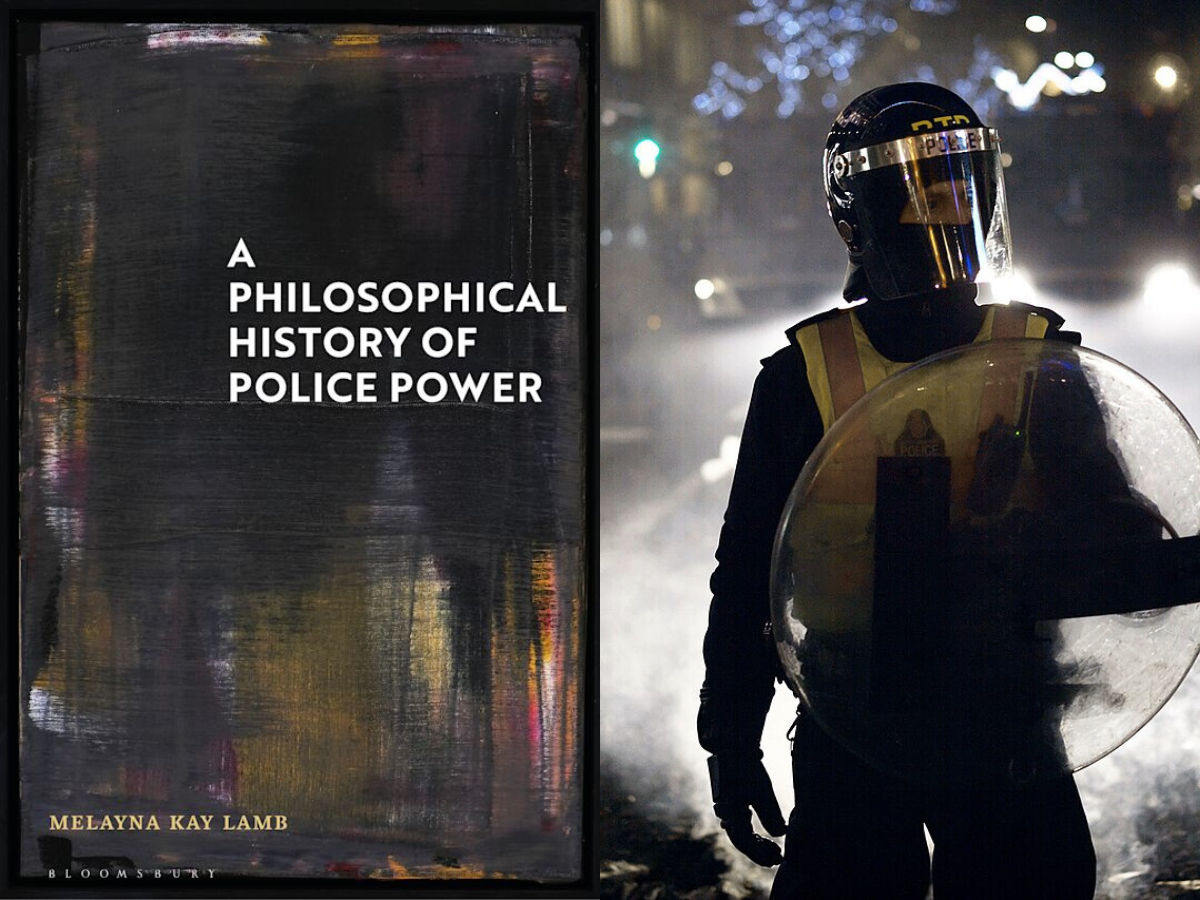
Review | A Philosophical History of Police Power
Niklas Rosen •Niklas Rosen reviews Melayna Kay Lamb’s book, which provides an overview of the philosophies at work behind policing and their development.
Towards the end of 2025, the Metropolitan and Greater Manchester police announced that they would make arrests of people chanting the word ‘intifada’ (Arabic for ‘uprising’). The first arrests under this new provision were made on the evening of 17 December 2025 at a demonstration outside the Ministry of Justice in solidarity with the hunger strikers taking action to protest unlawful conditions of imprisonment and trial. However, the joint statement by the Commissioner of the Metropolitan Police and the Chief Constable of the Greater Manchester Police explicitly stated that they have been advised by the Crown Prosecution Service (CPS) that these chants ‘don’t meet the prosecution threshold’ but that they want to be more ‘assertive’. Thus, seemingly without legal grounds, the police are deciding what can and cannot be chanted at a protest.
These recent developments go to the core of what Melayna Kay Lamb discusses in A Philosophical History of Police Power, which aims at unravelling the structure and logic of police power via what the author calls a philosophical history of the concept. While acknowledging individual cases of police violence, the book largely avoids engaging them as a means of tracing how police power came to be conceptualised in Western political philosophy and how this continues to shape both our understanding of, and the institution of, policing today. Rather, she follows György Lukács’ proclamation that there is no such thing as an innocent worldview, tracing the long-lasting and often mediated impact of philosophy on society.
The book does not aim at merely explaining extra-judicial killings by the police, but rather makes legible the ways in which police power exists within the law, but with the ability to transgress and form it. She calls this the ‘an-archy’ of police power, a term I will get to later on. In doing so, she goes beyond engaging with spectacular or especially gruesome cases of abuses of power, focusing on the arbitrariness and violence that are immanent and always already legitimised.
To do so, the book, on the one hand, traces the conceptual developments of police power in thinkers such as Thomas Hobbes, Georg Wilhelm Friedrich Hegel and Adam Smith to offer a perspective that helps one to understand its relationship to sovereignty, government and order. On the other hand, she critically investigates this understanding through the writings of Walter Benjamin, Giorgio Agamben and Denise Ferreira da Silva.
Due to the complexity of the argument, the remainder of this review will go through the different chapters in a chronological manner. Setting out with an extensive prologue, the book aims to ‘break free’ from the perspectives on the police, shaped by Michel Foucault that have been vastly influential in recent years. These conceptualisations extend the concept of policing to an all-encompassing biopolitical and disciplinary force that attends to the normative ordering of society and its population and can as such also be found in, for example, education or healthcare. By critically examining Foucault’s reading of Smith, she unsettles the notion that policing and the police are separate entities, and which consequently regards the former as a positive ordering power of society, while the latter becomes concerned with disorder. Rather, what she points us to is their ‘indistinction’. This is leading her to the centrality of the metaphysics of order, i.e., the question of what it means for social systems to count as ordered rather than disordered or contingent – for her argument. She states that ‘police power projects a metaphysics of order that it supposedly derives from (i.e. the police are there to maintain or uphold order) but which in fact has no other content than the police power invoking it.’
In the first chapter, Lamb engages with the question of order, tracing the way Hobbes supposedly breaks with an Aristotelian conceptualisation of order as being natural, by claiming the artificial nature of order. This, she stresses, enables Hobbes to claim that order stems from sovereignty, or in her words, ‘order becomes the function of sovereignty’. In doing so, Hobbes lays the foundation for a conceptualisation of sovereignty that is unrestrained in its power to achieve order. In the third chapter, Lamb then turns towards Hegel – his criticism of Fichte and the role of Polizei in the state of emergency. Lamb investigates how Hegel conceptualises the police as mediating the split between the state and civil society. She shows how Hegel, albeit ostensibly having a positive conceptualisation of the state, understands it as being on the ‘verge of collapse’, necessitating allegedly exceptional police powers in times of crisis. She states: ‘It is this rendering apart of civil society and state, the realms of the particular and universal, that necessitates a Polizei “to actualise and maintain the universal contained within the particular civil society”’ While his conceptualisation of the Polizei as mediating is a positive one, Lamb shows that also in Hegel we find a moment of instability that necessitates extended police power: a state of emergency, leading to the ‘radical indeterminacy of the police’.
After tracing the conceptualisation of police power within liberal Western philosophy and its link to sovereignty and order, Lamb turns to Walter Benjamin and Carl Schmitt in the second part and engages in a critical investigation of the relationship of the police to law. She shows how the police are not simply covered by the law and responsible for its execution and protection. Rather, she stresses, the police are a force of law. She states: ‘it is exactly in the figure of police that the gap that exists between the law and its application is shown for what it is: an unbridgeable divide that presupposes the suspension of law to be rendered operative’ and further, they ‘suspend the law while bearing its force’. She captures this well in Jacques Derrida’s concept of the future anterior, stating that ‘[i]t is not so much that all police actions are legal but rather that they will have become legitimate’. This has grave implications because it enables one to understand that the police are less about upholding the law or a direct expression of sovereign will. Rather, they are concerned with upholding order which leaves it with unconstrained powers.
Subsequently, she argues that police is ‘the metaphysical condition of possibility for sovereignty and law’. It is within this chapter that she offers two key theoretical developments: the an-archy of police power and the idea of order as the ‘self-referential, legitimising term par excellence’. The latter is a highly relational concept that has ‘no substance as such’ and is able to shift according to the needs of power evoking it, being flexible in legitimising different forms of violence, forms of repression and discretionary powers. Lamb then goes on to show that this invoking of order and its protection, is linked to and made possible by an-archic police power arguing that ‘the anomie/an-archy that is (fictively) supposed as existing outside of (or indeed before or after) the law is actually the very thing presupposed by the law, that the law must capture in order to be operative.’ In writing an-archy with a hyphen, Lamb highlights the meaning in Greek of both words (without a ruler), pointing to the fact that to achieve order (in a state of anarchy), the an-archic power of the police is necessary. Her concept of an-archy thus means that the police must necessarily be unconstrained and without proper oversight for order to exist. The relationality of order then becomes crucial because it helps one to understand how invoking order has a potential limitlessness of extending police powers.
In the final chapter, Lamb then makes the strongest provocation of the book in rejecting the popular claim among critical scholars of policing and activists that exceptional police violence in the core of imperialist states stems from colonial encounters and, like a boomerang, is imported and used here. In doing so, she argues against splitting police violence along spatial and temporal lines, thus warning against the fallacy of reproducing a good/idealised version of the police within the imperial core that merely turns bad because of another geography and/or temporality. In criticising this notion, she is ‘wonder[ing] what is lost or obscured when these killings are framed as a process of police “militarisation” or indeed as the result of colonial “boomerangs” or “aftershocks” because this is to make external something immanent and internally productive’. In, once again, engaging in a critical reading of Hegel and Hobbes, Lamb, in thinking with da Silva, shows how racialisation links subjects to the state of nature, i.e. portrays them as an imminent threat to order. This then legitimises violence against racialised populations as being against disorder. Racist police violence thus is not an anomaly but central and immanent to the upholding of a white supremacist order.
While this claim operates on an ontological plane—order within the imperial core arising through the repression of, and separation from, racialised populations—and is both reasonable and politically significant, it raises questions. Specifically, it is unclear how the author would account for the well-documented material entanglements that risk being treated as already given, thereby losing nuance in how they develop across time and space (see, for example, Stuart Schrader’s Badges Without Borders and Antony Loewenstein’s The Palestine Laboratory).
Returning to the example from the beginning of this text of protesters being arrested for chants including the word intifada, one can see that is not an aberration of the otherwise law enforcing police. Rather, we can understand this as an example of the police as a force of law, that invokes a self-referential idea of order that needs to be defended. Over the last two years, we were able to observe how Palestinian liberation and the Palestine solidarity movement once again became perceived and portrayed as a major threat to the order, enabling ever greater police repression based on discretionary powers that always ‘will have become legitimate’. Consequently, Lamb offers a useful and timely conceptual understanding of how the police are able to transgress the law while holding others accountable to it. While being a difficult read, she brings us one step closer to understanding the police and their positions in contemporary states.
Melayna Kay Lamb’s A Philosophical History of Police Power is published by Bloomsbury.





0 comments