

Unite’s General Secretary election
rs21 members in Unite •rs21 members in Unite discuss a leadership election dominated by two wings of the union machine and argue for critical support for Sharon Graham over Simon Dubbins. Graham has infuriated many members by falsely counterposing jobs to action on climate and war. While Dubbins talks left on Palestine and climate, his support for the Labour Party makes these positions almost meaningless. With majority support on Unite’s Executive Council, Graham now has no excuse for failing to deliver. Our priority must be to exploit the industrial space her approach opens up, while ensuring that union policy on Palestine and climate is upheld, irrespective of her position
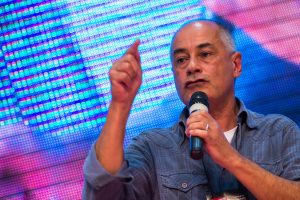
The campaign for Unite’s General Secretary election is now underway, with the incumbent, Sharon Graham, facing Simon Dubbins, Unite’s Director of International and Research. Unfortunately, no rank-and-file candidate is standing in the election. Both Graham and Dubbins have spent many years within the Unite bureaucracy.
The choice between Sharon Graham and Simon Dubbins is not simply about personalities, nor is it a straightforward contest between left and right. It is a debate about the future direction, priorities and culture of Britain’s second largest trade union, and about Unite’s relationship with the Labour Party.
Sharon Graham’s successful 2021 campaign was built around a commitment to return Unite’s focus to workplace organising and away from Westminster politics. Her current campaign argues that this approach has delivered results and should continue. Graham points to Unite’s involvement in hundreds of disputes, securing better pay, improved conditions and stronger protections for members through industrial action and collective bargaining. Her campaign claims that since taking office the union has been involved in 1,801 disputes involving 280,000 members, winning more than £700 million for workers.
As part of her move away from Westminster politics, Graham has argued that Labour cannot rely on Unite’s support if it fails to act in workers’ interests, promising to hold Sir Keir Starmer ‘to account’. During the Birmingham bin strike, Unite suspended Deputy Prime Minister Angela Rayner from membership and reduced donations to Labour, although the union remains by far the party’s largest donor.
However, Graham’s promise to move away from Westminster politics has, in practice, coincided with a deterioration of political campaigning more broadly. Unite has failed to take a leading role on issues such as Palestine, climate change, the war in Iran and opposition to increased military spending. Graham justifies these positions by claiming they protect jobs. In reality, it has meant tailing employers’ talking points and letting them off the hook when they cut jobs. For example, the North Sea is in long-term decline irrespective of government policy. When Unite blames electric vehicle targets for automotive job losses, it directs anger away from employers and prevents effective resistance. Jobs can’t be saved by opposing net zero. Blaming climate policies for job losses makes it harder for workers to fight their employers and fuels the arguments of the far right. Rather than ‘no ban without a plan’, we need to fight for a worker-led just transition. While arms production is highly profitable, it creates far fewer jobs compared to public spending in other areas such as housing or public services. It’s not that Unite isn’t doing political campaigning – it is campaigning for more arms spending. Meanwhile, the British government’s support for Israeli and US warmongering is pushing up the cost of living for Unite members.
Graham’s ‘jobs first’ approach has been particularly evident in her response to the war in Gaza. She has condemned protests outside arms factories linked to producing components used on the F35 which has been sold by the US to Israel and used in the Gaza genocide. Graham has weakened Unite’s relationship with the anti-war movement, claiming that it threatens members’ jobs. In the context of a genocide, such a position is indefensible. Real leadership means defending jobs and opposing genocide.
In March 2024, Graham wrote to Unite staff and officials in response to actions by groups including Palestine Action and Workers for a Free Palestine. In the letter, she argued that there was ‘no contradiction’ between showing solidarity with Palestinian workers and refusing to support campaigns that targeted Unite members’ workplaces without their backing. She reiterated that Unite’s priority is to protect and improve the interests of its members at work and that the union ‘cannot and never will support any action that goes against that principle’. However, Graham appears to recognise the contradiction – she has been notable for her absence from major demonstrations against the genocide in Gaza.
Unite’s retreat on political campaigning is damaging both to the wider labour movement and, ultimately, to Unite itself. By tailing employers’ damaging agendas rather than pursuing an independent workers’ position, Unite reduces workers’ influence over government policy, climate transition planning and international labour struggles. It widens the space for political forces such as Reform UK to gain support among disaffected workers. Such developments threaten public sector jobs, employment protections and trade union rights.
A union that echoes the establishment on political questions may also struggle to retain activists motivated by broader social and international issues, weakening its organising culture over time. In the long run, this makes it harder for Unite to function as the militant, outward-facing force that Graham wants.
Even on the industrial front, Graham’s strongest suit, things are far from perfect. The sustained support for the Birmingham bin workers has been crucial and much appreciated. Still, there has been no clear plan to win, for example, through a sustained effort to spread action to other parts of Birmingham City Council or the refuse departments of neighbouring councils. It is frustrating that union communications always centre Graham herself rather than the efforts of workers themselves. When activists are trying to convince workers that the union is a tool for their own collective organisation, rather than merely being a third-party service provider they buy a service from, it is deeply frustrating to see Graham’s election campaign using slogans like ‘I will fight for you’, reinforcing the expectation that members are passive spectators.
Simon Dubbins is standing as the candidate of the Members United grouping. Members United is a new platform, bringing the old right-wing and the United Left faction that backed Len McCluskey together.
Dubbins himself is a trade union bureaucrat with no historical links with Unite’s left. He tried to stand for General Secretary back in 2010 before throwing his support behind Len McCluskey, who beat the left-wing rank-and-file candidate Jerry Hicks. As head of Unite’s international department, he has placed significant emphasis on international solidarity, particularly with Palestine, and supports a just transition to address climate change. These positions have led some supporters to describe him as the left-wing candidate in the election, appealing to members appalled by Graham’s approach. However, his radicalism seems restricted to issues far from home, and Graham has been far more forthright in challenging employers and government.
Dubbins is a member of the Labour Party. His manifesto focuses on holding Labour to account, demanding investment and rebuilding public services rather than advocating a political break from the party. This creates a contradiction between his internationalist rhetoric and his continued support for a party complicit in the genocide in Gaza.
From this perspective, while Dubbins takes stronger positions on issues such as Palestine and climate change, his loyalty to Labour makes those positions almost meaningless. Continuing to support the Labour Party while it attacks workers, promotes privatisation and backs military interventions means his leadership would not be radical in practice. He has little to say about building or using Unite’s industrial power, or improving the union – his pledges are threadbare.
Over the last few years, Unite has been full of division. The Executive Committee, dominated by United Left supporters, constantly clashed with Sharon Graham. Each has been able to blame the other for problems in Unite. No proper financial returns have been submitted since 2020 and minutes of Executive meetings haven’t been published since 2023. However, earlier this year the Back to Workplace faction, backed by Graham, won a clear majority on the Executive Council. The majority of the Unite bureaucracy is hostile to Graham and backs Dubbins, but they report to her. This means that Graham now has no excuses for not delivering on her manifesto.
Despite Sharon Graham’s weaknesses, her commitment to workplace organising and industrial struggle is the better option for developing a layer of trade unionists who feel confident to organise at work. This is the foundation for both industrial and political struggle. The fact that the Back to the Workplace faction now dominates the Executive Council means the United Left’s factionalism is a smaller obstacle for Sharon Graham. Activists should therefore campaign for Sharon Graham to win the current General Secretary election.
However, members can’t rely on Graham to deliver all we need. It will be down to rank-and-file activists to take advantage of the opportunities her leadership presents to develop strong and militant workplace organisation. It will be down to rank-and-file activists to fight for the implementation of Unite policies on Palestine and just transition rather than dependence on declining fossil fuels.
The fact that the union bureaucracy dominates both wings of the election, each backing flawed candidates, exposes the lack of effective independent left organisation in Unite. The Back To the Workplace faction is united by little more than support for Graham’s manifesto. Unite Broad Left, which was formed by members who wanted to support and go beyond that manifesto, has rarely acted independently and hasn’t taken off. While campaigning for Graham, activists should build their own networks so that members are less at the mercy of conflicts between sections of the bureaucracy and better able to shape Unite’s future.



0 comments