
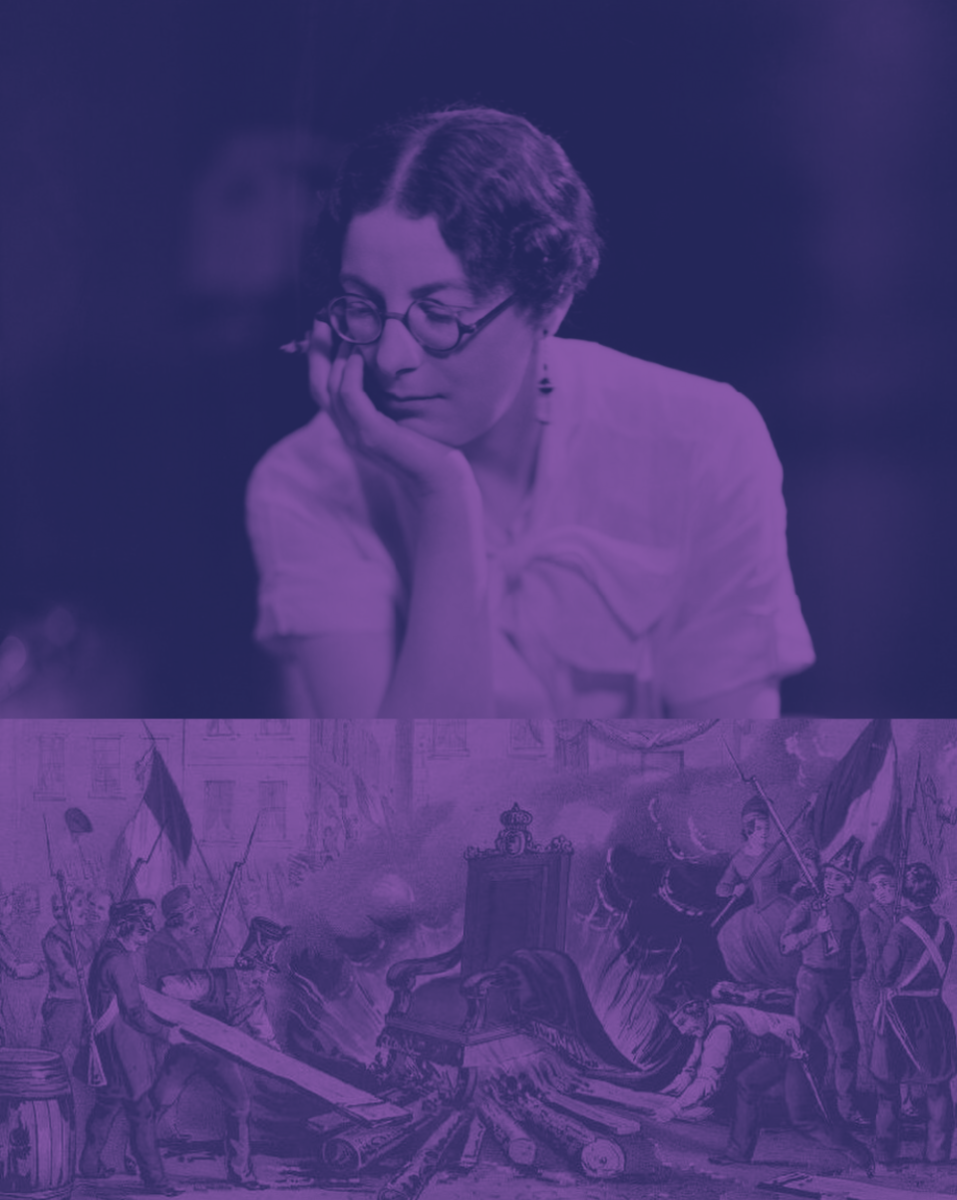
Bottom Image: By Nathaniel Currier – https://springfieldmuseums.org/collections/item/the-burning-of-the-throne-paris-25th-february-1848-nathaniel-currier/, Public Domain, https://commons.wikimedia.org/w/index.php?curid=65190413
Lavender Solstice: Revolution in Summer Will Show
Benjamin Hargreaves •Benjamin Hargreaves looks back at the 1936 novel Summer Will Show by Sylvia Townshend Warner and the models of organising we can learn from it.
Summer Will Show, the 1936 novel by English novelist Sylvia Townsend Warner, starts with one of its titular seasons as a representation of capitalist society: a summer pregnant with tensions, all hidden beneath a bucolic bourgeois veil. The protagonist of the novel, Sophia Willoughby, appears at first to be the model Englishwoman, so unflappable that even the Swing Riots of 1830 appear as a jolly day out through her reminiscences. She prides herself in the cool competence with which she carries out her motherly duties and the management of her Victorian estate, but at intervals we glimpse the intense frustration that lives alongside her pride: frustration with her sickly, listless children; frustration with her superstitious staff; most of all, frustration with her absent husband.
What becomes clear is that her pride and her frustrations are not simply opposing feelings, but are an integral contradiction as part of her position in society, and this contradiction will create the internal impetus which lead her to develop along a course which mirrors the development of socialism throughout the 19th century, and perhaps provides a model for our own organising.
Sophia may be a bourgeois, but like everyone within capitalism she experiences intense alienation, and her alienation is primarily experienced through the modality of gender to begin with. These gendered expectations are deeply internalised to the extent that, when tragedy strikes and her children die, she goes to extreme lengths to have another child so that she can reclaim some sense of purpose. This eventually leads her to Paris to seek her husband, just in time for the revolutions of 1848 in which her husband’s mistress, the Jewish storyteller Minna, plays a leading role.
Sophia’s first encounter with Minna begins not only an intense relationship but a process of political conversion. Before this meeting, Sophia rarely dreams of escaping her oppression, and when she does it is presented as a comic absurdity. In one unusually romantic moment for her, she sees “a company of gipsies… at home in the landscape like animals”. “I should never want to be a gipsy”, she thinks, “But I would build a house here… live alone, and do everything for myself. Perhaps a woman coming in to do the cooking and make the bed. But everything else I would do, and at night sit by a fire of wood that I had chopped myself.”
This is a reactionary utopian expression of anomie and misanthropy more than it is any real revolutionary sentiment. She wants to escape as an individual, with only a servant for company; why this person would serve her is left as an unaddressed assumption.. She looks down on others who actually live the life she romanticises, unwittingly revealing that – as the Romani can attest to – living on the margins of society (closer to nature, free “like animals”) is no escape from oppression; quite the opposite. Her individualistic desire for escape and her naïve dualism of nature and society leads her to not only unrealistic but racist conclusions. But there is something here: she wants to be able to feel satisfaction in her work and enjoy the benefit of it – in this case chopping wood – without having to worry about the effect it will have on her social standing as a bourgeois woman.
Like the dreamy utopianism of the early modern period which preceded socialism as we know it today, her escape is unrealistic and contains many oppressive, individualistic ideas, but draws out real contradictions in capitalism (the oppression in society and how it alienates us from our labour and ourselves) and thinks about how they might be overcome.
This progressive kernel germinates on meeting with Minna, beginning a winding process which will culminate in Sophia blossoming into a communist, even outgrowing the woman who serves as both a political and sexual awakening for her. But it is not any grand political speech which wins her over. Instead, it is the slow building of solidarity. Early in the book, there are a couple of cases where Sophia could extend or accept offers of solidarity, with the doctor’s wife who expresses sympathy to her for her lonely position and offers solidarity based on their shared experience of bourgeois womanhood, and with the mixed-race son of her uncle who she suspects will suffer terribly at the boarding school she is expected to send him to. In both cases, she shuts down the possibility of solidarity.
It is only Minna who is able to slowly draw her into it. Minna’s romantic storytelling, so evocative of the natural beauty of the Lithuanian woods she grew up in, appeals to Sophia just as it appeals to many other radical liberals who feel vaguely alienated from nature, including Sophia’s husband, but it takes her much longer to be drawn into the political message of Minna’s storytelling.
What brings Sophia over at first is a sense of friendship with her, an appreciation for how Minna recognises and respects her value as an individual, and over time this develops into a solidarity built on their shared poor treatment at the hands of Sophia’s husband. And this is part of Minna’s great strength as a revolutionary, when the current is flowing in a progressive direction, many people from diverse classes are enchanted by her storytelling and allow themselves to be inspired in the heat of the moment to revolutionary acts, spurred on by the emotive direction of Minna and other individual utopians.
This becomes so meaningful to Sophia that she chooses a life with Minna and her milieu of revolutionaries over her bourgeois comfort, revelling in the romantic drama of throwing away her privileges. And here the romanticism becomes dangerous again. Sophia accepts it easily when her husband cuts her off from her resources, which could be so useful to the revolution, not bothering to check whether he actually has the power to do so, and none of the revolutionaries do any paid work, leaving them all in a very dangerous financial position. They are living precariously on the edges of society, a bohemian collective much like those aimless groups dubbed by Marx as the “lumpenproletariat” who would get drawn into Louis Bonaparte’s coup soon after the events of the novel.
This method of organising, similar to that of real utopian socialists of the era such as Robert Owen and Pierre-Joseph Proudhon seeks to achieve freedom within an unfree society, “to achieve its salvation behind society’s back, in private fashion, within its limited conditions of existence, and hence necessarily suffers shipwreck”, a strategy Marx would critique in The Eighteenth Brumaire of Louis Bonaparte. Again, this fails because it seeks escape rather than facing up to the totality of society, but its great strength, to which we will return, is its commitment to a consistent ethical idea in the present.
Sophia struggles to connect to this group, but her relationship with Minna deepens and her practical experience of poverty leads her to a new political outlook. Both these developments happen slowly, subtly, more through the development of habits than any grand revelations. Eventually, she finds a kindred spirit in Ingelbrecht, the communist, who shares her cold, practical outlook.
Ingelbrecht and the other communists are effective representations of the newly emerging “professional” revolutionary type which would eventually be typified by the Bolsheviks, and Ingelbrecht explicitly opposes his approach to Minna’s, claiming that in people like her “the imagination is too rich, the emotional force too turbulent. The anger which they undoubtedly feel is neutralised by the pleasure they experience in expressing it… they are in such a mood of satisfied excitement that they are almost ready to forgive the state of society which allows them such abuses on which to avenge themselves.”
He suggests, much like Lenin in What Is to Be Done?, that these types of activists who live for grand gestures like speeches and assassinations are an artisanal, dilettante style of revolutionary – often very skilled, but inadequate to the needs of the more developed movement. Furthermore, her appeal to diverse classes opens up the danger of infiltration by class enemies, some of whom could be converted, like Sophia, but some of whom turn out to be reactionaries, like her husband.
We have moved beyond Sophia’s idle dreams of escape, but these romantic methods still have a dreamy grandeur to them which prevents a committed engagement to transforming society – they are more interested in spectacle than consistency. Even Minna acknowledges to Sophia that Ingelbrecht “made all [her] enthusiasm for liberty seem like a paper garland, and my idea of a republic a child’s Utopia”. One of Minna’s strengths is now revealed as a weakness: the fiery enthusiasm she inspires in all classes is fickle. As the revolutionary energy in society dies down, and the political windvane that is Sophia’s husband turns to Bonapartism, Minna is left with few supporters. A more disciplined form of organisation, firmly rooted in proletarian class interests, is required to weather this storm.
But although Minna can accept the communists’ criticisms of her methods, she remains persuasively uncomfortable with them: “There are so few of them. Ten here – another ten there – saying so little but all saying the same thing. So few of them. And all knowing their own mind. And all of them dead in earnest. There must be death… in any such earnestness!”
After the many deaths in the disastrous left-wing uprising which ends the novel, her words appear prophetic, but it is hard to know how to interpret her warning. Taken literally, she has foreseen the coming bloodshed, and is arguing against communist militancy as an exacerbation of class conflict on this basis, which is a clearly reactionary perspective. A more sympathetic interpretation sees her concerned about the narrowness of the communist movement as she sees it, lacking in vitality because it extends solidarity to only the most militant, making it unable to represent the rich diversity of the oppressed and be as Lenin would often advocate, a “tribune of the people”.
To both Inglebrecht and Minna’s credit, Sophia is awed by the way they conduct their argument in total sincerity, united in their opposition to the present state of things. It is this experience that enables Sophia to “feel and follow the workings of a different world… that irrefutable force and logic of a different existence”, present in the theoretical discourse of the two comrades. In this, the novel presents its most unambiguously positive model of revolutionary practice.
Sophia will meet more of these serious, practical communists as her skills are recognised and she is invited to assist them in their work. She is struck by their confidence, their clarity, and their lack of shame. She describes one woman as “a glass of pure cold water” due to the honesty with which she explained the need for hiding information from Sophia, which she finds far more comfortable than Minna’s method of “arrang[ing] their revolutions standing on landings and gabbling at the tops of their voices”.
It is wonderful to see Sophia come into her own in the uprising of June 1848, the book’s concluding summer. The communists we see leading parts of the struggle are inspiring in their ideological clarity and professionalism, and the effectiveness with which they can frankly communicate their ideas to the other workers rather than relying on the theatrical storytelling methods used by Minna. It is definitely an advance, a progressive development from chaotic uprisings manipulated by charismatic individuals towards a mass democratic movement led by professional revolutionaries, but it is hard not to feel that something is lost as Minna is sidelined from the struggle.
The proletariat was not strong or unified enough in June to be successful. The city fought against itself, and on the other side of the barricades is the boy Sophia sent to boarding school back in England. The boy, Caspar, managed to escape that horrible place and somehow made his way back to Sophia across the channel, but Sophia now finds the boy’s bourgeois habits irritating and dangerous and she resents how caring for him distracts from her political work. Rather than attempt to educate him she does everything she can to get rid of him, despite Minna trying to help her see the love and respect he has for her. Falling back on the excuse of her obligation to his father, she writes to her husband to arrange for him to be entered into a new school, but he sends him to the military instead, and when we next see him, he is killing revolutionaries and spewing antisemitic abuse.
Minna’s friends all deeply disapprove of this abandonment of Caspar, and in this their sentimentality, which has been ridiculed throughout the book, is quietly revealed to have a lot of value. The cold earnestness of Sophia and the communists has left us not only with a homogeneity of ideas but also a homogeneity of temperament (there may also be something to the fact that Minna’s Jewishness and Caspar’s Blackness fail to be incorporated into the communists’ project), and the movement is divided and weaker for it.
In making these comments about the weakness of our proto-Bolsheviks, I do not mean to suggest that the solution is to return to the utopianism of Minna. Hopefully, I have made clear that despite its weaknesses the professionalism of the communists is superior to Minna’s romanticism. But now we have a contradiction, one which seems unresolvable if one takes the perspective of most Marxists organisations in Britain today. This position is that each progression of organisational strategy is a total, uncontradictory advance on the last, with only one way that one can faithfully implement it. It is what causes the uncanny dogmatism described by Minna and observed today in many Marxist sects (“so few… all saying the same thing”), all claiming against all evidence to the contrary that they are the one true inheritor of the Leninist tradition, and that every other practically identical sect is infected by alien class ideas.
Not only is this ridiculous on its face, it is contrary to the dialectical perspective they all claim to champion, which recognises the internal contradictions within all things, all the greater when something has a great deal of life and energy. In the words of Victor Serge, “Bolshevism, despite its unity of thought and discipline, was always prey to contradictory tendencies. While some of them opened the way to history’s most beautiful futures, others clearly led to its destruction”. Similarly, we can see contradictions within the communists of this novel, how their homogeneity led to powerful organisational efficiency but also a crippling narrowness, and how Ingelbrecht contained within him both a disquieting stubbornness and an inspiring humility in the face of disagreement.
Serge again: “One must always simultaneously defend the most generous, the most elevated interests of the movement”. In Ingelbrecht’s humility we have one of these elevated interests, where we can weave in Minna’s open solidarity. Rather than organise exclusively around exact conformity with a theoretical line – often one untested in practice by those who hold to it – we would do better to combine revolutionary professionalism with a “double duty… of the workers movement, of socialism, of the revolution”, which seeks solidarity and is comfortable with contradiction and disagreement inevitable in any organisation engaging in real indeterminate struggle.
The novel ends on a triumphant note, albeit one tarnished by her failure of solidarity with Caspar. Once all is said and done, Sophia finally has a moment to sit down and read the pamphlet she was tasked to distribute throughout Paris before the revolt, and she is inspired by the words, allowing herself to feel hope again and likely also feeling pride at having played a role in its distribution. The familiar opening words of the pamphlet break her out of the cynicism of defeat, leaving us to hope ourselves that she can find in those lines something of Minna’s spirit of solidarity.
‘She took up one of the copies, fingered the cheap paper, sniffed the heavy odour of printers’ ink, began to read.
A spectre is haunting Europe — the spectre of communism.’







0 comments