
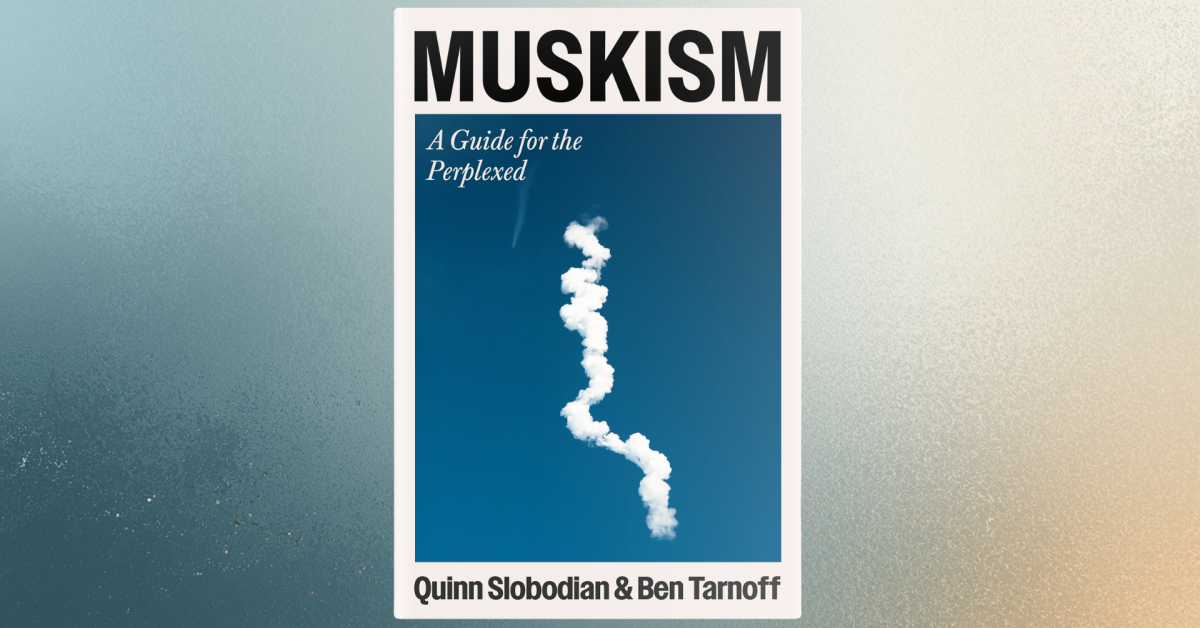
Review | Muskism
Colin Wilson •Colin Wilson reviews Muskism: A Guide for the Perplexed, finding that Slobodian and Tarnoff reveal how Musk’s blend of autocratic control, state symbiosis, and far-right ideology forms a coherent capitalist strategy instead of merely a confused contradiction.
Elon Musk represents, perhaps better than any other individual, recent developments in capitalism. Those trends include the dominance of US technology companies – companies not controlled by faceless managers but by high-profile billionaires. The oligarchs are relying on huge investments in AI to reinforce their dominance. High-profile bosses like Musk, identified until several years ago with the centrist politics of corporate ‘diversity’, have now aligned themselves clearly with Trump, and in Musk’s case, spoke at the far-right “Unite the Kingdom” rally in London last September.
Slobodian and Tarnoff suggest that Musk’s strategies reflect broader changes in capitalism. They draw a parallel with Fordism – the mid-twentieth century regime of mass production, mass consumption, the welfare state and the family wage. Just as Fordism was first put into practice by Henry Ford, who nowhere theorised it as a strategy, they argue that Muskism, though nowhere articulated as such by Musk, can be deduced from his actions – and that it forms a coherent whole.
It can seem that Musk has two dramatically different sides to his personality. On the one hand, he’s a highly capable business leader – Tesla sold 1.6 million cars in 2025, and Musk companies own a remarkable two-thirds of all active satellites. But then there is the Musk who appeared on stage at the conservative CPAC conference a year ago, wearing shades and wielding a chainsaw – or the Musk who believes that Neuralink, his brain-computer interface, will be used not only by disabled people but by hundreds of millions more people, linking them into global networks and dissolving the distinction between humans and machines.
There’s a simple way of resolving this apparent contradiction between the two Musks, epitomised by the Tesla bumper sticker reading ‘I bought this before Elon went crazy’. The claim is that for whatever reason (drug use was frequently mentioned) hard-headed business leader Musk flipped and became a MAGA-crazed fantasist. It’s an explanation that Slobodian and Tarnoff reject – instead, they stress that while Musk’s ideas and practices have evolved, there is a continuity to them that includes both the business leader and the fantasist.
Musk’s businesses have long had a relationship with the US state. Slobodian has stressed in his previous books that, despite its anti-state rhetoric, neoliberalism doesn’t aim to destroy the state – rather, it attacks democratic controls on the state which could mean reduced corporate profits. But the ubercapitalist Musk is happy to take state funding, such as government subsidies for Tesla’s electric cars or military funding for his Starlink satellite-based communications system. At times, that state-corporate relationship develops to the point where IT companies, far from destroying the state, merge with it and start to take it over – as with Palantir’s contracts in Britain to administer systems from the NHS to the military, or Musk’s reported disabling of Starlink satellites in 2022 to prevent Ukrainian drones from attacking the Russian navy.
A further feature of Musk’s businesses has always been his development of synergies between them. Battery technologies developed at Tesla for cars are then reused in the company’s Powerwall home battery (one million installed globally), which allows users to store electricity from solar panels and so become less dependent on the power grid. Posts on X are used to train Grok, Musk’s AI, which will play a vital role in running the millions of humanoid robot servants Musk expects to sell in the future.
Musk favours what business strategists call ‘vertical integration’. His companies produce as many parts of their products as possible, in contrast to the practice of many companies which subcontract services or buy components such as microchips or batteries on the global market. He constantly adopts the most successful production techniques. This involves a corporate structure which eschews bureaucracy and some workplace hierarchies – workers manufacturing products can give feedback directly to designers about what works and what doesn’t. But there is a strict hierarchy when it comes to anything that might restrict profitability, which Musk associates with his autocratic control. Accordingly, his companies have a consistent policy of union-busting, and Musk changed his job title at Tesla to “Technoking” in 2021.
There is a consistent approach through all this, which links up with the more apparently eccentric side of Musk. He grew up, Slobodian and Tarnoff point out, in the white supremacist ethnostate of South Africa. Surrounded by hostile African states, the apartheid regime relied on high technology to deter attacks, developing nuclear weapons in the 1980s. (There’s a clear resemblance here to Israel, a state with which South Africa had a military alliance, including collaboration on nukes). Musk believes in the conspiracy theory whereby the replacement of apartheid by democratic black-majority rule is leading to a ‘white genocide’.
What we see here is the association, which of course goes much wider than Musk, of ‘civilisation’ with the culture of Europe and people of European descent globally, for example, in the US. That centuries-long dominance of the globe by white people is now threatened in the long term by China, and in the short term by political forces associated with Islam in the Middle East, strategically crucial to fossil carbon production. A theme shared by many of Musk’s businesses is that they fend off threats of instability. Your home Powerwall keeps you safe from power cuts, while vertically integrated factories provide safety from disruptions to global trade in a world where the international trading system is beginning to fragment. As regards who exactly is protected here and who is excluded from protection, Slobodian and Tarnoff note that Grok is powered by a Memphis data centre located in a historically black neighbourhood, where the facility emits pollutants ‘that are linked to increases in asthma, respiratory diseases, heart problems and cancer, especially among children’.
Musk’s fantasies about the ongoing dominance of white supremacy are expressed in a science fiction idiom. Or rather, they are expressed in what is now a somewhat old-fashioned SF version of the future involving robot servants and colonising Mars, which takes for granted the desirability of endless economic growth fuelled by ever-higher tech. The danger facing this future, from Musk’s perspective, is the destruction of white-dominated, male-dominated capitalist civilisation by the ‘woke mind virus’. This mind virus is not just a metaphor. Musk fears that ‘Western’ culture becomes so dominated by equality and compassion that it will become impossible to train the AIs, on which humanity’s future depends, to act with the necessary ruthless efficiency. In particular, he regards compassion as an ‘exploit’, a computer security term for a method that takes advantage of IT system vulnerabilities.
So, what chance is there of Musk’s high-tech dystopia becoming a reality? One issue Slobodian and Tarnoff outline is that it’s hard to see why anyone would want to live in such a world, except perhaps a tiny number of tech billionaires who believe that they are geniuses with exceptional genetic material worthy of endless propagation. Fordism offered people the pleasures of mass-produced consumer goods to be enjoyed in the intimate space of the family home. It’s far from clear how the brain implants, robot servants and colony on Mars make anyone happy, and thus how mass consent to such a society can be created. Musk’s deliberately compassionless DOGE project, for example, created real harms, cutting off the bank accounts and credit cards of people it decided should not have them, but then ran into the ground, ‘saving’ far less than claimed, while Tesla Takedown protests appeared around the globe and Musk became a despised figure.
A second issue is just how much Musk’s wealth and power depend on speculation, on investors believing that he will, at least to some extent, deliver on his extravagant promises. Now, he isn’t just a bullshit artist – he does own two-thirds of the satellites in the world. But there’s also a large speculative element. Tesla’s share price jumped by 740 per cent in 2020, for example, an increase not justified by a similar increase in productivity. Slobodian and Tarnoff cite the cryptocurrency Dogecoin, which increased in value after Musk began tweeting about it. This then reinforced Musk’s charisma, which in turn increased his ability to influence markets simply through tweets. Musk could own ‘meme coins’ and ‘meme stocks’, talk up their value, sell them and pocket the cash. The Bloomberg columnist Matt Levine compared it to owning a magic lamp:
You can just whisper ‘price go up’ or ‘price go down’ into the lamp, and it will happen instantly… You are the only person who can do this, and you can do it as often as you want… [It’s] as close to a free-money perpetual motion machine as you’ll ever see in finance.
But, in the end, shares have value because they reflect markets’ belief in companies’ future profitability, which is why shares have fallen in the last month as the US-Israeli war on Iran has threatened those profits. Musk’s personal credibility is everything here, and with a global recession seeming horribly plausible, and massive AI investments in that context beginning to look possibly ill-judged, he will need to keep delivering enough successes at the cutting edge of technology that investors overlook his failures. But if Musk’s dominance is undermined by an economic crisis that is not, unfortunately, a reason to celebrate – because such a crisis will impact billions of workers far more than tech oligarchs. The task facing us remains to build organisation that can take advantage of such a crisis to sweep away capitalism and its pathological manifestations, such as Elon Musk.
Muskism: A Guide for the Perplexed
Quinn Slobodian and Ben Tarnoff
£25, Allen Lane


0 comments