
Interview | Plaid Cymru’s contradictions
Morgan Rhys Powell •Following Plaid Cymru’s victory in the Senedd elections, rs21 member Morgan Rhys Powell considers the tensions within the party’s political identity and how those might shape its behaviour in government, interviewing Mike Jenkins, founding member of the 1980s socialist republican group Cymru Goch.
For the first time in its 100-year history, Plaid Cymru has won the popular vote and taken sole power as the largest party in the Senedd. It has governed in coalition with Labour before, but the latter’s demise in Welsh politics coupled with tactical voting against Reform has paved the way for the Welsh nationalist party’s ascension.
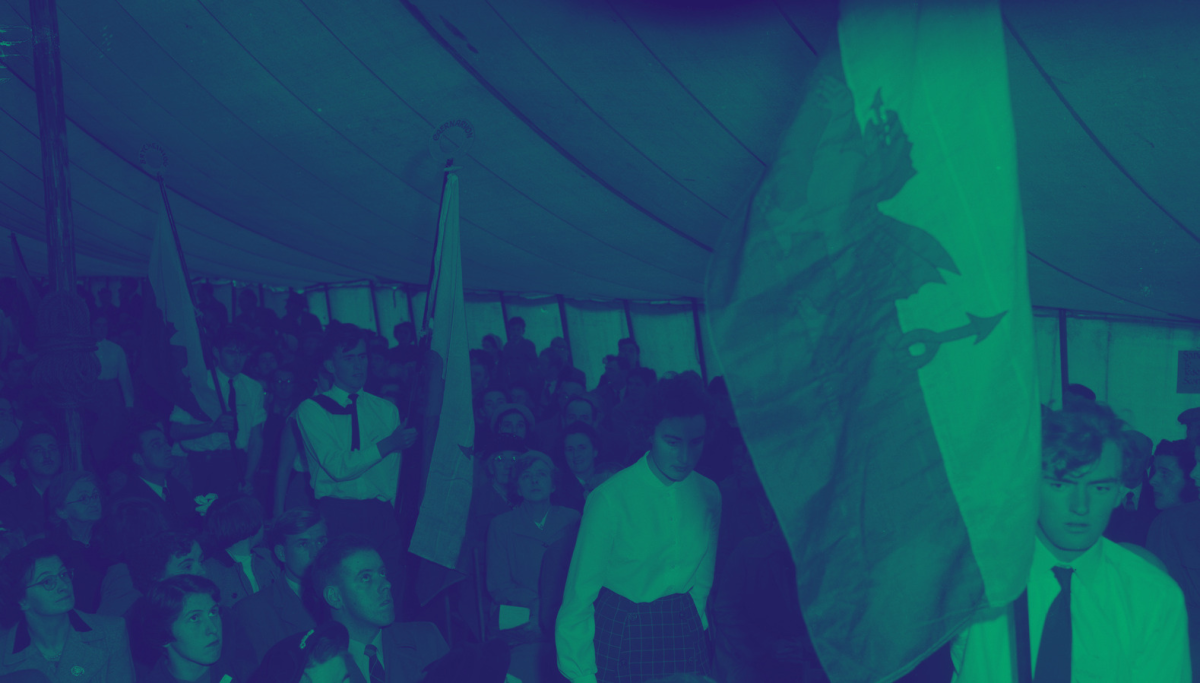
Founded in 1925 by professional intellectuals at an Eisteddfod – a Welsh-language cultural festival – the party has long balanced tensions between its radicalism and need for respectability, and between its left, right and centrist tendencies.
In 1936, three of Plaid’s founding members set fire to an RAF training school in Penyberth in protests at the imposition of the facility on an unwilling community; in the early 1960s, the party acted as the incubator for a nascent Welsh language movement which would go on to undertake decades of direct action; and in 1980, Plaid leader Gwynfor Evans threatened a hunger strike in the campaign for a Welsh-language television channel, contributing to a u-turn in Thatcher’s new government.
Alongside this radical strand in Plaid’s DNA, however, sits the party’s need to prove itself as the respectable, sensible and government-worthy representative of the Welsh people as a whole, typified by the awkward tension between the party membership and its cautious then-leader, Ieuan Wyn Jones, around the question of independence throughout the 2000s.
Whilst Plaid’s leadership has historically attempted to conjure a distinctive Welsh nationalist politics beyond the left-right binary, in reality the party has necessarily been pulled in left or right directions by its internal dynamics and wider political circumstances, with its broad nationalism facilitating malleability. This same tension will almost certainly play out in power.
Devolution was a project ultimately brought about by New Labour in the 1990s, and after almost three decades of Labour victories in Senedd elections, the devolved Welsh state apparatus is deeply entwined with the practices and culture of Welsh Labour: a technocratic mode of governance fostered in Westminster’s domineering, perpetual shadow. In the coming months, Plaid will fully discover the extent to which the levers of state power are built for different hands, and whether it must adapt or try to force fundamental change. Leading a minority government and likely relying on votes from the nine remaining Welsh Labour MS’ makes the former more likely.
The party’s avowed socialism – enshrined in its constitution following an internal struggle in the 1980s – will meet the context of a dependent and underdeveloped Welsh economy, whose patchy private sector is sustained in no small part by appeasing international capital and outsourcing state functions. In local government, there are instances where Plaid has caved to structural pressure against its principles, and its unresolved internal conflict over nuclear power indicates an indecisiveness on difficult issues.
The insurgent left within Plaid has a history of struggle, victory and defeat. In the 1980s it was personified by Dafydd Elis-Thomas, the party’s most prominent Marxist who drifted ever-further to the right over time, entering the House of Lords and ultimately leaving Plaid to support Welsh Labour. Leanne Wood – Plaid’s openly republican, socialist and feminist leader between 2012 and 2016 – was ousted in a coup by Adam Price, who would later resign over failure to tackle misogyny in the party.
Splits from the party and efforts to build alternatives have constituted a minoritarian ‘socialist republican’ tradition – critical of Plaid while conceiving of independence as a means of undermining the British state and asserting the Welsh working class’ needs against the interests of capital. The poet Mike Jenkins, has long been a figure within this tradition, founding Cymru Goch [Red Wales] in 1986. Today he is involved in Cymru’n Codi [Wales Rising], a regroupment initiative on the Welsh left. The left in and beyond Plaid now has its work cut out in opposing any rightward drift.
–
Morgan Rhys Powell: In the 1980s, you were one of the founding members of Cymru Goch. Can you tell us what the group was, what distinguished its politics from Plaid Cymru’s at the time, and what became of the group?
Mike Jenkins: Cymru Goch (CG) was born out of the demise of the Welsh Socialist Republican movement (WSRM), a number of whose members were arrested in a police operation. While a couple of important figures in that movement joined the Communist Party, others like myself, Tim Richards, Marc Jones and Alun Roberts went on to form CG. It was often regarded as a group, but I always thought of it as a party: socialist, republican and essentially activist.
We were very different from the WSRM, as all of us were heavily involved in our communities. The WSRM looked constantly to the north of Ireland for its inspiration.
Some of us were ex-Plaid members who had tried to work within that party to make it into a genuinely socialist and republican entity. This failed and we soon witnessed the symbol of that failure when Dafydd Elis-Thomas jettisoned his ideals which had made him move the writ in the Commons to get hunger striker Bobby Sands elected, instead embracing nuclear power in Trawsfynydd and a very establishment stance on all matters.
We had a monthly paper ‘Y Faner Goch’ [The Red Flag] and got two Councillors elected onto Merthyr Council as anti-poll tax candidates. We even campaigned to get Siân Williams elected to the European Parliament on an overtly Euro-sceptic platform.
We felt that Plaid had abandoned its semblance of republicanism and socialism to embrace a mixed economy. Those who’d been in Plaid knew the impossibility of change from within. Our anti-poll tax campaign showed the differences markedly. Plaid advocated non-payment by a few individuals; we helped organise a mass civil disobedience campaign.
I went to court and would’ve gone to prison, only the iniquitous tax was stopped just after my case.
Poetry was fundamental to our cause and to getting the message out there to working class people in clubs and pubs. We began what was then the Red Poets’ Society, which later became Red Poets and which still thrives today.
Morgan: How do you feel about the election of Plaid’s first government? What hopes do you have for it?
Mike: I was delighted for friends and comrades in particular who have been elected. It’s another step towards taking control of our own destiny, but I also know that Plaid are not republican and are social democratic rather than socialist. They pay lip service to the monarchy and have not been prominent in the campaigns against the fascist Zionist genocide, occupation and apartheid.
I have a degree of hope that they will improve our decimated health and education services and also cut the appalling rates of poverty. However, their dependence on failed ideas like the WDA [Welsh Development Agency] points to a lack of imagination.
My background is in education and I know that their policies will be marginal. To truly change things would need a revolution. To give one example: too many young people – at least a third – are branded as failures because of an unjust exam system. Nobody should fail! There should be folios kept of pupils’ best work throughout their school years and that should form the basis of any assessment – which should be a commentary and not a number or letter.
But because they at least care about Cymru and genuinely want the best for our people, I’m hoping that I’m wrong. However, as with individuals like Lord Elis-Thomas, I’m anticipating that the system changes them more than vice versa.
Morgan: Do you think there is a risk of Plaid being pulled to the right in power? If so, what might cause that?
Mike: I think this is inevitable. The forces of business and industry and especially the multinational corporations always hold sway. The media likewise will pressurise them to conform and sanitise any so-called radical policies.
There are distinct tendencies within the party, but I have already seen how some will change given power. One comrade – ex-Cymru Goch – was even justifying their acceptance of the House of Lords! A sure sign of compliance!
Morgan: Which forces within or outside Plaid could act as a bulwark against any rightward drift?
Mike: In this respect our movement Cymru’n Codi could be absolutely crucial. We are clearly a movement, not a party and welcome members from parties like Greens and Plaid as well as those, like myself, who don’t belong to one.
We came out of Left Unity Cymru – with pan-European links – and are fairly recently formed.
There have been two conferences held in Merthyr with large numbers and great enthusiasm. Then the emergence of Your Party called a halt to this progress and we are a few activists keeping it going.
We have a programme for an ecosocialist, republican Cymru based on decentralised and co-operative ownership. We espouse the distribution of power, both political and economic, and it was exciting to see how much agreement there was – and little sectarianism – at our conferences.
I fully believe we will call Plaid to account if they fail to seriously address the problems in health, education and our economy and also should they fail to gain more powers and funding for this Welsh government.
Morgan: Is there still space for radical, socialist pro-independence politics – of the type advanced by Cymru Goch – in Cymru today?
Mike: Yes! Most of Cymru’n Codi’s programme is very similar to what CG stood for. Cymru’n Codi has more ex-Labour activists, so they know a lot about the demise of that party and are probably more inclined than myself to want to form an actual party to stand in elections.
We are probably more interested in making transitional demands than CG was, which comes out of experience of People’s Assemblies and their demands for the likes of free school meals.
Cymru’n Codi is well-placed to bring together leftists with a shared vision. I really hope there isn’t widespread disillusionment with a Plaid government, but my experience tells me otherwise.
Breaking with an entrenched and arrogant Labour Party who have taken power for granted and betrayed the very working class they claimed to represent is a momentous achievement for the people here. I honestly thought I’d never see it and treated polls with some caution.
We’re a nation treated like a colony for too long. I really want Plaid to succeed, but I’m perfectly prepared to support other parties, like the Greens, who now support independence.



0 comments