
Review | Mother Courage and Her Children
Keith McKenna •Keith McKenna reviews a timely but uneven new production of Mother Courage and Her Children at Shakespeare’s Globe in London, which strips Brecht’s anti-war play of its historical specificity, finding a flicker of hope in the silent daughter’s rebellion
Brecht’s play Mother Courage and Her Children immediately takes us to the war machine. Two army recruiters spot Mother Courage’s supply wagon being pulled by her sons and decide to persuade them to become part of the army. Courage isn’t going to have any of that and threatens that if they try, “I will slit your throat and cut your cock off”. But while one of them distracts her by negotiating behind the wagon to buy a belt, the other persuades her son Eilif (Vinnie Heaven) to join the fighting, in which he is, for a while, a big success.
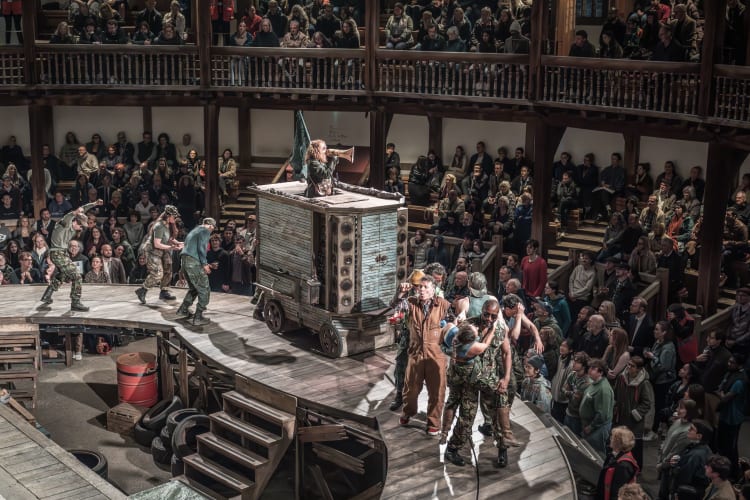
The Globe’s outdoor space and tendency to incorporate music into the performance seem well-suited to this venue’s first production of a Brecht play. The stage is extended to include a pit into which dead bodies are dumped.
The anti-war purpose of the plot seems particularly timely given the warmongering US President Trump and the cruel conflicts that are going on across the world. But this version extracts Brecht’s original references to the European Thirty Years’ War of 1618–1648 and does not specify the war taking place in the play beyond dressing the characters in modern clothes and identifying the combatants by the colours of the flags that Courage hangs over her wagon.
We never hear the official reasons for the fighting, just some of its consequences, though one character argues, “war can’t end because of money. War is a guzzling money-making machine. At the top they gorge themselves on steak, wine and pussy… and laugh”. If there wasn’t a war, he says, “they’d have to provide jobs, education and houses.”
Michelle Terry as Courage is a lively, formidable figure, quick to find ways to make some money out of the war, from selling meat and weapons, to putting a sign outside her wagon reading “Girls Girls Girls”. Unfortunately, she is not always able to protect her children, who are effectively gobbled up by the war. Even then, she tries to find some consolation, as when an attacker leaves a deep scar on her daughter Kattrin’s face, she claims it will protect her from other men.
The second half takes a harsher, more disturbing turn, opening with what looks like a drunken carnival of characters, including the wagon circling the stage, perhaps celebrating “peace breaking out” or perhaps for those people who have lived from its continuation, an uncertainty about what follows. Courage, looking worried, is asked, “how can you talk about peace as if it is an inconvenience?”
However, Kattrin (Rachelle Diedericks), the daughter who cannot speak as a result of someone putting something in her mouth when she was a child, gives the audience a glimpse of a better, alternate future when she makes a stand against the killing.
Until enough people follow her example and we have a different kind of system, wars will continue.





0 comments