
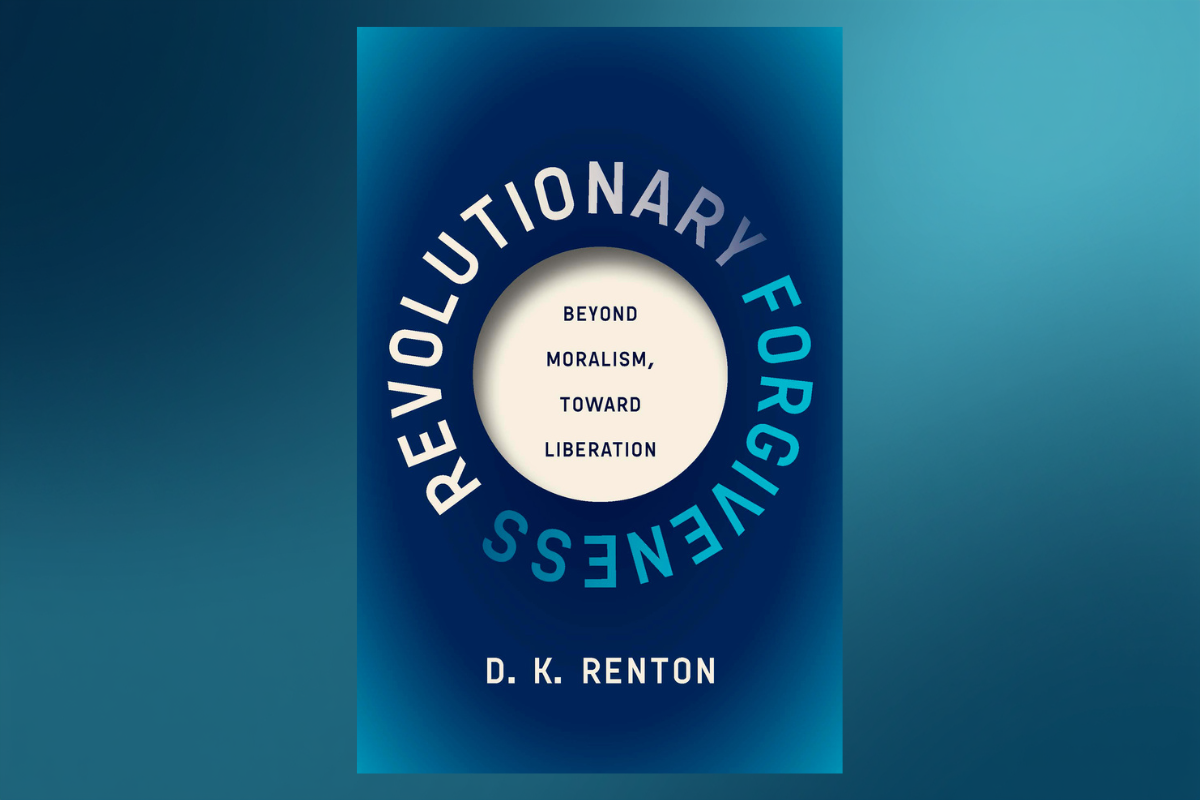
Review | Revolutionary Forgiveness
Thomas Necchi •Thomas Necchi reviews David Renton’s Revolutionary Forgiveness and argues that forgiveness is about the survivor, and creating the conditions in which one can forgive needs to be part of socialist strategy
For abolitionist movements today, the questions of if, when, and how to forgive seem unanswerable – a quagmire of repeated harms, betrayals and unaccountability. Covering a period from just before the Russian Revolution to the modern day, DK Renton takes the scale of these questions and their problems seriously and attempts to provide at least some answers.
He begins to formulate a theory of forgiveness for the oppressed, a revolutionary forgiveness which might help lay the foundations for a transformed society by engaging with several historical moments and traditions. However, Renton warns us, such things are much easier said than done. Briefly revisiting his own experience as a former member of the Socialist Workers Party (SWP), he makes clear that revolutionary forgiveness is as much about confronting the reactionary and oppressive attitudes within our movements as it is about forgiving the class enemy when we are victorious, if not more so.
Revolutionary Forgiveness, in terms of form, is essentially a collection of historical case studies where an attempt at forgiveness was practised, to varying degrees of success. Each one tends to cover a different scenario and historical period, with Renton describing the course of events in each one and explaining both the strengths and limits of each example. For a relatively short book, he covers a wide breadth – going from the (mis)treatment of Eleanor Marx & Catherine Wells, to South Africa’s Truth and Reconciliation Commission, to Trotsky and the Bolsheviks during the Russian Civil War. And these are just the first couple of chapters. This approach itself has strengths and limits: Renton covers so much that sometimes it can feel like you’re only seeing the tip of the iceberg, and it runs the risk of the exploration of forgiveness feeling shallow. But it has its upsides as well. In valuing reach over depth, he has created a work on a complex debate which feels accessible to readers who are not well-versed in philosophy or history.
Renton’s choice of examples has another facet of accessibility to one of the groups the work is most concerned with: survivors. The elephant in the room with a work on forgiveness is quite clearly the many known cases of abusers and predators in movement spaces. Although how these spaces treat those people is important to the book’s overall thesis, Renton chooses to avoid relitigating the various scandals and cover-ups which have rocked various left-wing groups. Instead, he chooses to focus on other, less obvious ones. The result is a book which is less retraumatising whilst still covering the thornier points of debate.
So what is revolutionary forgiveness? Let’s look at an example Renton didn’t cover. In 1979, the Sandinista National Liberation Front (FSLN) came to power in Nicaragua after a long armed struggle against the dictatorship of the Somoza dynasty. One of their leaders, Tomás Borge, became the government’s justice minister. Part of his role meant overseeing the country’s prison system. As New Internationalist recounts:
Many of the former National Guard were now prisoners for whom he was responsible. Under Borge’s direction, the prison system was completely overhauled. Prisoners received progressively more humane treatment for good behaviour until they could visit home at weekends and guard themselves.
Borge had been tortured by the National Guard. According to one story, he later met his former torturer. Faced with the man who had caused him so much pain, Borge reportedly said, ‘For your punishment, I forgive you.’ Based on this and other words, the songwriter Luis Enrique Mejía Godoy wrote a poem/song:
My personal revenge will be your children’s right to schooling and to flowers. My personal revenge will be this song bursting for you with no more fears.
My personal revenge will be to make you see the goodness in my people’s eyes, implacable in combat, always generous and firm in victory.
My personal revenge will be to greet you ‘Good morning!’ in streets with no beggars, when instead of locking you inside, they say, ‘Don’t look so sad.’ When you, the torturer, daren’t lift your head, My personal revenge will be to give you these hands you once ill-treated with all their tenderness intact.
This is a poignant example of revolutionary forgiveness and an eloquent work of art inspired by said example. But Renton is not content to call it a day there and go home. Even in examples like this, where revolutionaries forgive to set a precedent for the society they are trying to create, there are possible pitfalls. In this example, as well as in some of the ones Renton covers, there is a chance that the oppressor ignores your forgiveness and its meanings and keeps causing harm. In the example of the Sandinistas, ‘when the torturer was freed, he went to Miami and became a leader of the counter-revolutionary contras. Borge reflected that the man didn’t understand forgiveness.’ Renton calls attention to things like these, not to paint revolutionaries as naive, but to get readers to question what exactly it would take to make a torturer change who they are as a person.
Another problem, Renton points out, is that some things simply can’t be forgiven. Drawing on the writings of Jean Amery, a holocaust survivor, Renton articulates the limits of forgiveness in concrete terms. Some forms of harm, such as genocide, are so big that even if one person forgives their torturer for the murder of their people, there are still countless other victims. Can you forgive on their behalf? Of course not, Renton answers.
Sometimes what is considered unforgivable might have nothing to do with scale. Sometimes it may come down to the feelings of the harmed party at any given moment. People are messy and complex, and so is their healing. In conversation with thinkers such as Hannah Arendt and Jacques Derrida, Renton argues that forgiveness should never be a way of trying to bootstrap healing.
It’s not all failure: towards the end, Renton gives positive examples of transformation by prisoners, former fascists and others. But by setting hard limits like the above, by introducing the cold, hard truth of unforgivable acts, Renton is trying to get us to think about how we can work towards forgiveness practically and how it fits into our revolutionary practice.
It’s not a shortcut but rather a step toward a socialist society, and for that step to be possible, certain conditions must already be in place. One of those conditions is victory. If we want things like transformative justice to actually happen, we need to start opening up space and laying the groundwork for these processes to truly function – not just applying them reactively when we want to repair harm in our spaces. Doing the latter will only end up retraumatising people.
But even if victories create space for such processes, more is needed. In his short essay ‘Notes on the Russian Revolution’, Italian communist Antonio Gramsci wrote about the plethora of changes the revolution had triggered in Russian society. In particular, he notes how the revolution treated prisoners and how those prisoners responded. He goes on to write:
The Russian revolutionaries have released not only political prisoners, but also prisoners serving sentences for common crimes. In one house of detention, the common criminals, when they heard they were free, replied that they did not feel they had the right to accept their freedom, because they should pay for their crimes. In Odessa, prisoners met in the prison courtyard and voluntarily swore an oath to become honest men, and to resolve to live by their own labour.
Gramsci notes that such a decision meant only one thing: ‘the revolution in Russia has created a new way of life.’ The prisoners had been given freedom, and because they had the freedom to choose, they recognised that their debt to society had not yet been paid.
If forgiveness is to be part of a new society, then so too is the ability to reject forgiveness. The act of forgiveness matters insofar as it heals a survivor, and it is relevant to that person and that person alone. For those seeking to change, they must ask themselves whether they have really earned it. If we want to create a new human being, then that human being must have the honesty and the humility to recognise when the work is not yet done, when restoration and transformation are not yet complete, and to choose to continue with the process, perhaps never-ending, of revolution. They must say that it is better to spend a lifetime restoring even a little tenderness to everyone’s hands than to take the easy way out.


1 comment
What if those demanding forgiveness are implacable about its guidelines and timetable that they are unable to reach any mutual agreement, let alone forgiveness?
It’s my way or the highway!
This intransigence has dominated the Left in so many ways it has limited the formation of coalitions.
Isn’t political development, especially as social liberation movements change over time, an uneven and contradictory process rather than an individual purity test?
Conversely, some people and organisations never change so why bother? Move on.
And when do you ditch or stay on and fight for change? Is winning hearts and minds a flip of a coin or a concerted effort over time?
Questions to ask ourselves.