
Review | Wasteman
Mark Ramsbrook •Mark Ramsbrook argues that watching Wasteman forces us to confront our own fear of punishment, and the gap between the change we desire and the price we are unwilling to pay.
In a recent interview, the playwright Wallace Shawn was asked why he so often calls himself a coward. The man is an outspoken socialist in Hollywood – isn’t there something brave about that? Relatively speaking, no, according to Shawn:
If I had no fear of jail or being hit on the head by a billy club, I would be running to the front of every demonstration. Instead, if I go at all, I tend to be in the back, and I certainly don’t volunteer for arrest. Am I a physical coward? Yes, obviously, or I would be doing these things, because I believe in them.
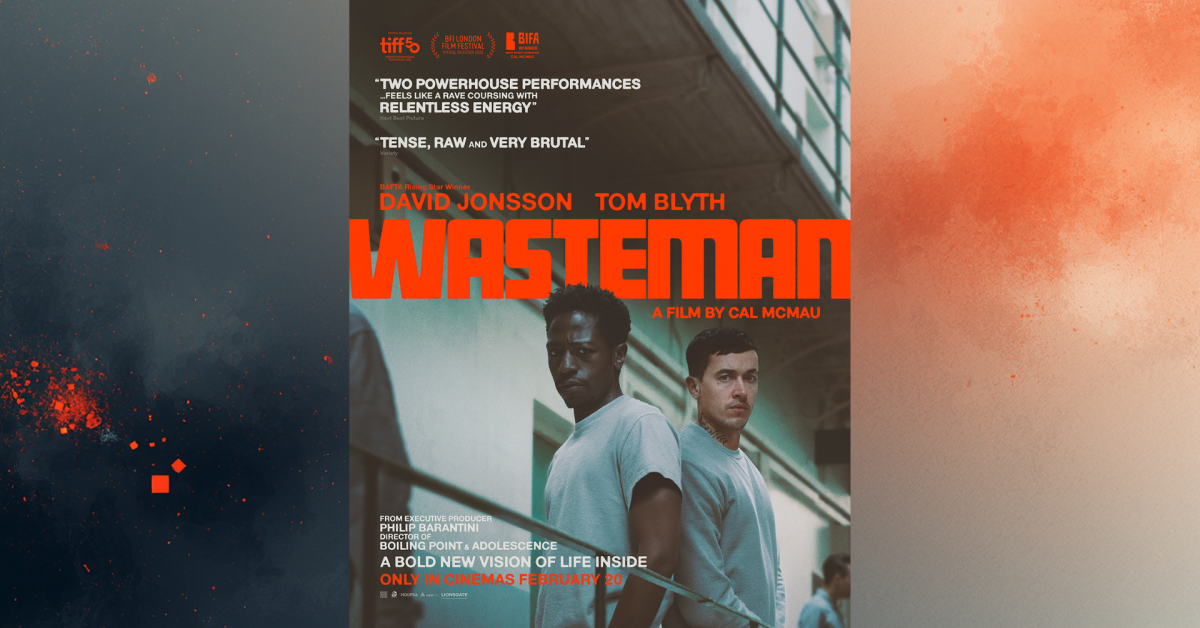
The bluntness of Shawn’s fear of prison, and his honesty about his failure to overcome it, brought to mind my recent experience of watching the debut film of director Cal McMau, Wasteman (2025), a 90-minute anxiety attack about life on the inside in Britain today.
Adapting a script by Hunter Andrews and Eoin Doran that was originally offered to Josh and Benny Safdie (they made Uncut Gems (2019) instead), McMau’s film is one of the best British films of recent years. But it is so stressful for the viewer that I’m cautious to recommend it.
A stooped, careworn David Jonsson plays Taylor, a Black man who has spent his adult life in prison for a crime he committed as a teenager. Out of the blue, a parole officer explains that a new government scheme to reduce overcrowding is offering people with Taylor’s sentence a new opportunity for early release, conditional on good behaviour. Just keep your head down, engage with the services, make good choices, and you can get out. The message of the film, however, and the thrust of its narrative, is that the choices that actually matter get made for you.
The claustrophobia of a locked-in life informs the aesthetic of Wasteman. Director McMau never visually departs from the prison environment – the few glimpses of the outside world come only through phone screens – instead blending a desaturated, digital-for-film naturalism with portrait-orientation phone montages that mimics footage actually shot and uploaded by prisoners. This innovative formal choice evokes something of the psychic life of prison: a vast loneliness vulnerable at all times to overwhelming intrusion, like tiktoks you wish you hadn’t seen on a phone you can’t turn off.
This montage technique, combined with the bereft, anxious facial expressions of Jonsson’s terrific performance, helped me connect with the bone-deep stress fueling Taylor’s drug habit. This dependency makes him a serf to his dealers, whose fades he touches up in exchange for the blister packs of Subotex that get him through the day. It’s a reality for many prisoners within the system currently.
The stability of this relationship is disrupted by Taylor’s new cellmate, a transfer from another prison. Dee, played by Tom Blyth, is an entrepreneur who quickly establishes himself as the prison’s market disruptor, able to get anything for anyone, unruffled by the halfhearted investigation of the overworked screws. He even helps Taylor connect with his estranged son on the outside. It isn’t long before Taylor’s basic human needs for connection, peace, and meaning put him in an impossible position of owing the same absolute loyalty to masters old and new. This contradiction between life and death drives the film to an intensity that had me squirming in my seat.
My fear of prison, like Wallace Shawn’s, is a fear of losing the safety and protection from pain that I currently enjoy. Like Taylor, I’m reliant on relationships of obligation with people who are exploiting me. Unlike Taylor, those people are comfortably far away from me, to the point where most of the time I can forget about them, or talk about them in abstract language, just for the pleasure of writing – a different kind of forgetting. I don’t have to think on the spot what to say to them to persuade them not to break my nose, take my stuff, hurt my family, or kill me.
I know people who’ve risked imprisonment for the cause of Palestinian liberation. Why don’t I do the same? My get-out-of-jail-free card (sorry) has always been the people in my life who depend on me. But obviously, that’s a cheap answer, and not what I really believe deep down. My life isn’t worth more than anyone else’s.
I could do more for the causes I believe in, but I don’t, because I’m scared. The deterrent effect of prison works on me. It constrains choices I like to think I would otherwise make. I think less of myself because of this fear, and I respect people who overcome it and do things I won’t do.
This problem of cowardice that troubles me at times is divested of any importance by Wasteman’s narrative. Taylor’s story shows that courage is a privilege, that moral choices lose meaning the more they are shaped by coercion and compulsion. Even the most extreme acts feel stupid to call ‘brave’ when all they mean is bare survival.
At a certain point during the events of Wasteman’s story, there is a prison riot, instigated by Taylor’s cellmate, Dee. The scene takes on a hallucinogenic, transcendent quality that feels removed from the naturalism of the rest of the film. In that moment, Dee becomes a kind of warrior god, laughing manically, squaring up against an army of clattering shields and batons. This scene flips the whole logic of the prison inside out. Dee is on a life sentence in maximum security, he has nothing more that can be taken away from him, nothing to lose but his chains. Body and mind drop off, taking fear with them, and in that moment, he can do anything. No prison can contain him.
Moments like this show that people make the world and people can unmake the world. They show that there’s more of us than there are of them and take terror past its limit, where, through the alchemy of history, it becomes pure joy. I’d like to feel that joy, even for an instant, but I’m too scared of the billy club and the turning key.



0 comments