
Should the British left build its own DSA? Two views from rs21
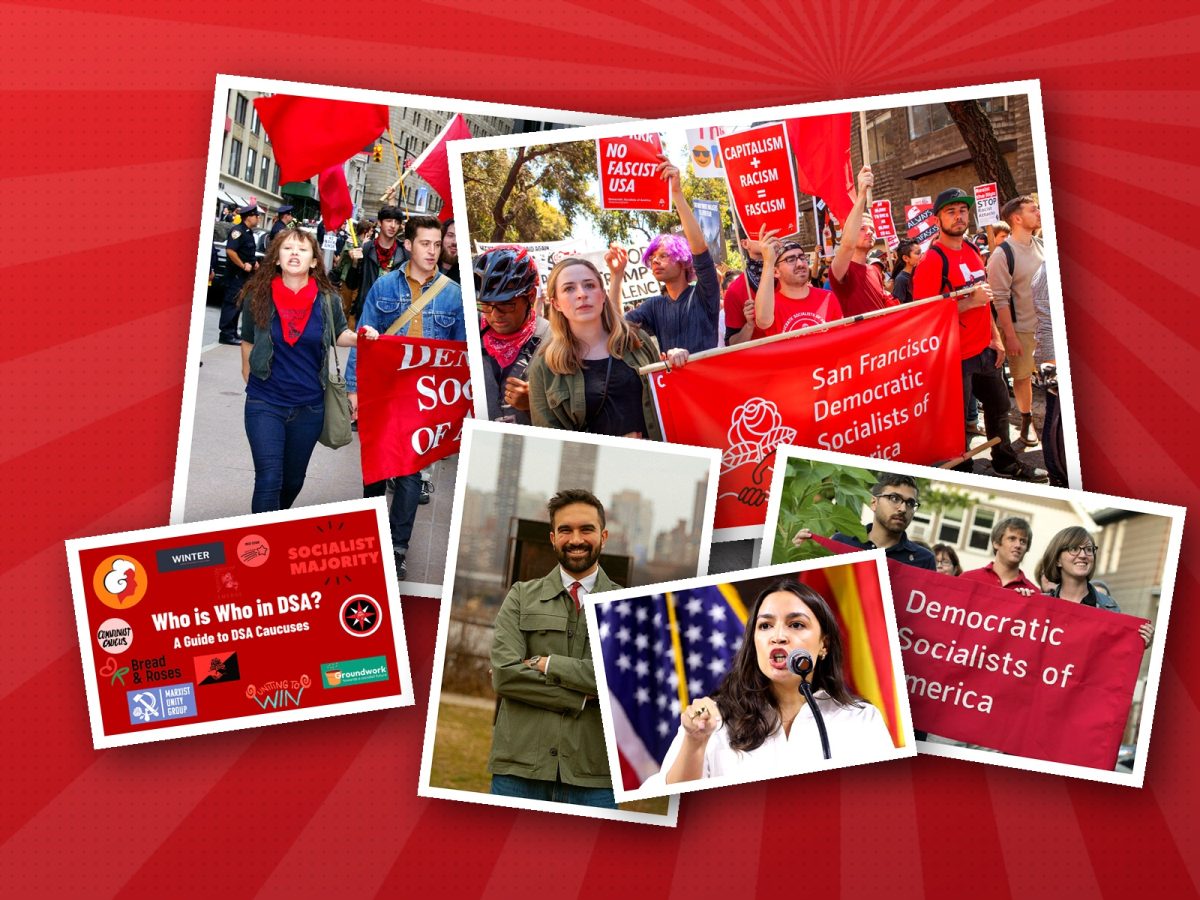
Rob Owen and Vik Chechi-Ribeiro •The Democratic Socialists of America have shown impressive growth and influence in the last couple of years. Their organisational model becomes increasingly attractive for socialists, both revolutionaries and reformists, in Britain. Many hoped Your Party would eventually become a British version of the DSA. That project has failed, but the vision is still gaining ground. rs21 members Rob Owen and Vik Chechi-Ribeiro discuss the DSA model and its problems, what it would take the British left to get there, and whether that’s desirable in the first place.
What problem is the DSA model trying to solve, and is that problem the same in Britain?
Rob O: The DSA was created by Marxists aiming to support the liberal wing of the Democratic Party whilst advocating for ‘democratic socialism.’ As the Democratic Party has no formal membership, the DSA provided an organisational form for socialists to operate within the two-party system. For decades, DSA membership hovered below 1,000 – less than the sum of the organisations that formed it.
From around 2015, the DSA grew rapidly off the back of the Sanders and Ocasio-Cortez (AOC) campaigns. Sanders was not a DSA member, but his popularisation of the term ‘democratic socialism’ saw DSA’s membership surge to 100,000. This coincided with a crisis on the revolutionary left that saw layers of radical Marxists drawn into the DSA, attracted by its rapid growth and open democratic structures. In recent years, left factions in the DSA have been able to win important debates, in part due to low participation amongst the wider membership. This included a shift towards running the DSA’s own candidates on the Democratic ‘ballot line’. A question remains over how the DSA will fare if it backs its own nominee against AOC in the Democratic presidential primaries.
The right’s lack of institutional power in the DSA marks a significant difference from the British context, where similar surges occurred within existing parties: first Corbyn’s Labour, and more recently the Greens. Here new members entered larger organisations built around the rhythms and methods of electoralism – organisations where the right, through elected office and the party bureaucracy, wielded more than enough power to contain and marginalise any left advance.
Vik CR: The emancipation of the working class necessitates self-organisation and governance. In other words, the working class needs its own party capable of developing a cadre and building mass support for a socialist programme. In the US, there is no mass socialist party; however, DSA, now 125,000 members strong, can be considered a ‘proto-party’ – a membership-based organisation with a national political committee, local branches and a sovereign delegate conference. The socialist sects, meanwhile, are increasingly marginalised: the DSA’s success in ‘infecting’ grouplets with better politics is a contributing factor to the collapse of the International Socialist Organization (ISO) and the crisis in the Party for Socialism and Liberation (PSL).
The DSA is playing an increasingly influential role in US politics, running Zohran Mamdani’s ground game and maintaining a visible presence in Palestine solidarity campaigns. Significant groupings that comprise its political leadership are openly communist – no mean feat in the belly of the US empire.
So, what interest is this to us? The DSA at least attempts to solve a problem similar to our own – our lack of working-class political independence – underlined by the lack of socialist candidates in the Clacton by-election, and by the albatross around our own neck: the socialist sects. So whilst DSA is not perfect, it is a viable political model to interrogate.
What does the DSA model assume about the current task of socialist organisation and its relation to the broader left, as well as the working class in Britain?
Vik CR: The primary crisis facing socialists and those fighting oppression is one of leadership and organisation. Unfortunately, the dominant socialist organisational form is the sect – a problem for all socialists – competing for and burning out the same activists, duplicating resources, producing front groups with inefficient and damaging effects, and poor democratic and cultural practices. The lack of influence, and the distance between socialists and movements, is downstream of this crisis.
The experiences of the Black Lives Matter, Kill the Bill and Palestine Solidarity movements highlight the difficulty of gaining concessions from an authoritarian capitalist state without a connective socialist organisation such as the ‘DSA model’.
The task of socialists is therefore to build such an organisation, containing the widest possible sections of the working class and its best organisers, capable of developing a wider socialist consciousness, moving ‘single issue’ campaigns towards challenging the state, and stretching the Marxism of socialists to incorporate liberatory thought.
Whilst a DSA-style party would be a ‘broad left’ formation in which those with revolutionary politics would be a minority, this would be a strength in the long term. An organisation containing Marxists as an ‘open faction’ would have a greater capacity – through joint struggle, branch building and political education – to win over broader layers of people to communist politics.
Rob O: The crisis of the left is a symptom, not a cause, of the problems facing our movement. Since the struggles of the late 1960s, the far left has been isolated from the levels of working-class struggle that give our politics vitality. Comrades who experienced the revolutionary hopes of the early ’70s are now in their twilight years, the organisations they built slowly calcified by practices adopted to survive a downturn in struggle.
Our task is not to group together with the damaged fragments of the Marxist left, but to learn lessons from past high points in struggle and sniff out opportunities to work with new forces capable of breaking the cycle of defeat and starting to rebuild our movement. Recent history offers us hope.
The revolutionary left has helped lead some of the most important movements of recent times, from the anti-poll tax campaign, to the antiwar movement of the early 2000s, to the Palestine movement today. Each showed the potential to generalise, and offered an opportunity to build a large-scale political organisation rooted in a shared experience of collective politics.
Our task today is to sustain a revolutionary organisation that makes new socialists and prepares us to throw ourselves into potential movements with the confidence to listen, raise revolutionary politics, and advocate for strategies that deepen self-activity. This will help prepare us to seize the next opportunity to build a political organisation capable of leading a wider, resurgent class politics.
What would a DSA-style organisation do differently in the next four years in Britain that rs21 and other existing Marxist organisations don’t currently do?
Rob O: The DSA’s relationship with the Democrats means it benefits from the profile of national political figures without needing to navigate their direct influence on the DSA’s internal life. As such, the contradiction between the majorities that radical Marxist factions have won at the national level and the politics of a wider, inactive membership has not been brought to a head. Our recent experience with Your Party has shown how prominent reformist politicians can explode similar contradictions.
The wreckage of Your Party means we can only talk of how the DSA’s democratic form, abstracted from its strategy and practice, might apply here. The Green surge and the collapse of Your Party mean the material forces for a DSA-style organisation in Britain are limited to the existing left groups and bruised refugees from Your Party. Absent the discipline of a common periphery or strategy, it is difficult to imagine such forces cohabiting an organisation productively enough to become a pole of attraction for wider forces. Instead, rs21 and other Marxist organisations have to seek opportunities to work with others to renew the movement against the cost-of-living crisis, militarism and the threat posed by Reform. We need to look outwards, not inwards, for the forces capable of reconstituting the left. History has repeatedly shown that struggles produce new layers of activists and, in bringing the healthy parts of the left into common work alongside them, provide the basis for genuine organisational unity.
Vik CR: Currently, we’re seeing a trend of ‘single issue’ groups turning towards organisation – e.g. Energy Embargo for Palestine, Palestine Youth Movement, Climate Vanguard, Orbit – which is welcome; however, it risks formalising fragmentation, and with it a lack of accountability and democracy that can be found in coalitions. We should therefore think through how best to merge these movements – not necessarily to liquidate themselves entirely, but to explore what organisational form would let them co-exist together.
A DSA-style organisation could serve this purpose with a lower bar of entry than a Marxist group – many comrades in movements would not describe themselves as communists (yet!) and would not join rs21 and accept its upcoming political programme. A DSA-style organisation, however, would welcome reformists and provide a vehicle for them, for those across different movements, and for Marxists – working, learning and engaging in struggle together. Here, local branches could exist as spaces for deliberation, strategy, socialist education, campaigns and electoral activity. So whilst this would be a smaller formation than Your Party had promised, the wager is that cadreisation, democratic structures and healthy political cultures would fertilise the ground for a ‘massification’ of membership.
What would the British left lose if it embarked on such a project, and what is the worst-case scenario of the DSA model?
Vik CR: The British far left is so weak that it has little to lose by breaking out of its organisational stasis. Your Party – even with incompetence and infighting at the top – was a sobering reflection of the strength of Labourist bureaucracy relative to Marxist and movement organisations. It’s therefore worth looking at novel forms, even idealised ones.
A worst-case ‘DSA model’ scenario could see political tendencies harden into open factions, incapable of building unity through diversity. Unlike a healthy process – where opposing views are synthesised in a way that raises the organisation’s political floor, and where losing a vote still produces unity in action rather than a split – the worst-case scenario leaves the organisation fractured. This is a particular risk for a membership that lacks organisational experience, cannot accommodate differing political viewpoints, or is unwilling to tolerate a principled minority.
Another related concern is the ‘DSA model’ being overly inward-looking, with factions struggling for political control detracting from mass work.
However, open democratic structures strengthen the ability to intervene in movements, ensuring the widest possible input and greatest buy-in from members. A Marxist faction would also act as a guardrail against liquidating politics into mass work, ensuring ‘community organising’ has an explicitly political purpose and pulls individuals into a DSA-style party.
Rob O: As revolutionaries in Britain, we organise to try to answer the question ‘How do we change the world?’ There can be few other situations where so small a group of people has set itself so massive a task. The stakes can feel overwhelming, particularly when faced with the current state of the wider working-class movement.
Part of the role of a revolutionary organisation is to help us sustain ourselves through:
• collective discussion of the lessons of the past and of contemporary moments where glimmers of a movement capable of contesting for power can be seen;
• supporting each other to work productively in wider struggles whilst being open about our politics, realistic about the existing situation, and capable of articulating strategies to take the movement forward.
In doing this hard work, we ‘make ourselves fit’ to engage in building a mass political organisation when struggles make such a possibility real.
The danger of chasing the DSA model is that it turns activists away from the hard work of winning arguments in the wider movement, in favour of the easier task of winning internal motions, positions and majorities within small socialist organisations. In Britain, such strategies have only attracted the most sectarian and isolated fragments of the far left, and have fetishised formal democratic processes over roots in the wider movement.









2 comments
I think, I broadly agree with Rob here. But this is complex as I think there’s a dynamic between the two sides that are both variations on abstraction.
Vik identifies the organisational form of the DSA and abstracts it from the material/historical context of the American left so isolating the novel circumstances of it’s successes from the the realisation of those novelties into practicalities – i.e. you can’t divorce the growth of the DSA and it’s ‘successes’ from the ‘success’ of Sanders failed attempt to secure the democratic nomination in 2016. The subsequent defeat of H. Clinton by Trump fed a political epiphany within the wider left that corporate democrats couldn’t beat Maga. The Biden hallucination wasn’t effective enough to end that idea, and thus the political notion of ‘no compromise’ crystalised into the organisational form of the DSA – they were well placed to succeed on that count. Hence, political struggle transformed/formed political form.
Rob’s dalience with abstraction is the abstraction of the loser. He’s right to point to the necessary translation/transformation of political moment into political organisation but the ‘transformation problem’ in the UK is that no political moment has been seismic enough to force into being a necessary moment of organisational founding. This is because the multitude of political moments in the UK are indexes of defeat – Corbynism was the last hurrah of left-labourism before the season finale of Pasokification, the UK BLM was a angry and justified reaction to institutional racism and the statue-ification of slave-owners but did not create a wider dawning of class consciousness, Brexit as a crisis was an anti-political lashing out by de-industrialised wastelands. Perhaps the Palestine solidarity movement could have forged new organisations, taking off for example from the various student protest camps across campus’ but this didn’t generalise into mass organisations and instead fed into the heroic but minoritarian actions of direct action groups. So Rob is left to gesture towards a moment, yet to be, that will act as the equivalent of the UKs Sanders moment.
I always find myself recalling the notion in physics of action at a distance. Forgive any butchering of real science that is about to take place…
My understanding is that action at a distance explains the way in which forces of nature affect an object despite having no ‘physical’ interaction – for example how gravity can influence the course of objects in space, or how subatomic particles can cause immediate effects on one another at distance – Einstein’s spooky actions.
I think of this because I wonder if the Left needs to break from an instrumental way of thinking about the translation of political moment to political form? The moment being the constellation of entities taken at a point in time, allowing for each to fully embody the contradictions of history that led to their formation, with political form being the ‘coming-into-consciousness’ of those moments as the make those embodied contradictions take action. From in itself to for itself. The dynamic moment of translation being the contradiction within the form of the entity action as locomotion for the action of it’s organic political form. The locomotion here being ‘force’. The political form is the force produced by the realisation of the contradiction within the moment as it’s moves from the product of history to histories producer.
Rob’s awaited moment does not find a form alighted upon it, nor does Vik’s form fully realise the full force at play when the in-itself becomes for-itself. Pre-empting the revolutionary form through expediency will only go so far. Lenin’s rejection of flowers from the party, and the call for soviet power for example. As an allegory, the DSA will inevitably fail to call for the soviet when the ballot box blooms. The form of electoral success will bind the DSAs fate to this temporality, not to that of the exploding historical moment and it’s need for organisational expression. When the historical moment calls for the DSA to cease to exist, will it be able to know this? Maybe this is too philosophical but I think the history of the UK Left is littered with undead organisations who should have had their obituary pages written so much sooner.
The action at a distance here is the knowing of the weak link in the chain, as is the cliche. Identifying the political form that matches the political task that magnifies the nascent force within the contradictions of the historical moment. This does not mean ‘lots of people want more welfare and less warfare, lets do that’, but means identifying how a demand for increased social spending from the state cannot be met by the machinery of the state and this will ultimately reduce any reform attempt to a side-effect of mass political struggle outside of the state. The DSA activism behind Zohran and other successful electoral projects is a pale imitation of the type of stateless political movement that will be required to ensure meaningful political change will happen in the UK. There is no path to pro-working class reforms within the British polity that won’t require earth-shaking levels of activity.
With this in mind, the weak links aren’t seeing a lack of ‘mainstream’ political Leftism (Corbynism without Corbyn, so to speak) and saying ‘this is our task’. It’s knowing that a deep and epochal political crisis will emerge *because* basic, minimal reforms will not take place within the logic of ‘reformism’. The reform or revolution question is resolved because there will be no turning of the tide against working-class immiseration without a moment that shakes the confidence of the ruling class. There is no program of reforms, negotiated through existing institutions, that can overturn the anti-reforms of the last 50 years without those institutions being rocked to their core. The Gramscian war of position is not possible. It is a Benjaminian redemption of history that these times call for, and the adminstrative left is a trench we can’t afford.
I appreciate, none of this is practical advice. I leave that up to your interpretation.
To help people in Britain have a more accurate understanding of DSA, here are several articles worth reading:
By Kim Moody, written before Mamdani’s win but still relevant:
https://newpol.org/issue_post/the-partys-over/
I don’t agree with all of this but it’s definitely worth reading to understand the reality of DSA:
https://cosmonautmag.com/2025/11/traveling-through-purgatory/
A more recent article also worth reading (again, I don’t agree with it entirely):
https://cosmonautmag.com/2026/07/the-ballot-line-is-the-discipline/
I imagine that after the Your Party debacle there could be some “the grass is greener on the other side of the ocean” sentiment on the left in Britain but I don’t that’s warranted or helpful