

Inside the Paris uprising: An rs21 report
rs21 members •Written by a delegation of rs21 members who were on the ground in Paris on 17 October, this detailed report describes a leaderless revolt of students and workers, the police violence it met, and why the trade union movement must now turn the momentum into a general strike.
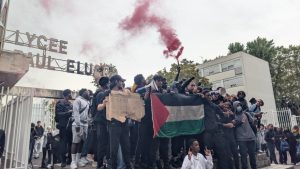
Smoke rose from the Paris skyline as hundreds of thousands of students and workers united in militant, organic protests across France.
17 October, a day long marked by Parisian protests following the brutal state murder of up to 300 Algerian nationals in 1961, carried a distinctly sharp energy this year. The day marked the return of the Gilets Jaunes (Yellow Vests) movement, which joined high schoolers in their battle against education cuts and shoddy infrastructure. As a result, the demands broadened rapidly to tackle the cost of living crisis and the rise of electoral fascism.
The Gilets Jaunes reported that 800,000 people took part in 1,700 mobilisations nationwide, particularly in Paris, Marseille and Lyon, but also in small towns and rural areas where roundabouts, toll booths, and petrol stations were blocked. The scale of dissent has generated a crisis for the French state. Terrified by a movement they could not easily manage or contain, establishment politicians and mainstream media reacted with panicked condemnation. Cries from centrists calling for “calm” and from the right predictably scapegoating immigrants have dominated coverage. But rs21 members on the ground in Paris saw a different picture.

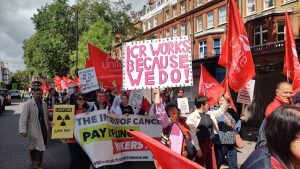
In Paris, with no fixed routes or set mobilisation points, processions formed organically and moved fluidly through the central city. Each junction presented a 50/50 decision, often decided in seconds by a few random people pointing the way. Every demonstrator followed a single instruction that spread online, “Move like water.”
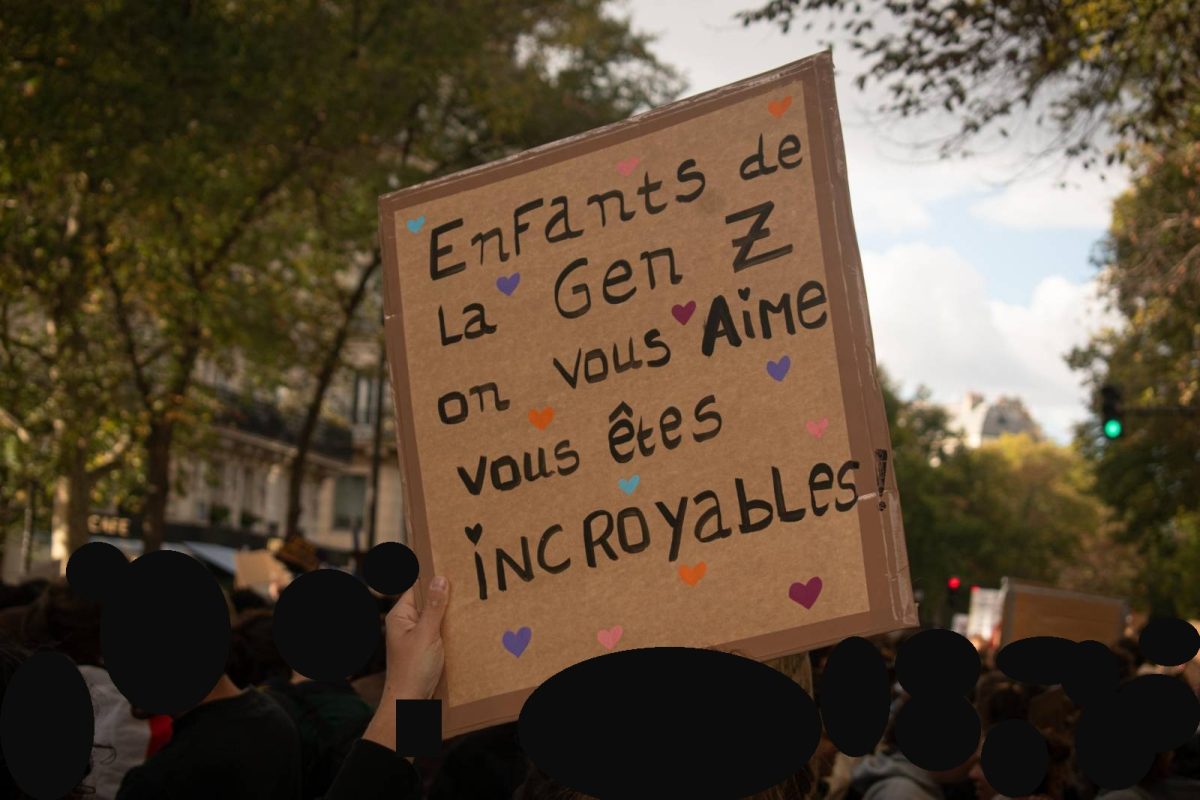
Blocs of trade unionists, students and activist groups such as Révolution Permanente and La France Insoumise were present, but mostly people came in pairs or small groups, roaming the streets to find a mobilisation to join. Chants were mostly antifascist and anti-police, with a significant portion directed at Macron, billionaires, and in solidarity with Palestine. Placards were creative, featuring elaborate artwork alongside direct slogans like “Eat the Rich” and “Gen Z, Rise Up.”
Members of the public showed massive support, whether it was people working in local shops or waving from flat windows. We also witnessed stark and often funny class divisions between those on the streets and the upper classes sheltering in high-end restaurants or luxury retailers.

Each time a procession caught sight of another, cheers erupted. This grew more frequent as marches converged vaguely towards Place de la République, Place de la Bastille or the Élysée Palace. But louder jeers and cries of “ACAB” rang out as police, clearly overwhelmed, were increasingly spotted cornered at street intersections or driving past in armoured vehicles.
As protesters neared key locations, the explosions of rubber bullet grenades, flashbangs and tear gas canisters multiplied. Thick plumes of smoke and gas filled the air surrounding the Bastille, which had been adorned in a giant yellow vest. For the marchers, undeterred, these sights, sounds, and shouts of “ACAB” (All Cops Are Bastards) became their guiding star.
Protesters were forced to adopt increasingly militant tactics in the face of extreme, indiscriminate police brutality. This was especially true regarding the BRAV-M motorised police unit. Young protesters described those units to rs21 members as “more than cops, they’re murderers” as BRAV-M officers patrolled in groups of four or five mopeds, each carrying a pair of armed officers. One officer stands ready to jump off, beat protesters indiscriminately and speed away before anyone can retaliate.

Unlike in Britain, where state repression relies heavily on widespread arrests of peaceful protesters, the Paris police were visibly overwhelmed and far less interested in making formal arrests. Instead, their strategy was beating, gassing and shooting rubber bullets at marchers. Hundreds of protesters were injured, and reports circulated on the ground of at least one demonstrator who died. rs21 members themselves were targeted, hit by rubber bullets.
Where violence occurred, it was the police who initiated it; state forces flooded the streets with tear gas as a starting point, not as a response. In reaction, street blockades were hastily erected and set on fire to slow down police charges. Fireworks and projectiles were directed at police lines, and tear gas canisters were routinely kicked back.
Corporate institutions were systematically targeted. Banks and multinational chains like McDonald’s and Carrefour had their windows smashed. Parked Tesla cars didn’t stand a chance. On several occasions, protesters successfully charged the police lines, forcing squad units into full retreat.

As night fell, tear gas canisters rained from the sky and explosions were heard in every direction. Yet large numbers remained on the streets, though crowd dynamics shifted into smaller, highly mobile militant crews actively engaging police units. Near the Opéra district, crowds gathered to confront police lines and breach luxury designer stores.
While establishment media predictably framed this property destruction and looting as mere criminality, its political nature was undeniable. Retail giants like JD Sports have long lined executives’ pockets while fleecing working-class youth who buy their products. And we shouldn’t shed any tears for the likes of Versace, Gucci, or luxury boutiques serving the ruling class on the backs of low-paid garment workers in South and East Asia.
This looting was not the work of organised crime or immigrants, as suggested by the racists and media. It was a direct, explosive response to pay cheques that no longer last the month under Macron’s neoliberal regime, which prioritises the profits of bosses and the petty bourgeoisie over working-class survival. Notably ignored by mainstream outlets were the numerous instances of looters immediately distributing expropriated goods and clothes to unhoused people nearby.
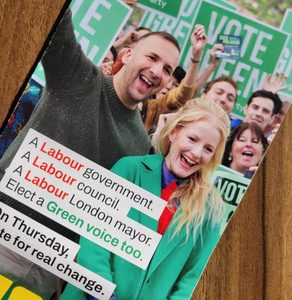
This dynamic shows a key difference between French and British protest cultures. In Britain, people far too often join demonstrations with no expectations of that protest winning, treating protests merely as symbolic pressure points. Demonstrators are too often told by social democrats and reformists to wait for the election of a Green MP, Jeremy Corbyn or a Labour government to deliver change.
That defeatist electoralism was absent in Paris. While the socialist La France Insoumise party had a presence, and many young people present will likely vote for them, few viewed parliament as the primary vehicle for liberation. The consensus on the street was that the solution to soaring living costs, low wages and fascism is the direct action of the mass movement itself. This generation of working-class youth has not been demoralised by defeat; its members are too young to have experienced a movement like this before. Therefore, their political determination is formidable and infectious.
As we returned towards Place de la République near midnight, only small groups remained and were eventually outnumbered by police reinforcements. Rubber bullets, spent canisters, and unmanned barricades littered the streets. Though explosions still echoed in the distance and fires were still going, remaining groups near us called it a night.

Yet as we left, a group of high school students sheltering in a side street with cans of beer told us, “7 AM tomorrow at République!” Their desire to push forward was inspiring.
We asked a local Parisian comrade if this day felt typical of past student demonstrations. “No,” he replied. “This has been more like a civil war.”
The day was a brilliant explosion of youth and working-class anger against capitalism. But we must go beyond the riot; the key task now lies with the trade union movement. While trade unionists, particularly from the CGT, participated on 17 October, a coalition of major union leaderships sparked frustration by calling a general strike for 5 November, rather than capitalising immediately on the momentum.
The delay is disappointing, but it can present certain possibilities. With French schools on holiday for two weeks, the central question is whether young activists, rank-and-file workers and the Gilets Jaunes can keep the flame of resistance burning through localised actions over the fortnight. If they do, the 5 November general strike could mark a decisive turning point in the struggle against Macron’s government.
The rs21 delegation in Paris calls on all socialist, antifascist and trade unionists to support and join the general strike mobilisations across major French cities on 5 November.
Actions from the Gilets Jaunes have been called for each Saturday. To keep updated, you can join their Telegram channel. https://t.me/info17octobre





0 comments