
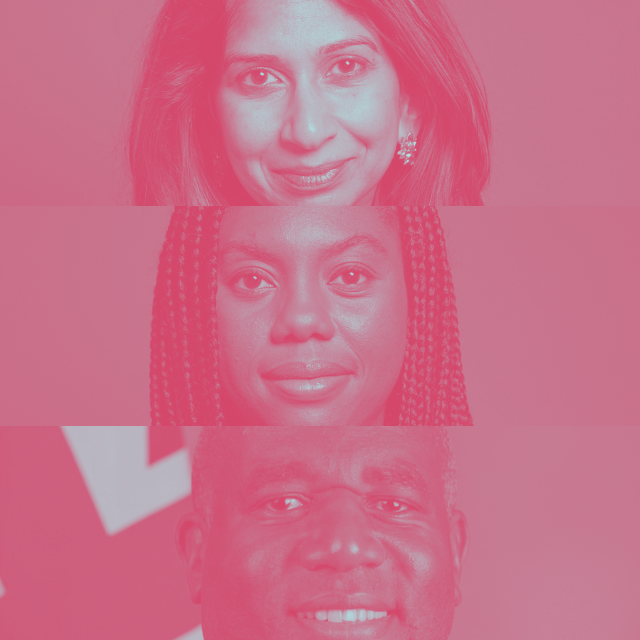
Middle Photo: By ©House of Commons / Roger Harris, CC BY 3.0, https://commons.wikimedia.org/w/index.php?curid=150972962
Bottom Photo: By Lauren Hurley / No 10 Downing Street – https://www.flickr.com/photos/ukgov/albums/72177720328858019/, OGL 3, https://commons.wikimedia.org/w/index.php?curid=183359551
Edited by rs21
Racial Capitalist Realism in Britain
Abena B •In this adapted speech from Festival of the Oppressed 2026, Abena B examines the growth of a Black and Asian bourgeoisie in Britain, the rise of right-wing politics within racialised communities, and what this means for anti-racist organising today
I want to talk about the rising Black and Asian bourgeoisie in Britain, and how this complicates anti-racist organising today. I will be talking about the presence of ethnic minorities in the political elite, especially those who are right wing. I will also be talking about racialised subjectivity under this specific era of capitalism, and why particular sections of racialised populations in Britain have embraced neoliberal subjecthood – upward mobility and buying into the ideals of meritocracy.
We see people like Kemi Badenoch, Rishi Sunak, Shabana Mahmood, David Lammy, Priti Patel and Sajid Javid amongst the ruling class, espousing anti-migrant, right-wing rhetoric and policies. What does this mean? We see growing Black and Asian support for Reform, which complicates the analysis of the ‘white working class man’ as the typical Reform voter. We see growing Black and Asian middle classes and petit bourgeois layers in Britain – Black and Asian landlords, professional and managerial classes. We see a strong individualised hustle culture as a means to escape oppression within migrant communities. The class character of racialised populations has shifted. So how has this happened, what does it mean for anti-racism, and what do we do about it? The way racism functions constantly changes. The presence of a Black and Asian bourgeoisie does not mean we have achieved racial equality – but, as fellow rs21 comrade Jaice Titus has written, it is an indication of a shift in how it operates.
I started thinking through these questions after an incident on a bus after a night out. I was with my partner and some friends. A guy gets on the bus – a Black guy – and goes on a rant about why we should vote for the Conservatives. This was a year and a half ago, and it prompted a conversation with my friends about this phenomenon of increased conservatism and right-wing rhetoric amongst racialised sections of the population in this country.
How has this happened?
Over the last 50 years in Britain, from the 1970s onwards, we have seen increasing class variation within Black and Asian populations.
A lot of this started when the Black and South Asian anti-racist movements of the 60s to the 80s became co-opted and institutionalised throughout the 1980s and 1990s. Black and Asian organisers and activists were absorbed into local state institutions, producing a layer of professionals and a professionalisation of anti-racism. This new layer, co-opted into the state, became mediators between the state and the racialised working class, stifling struggle, and eventually became part of the state class. Political struggle was diluted and absorbed into the state. Sivanandan, for example, wrote about Racial Awareness Training (RAT) within the public sector and Labour-controlled authorities: training programmes that individualised systemic racism and degraded Black struggle. These trainings focused on the values and attitudes of individual people instead of on the structural and institutional. We see this today with NGO anti-racism – a very liberal anti-racism which has lost its radical edge.
There was also a shift from political blackness to ethnicisation. Racialised groups broke down into the Nigerians, the Pakistanis, the Indians, the Jamaicans, the Ghanaians. This was accompanied by fragmentation in the movement and difficulty in sustaining a unified political identity, in the context of the rise of state multiculturalism, which led to an ‘ethnicisation’ of anti-racism, undermining the unity provided by political blackness – the banner under which Black and Asian people had united as politically Black. Communities became more individualised.
This, of course, happened under neoliberalism, which played a significant role in eroding these anti-racist movements. Neoliberalism has been the dominant form of capitalism for nearly 50 years, introduced from the late 1970s as a series of reforms which restructured the global economy, politics and class relations, as well as global society. It emerged in response to the strength of the social movements of the 1960s and the declining profitability of capitalism, and it redistributed wealth and power towards the global ruling classes and away from the working classes. Neoliberalism has become a hegemonic force, reshaping the subjectivities and ideologies of populations across the world, through neoliberal leaders like Thatcher who aimed to remake British society and the individuals within it.
I also understand neoliberalism to be a racial project, as described by Gargi Bhattacharyya, Arun Kundnani and others. It is the current mode of racial capitalism, a structure predicated on hundreds of years of colonial and racial violence. It has produced surplus populations based on differences such as gender, race and sexuality, producing renewed and distinctive structures of racial, gendered and sexual oppression – and new subjectivities – in the process.
What is racial neoliberalism?
Thatcher’s neoliberal government encouraged enterprise in Black communities specifically, aiming to quash the persistence of the anti-racist movement’s radicalism. For example, the government created ‘Task Forces’ in inner-city areas to stimulate Black business activity by creating an enterprise culture amongst Black and Asian people. The capturing of Black and Asian communities into this entrepreneurial project would have a crushing effect on anti-racist political culture more broadly, which persists today in the widespread affection towards notions like Black capitalism. The self-help ethos of sections of the Black Power movement was transformed and popularised into the neoliberal ethics of individualism, placing emphasis on self-help through individual means, entrepreneurship and the economic empowerment of Black and Asian communities.
Under neoliberalism as a hegemonic force, we become self-disciplining, self-improving and self-reliant individuals – entrepreneurs of ourselves. It encourages people to focus only on themselves and their families, at the expense of social solidarity and collective wellbeing. It obscures structures of oppression and blames the individual for what it frames as personal failings.
What is happening today?
Many of these politicians espouse the ideals of meritocracy. They model themselves as model minorities. Communities have lost faith in trying to collectively overcome racism, so they have focused on individual means instead, with many buying into meritocratic ideals. These figures become symbols of the model minority, indicating that if we all work hard enough, we can all reach their level. One Christmas, I was catching up with an uncle who asked me what I was interested in and up to nowadays. I said politics, and he said: you know Kemi Badenoch is the leader of the Conservative Party – it’s possible for us to be in those places now. As prime minister, Rishi Sunak said: ‘The United Kingdom did something extraordinary for my family when it welcomed them here as immigrants 60 years ago and allowed them to build a better life.’
There is a diaspora politics at work here too. My earliest memories of aspiring to ‘working hard’, excelling academically and wanting to make wealth, I connect to the stories of my parents moving to this country in the 90s, working multiple jobs and being upwardly mobile. My father would tell me: ‘You guys have everything here, you can do anything you want to succeed. It’s not like Ghana.’ It is very common for migrant parents to say that they moved to Britain for a better life – that they came here for that specific reason. There is a colour-blindness in these statements: the neoliberal promise of meritocracy despite our marginalised positions as Black people in this country, a significant discursive narrative of racial neoliberalism. There is a widespread belief in the pursuit of wealth as a route to escape racism, which shapes migrant communities many generations after the first arrival in this country. There is a transnational aspect to neoliberal subjectivity here: against the backdrop of a world structured by racism, (neo-)colonialism and imperialism, the local aspirations of many Black and Asian people in Britain are connected back to their home countries in the global South and to their parents’ experience of migration.
This upward mobility is also racialised and nationalist. People become more upwardly mobile and are suddenly ‘not like them’: I came here legally and worked hard for myself, so others should too. There is an increased proximity to whiteness – class mediated through whiteness – with older Black and Asian communities and elders saying: maybe it is the newer migrants. This is how nationalism and naturalisation work, almost in a ‘race-blind’ way, to capture racialised people. As a child of immigrants, my parents came here legally, so everyone else should too – this is Suella Braverman’s line, and Shabana Mahmood has argued similarly, praising constituents who ‘did things the right way’.
Olúfẹ́mi Táíwò calls this elite capture: the process by which identity politics is stripped of its political substance and liberatory potential, deployed by political, social and economic elites in the service of their own interests. A racialised elite acts in the service of state interests – white supremacy pushed by Black and Asian figures. State racism functions less in explicitly racial terms and more through legality, fairness and order, but also culture and assimilation. This is how the far right, and Reform UK in particular, have been able to pull in people from the middle and upper strata of racialised and migrant communities.
Consider what these politicians have said and done. Braverman said, ‘It’s not racist for anyone, ethnic minority or otherwise, to want to control our borders’ – and yet she has likened refugee flows to an ‘invasion’ and said that immigration threatens Britain’s ‘national character’. Sajid Javid said he would not allow people like his own parents to enter the country today. Under Priti Patel, a points-based immigration system was introduced and the plan to send asylum seekers to Rwanda was developed. Braverman went further, saying that seeing deportation flights take off was her ‘dream’ and her ‘obsession’. Mahmood has tightened the route from asylum to permanent settlement. We have also seen these figures speak out against the Palestine movement, which was able to draw in large numbers of the racialised working class.
Representation does not mean racial justice.
The working class in general is fractured, but the Black and Asian working class is fractured along class lines and along lines of citizenship, as described. Although sections of racialised Britons have entered the bourgeois class, racism is still prevalent, and migrants still occupy the most precarious and devalued forms of labour – migrant women doing care work, for instance. There is no uniform experience of racialised people in this country. There is more difference than ever. How do we bridge solidarities between everyone?
What does this mean for anti-racist organising?
We are living under increasing authoritarianism: far-right pogroms, with people’s houses being burnt in Ireland; rampant Islamophobia; over 100,000 people marching in the streets of London last September. And Black people still face the sharpest edge of police violence, and of exploitation and repression in the workplace. Our anti-racist movement needs to be strengthened.
The growth of a petit bourgeois layer complicates anti-racist organising because the response to racism becomes individual rather than collective. People believe racism can be changed from inside the system rather than by fighting against it. People respond to racism by wanting to gain individual power and wealth – it’s why we see people talking about Black excellence. People see their parents struggle and don’t want to struggle in the same way. People don’t want to get involved in organising and activism because they would rather focus on themselves and build themselves individually. This is a result of living under neoliberal capitalism, where we are encouraged to focus on ourselves as individuals – and this is the racialised dimension of it. Many in migrant communities self-govern themselves into neoliberal subjects through experiences of marginalisation and of navigating their diasporic identities. They focus on upward mobility instead of collective action – a subjectivity that is also gendered and sexualised. Ideas of collective action may also seem impossible or futile, the result of living within an all-encompassing capitalist realism. Alignment with neoliberal ideas makes people less likely to engage in liberatory organising, because liberation itself has been reconceptualised in neoliberal terms.
Neoliberalism produces new forms of racial discourse in which racism is obscured and silenced. It places racism in the past, so that the neoliberal themes of individualism, personal responsibility, opportunity and meritocracy allow racism to be framed as individual prejudice or failure rather than as structural. Race is increasingly erased from public and institutional discourse, but continued through ‘race-blind’ processes: the securitisation of borders, the ‘war on terror’, the policing of surplus populations, and moral panics. This is exacerbated by ethnic minority politicians – and this is what is meant by racial neoliberalism.
When political parties harden their stance on immigration, they often rely on minority politicians to act as reputational shields. The presence of Black and Asian figures in the political elite makes it more difficult to pinpoint state racism. Their race insulates the political parties from accusations of racism; criticism can more readily be reframed as ideological disagreement rather than racial exclusion.
Moreover, there is pressure on migrants to achieve educational and occupational success to legitimise their inclusion in the nation-state, and so there is an incentive not to involve oneself in anything that disrupts that. There is a pressure to ‘assimilate’, and to do nothing against the state, in order to secure the status of inclusion.
What do we do about it?
As we discussed in the festival’s opening plenary: what does freedom look like?
It is important that we look towards a radical political imagination. What kind of world are we trying to build? What alternative are we painting? It is imperative that we build a positive vision of the good life, because people can’t even imagine what this is anymore. Our job as anti-racists is to imagine and build that, so people can imagine a collective freedom and liberation, instead of an individualised one.
Going forward, it is also important to think about how these dynamics will be affected under a Reform government. Could it potentially break this illusion? We need to think about what kinds of organisational forms we need to raise class consciousness and bring unity across fractured class lines. Going back to Sivanandan, who talked about communities of resistance: how do we do this now? The question I ask you all is how we can continue to build these same communities of resistance, given everything I have just described.



0 comments