
Policy, strategy or structure? Imperialism and its varieties
Gareth Dale •As Trump brings imperialism back into the news, liberals tend to see it as a strategy that leaders adopt or abandon. Gareth Dale traces how Marxists have thought about it as a structure of capitalism, from Lenin and Bukharin to the rise of contender states such as Soviet Russia and China.
‘Imperialism’ has once again become a tool for analysing the present. For liberals, the sunlit days of globalisation have faded, giving way, for now at least, to a new Trumpian geopolitics, which, with its shameless grabs for power and wealth, can be analysed using such concepts as ‘resource imperialism’. Through liberal eyes, imperialism is a ‘policy’ or ‘strategy’. One example is Stephen Wertheim of the Carnegie Endowment, who laments that where earlier US presidents showed restraint, only occasionally ‘allowing liberal ordering to turn into liberal imperialism’, Trump offers ‘enthusiastically naked imperialism’.
For liberals, imperialist ‘policies’ describe states colonising or annexing other territories, or using military force to control them. Thus, imperialism has been around for four or five millennia, going back to Sargon of Akkad or before. In capitalist modernity, it tends to decline. Hence, its current return is an anomaly.
Such readings do ideological work. They present the geopolitics of capitalism as progressive in its deep structure: based around nations that represent the world’s various communities and that normally adhere to international law, in contrast to the expansionary militarism of historical empires and of those non-Western nations that are ‘socialist’ or statist or otherwise inadequately capitalist. The Marxist alternative understands imperialism not as a set of policies but as a system that constitutes world ‘order’ in hierarchical form, structuring interstate power as a fusion of imperial hierarchy and the formally equal sovereignty of nation states.
How, precisely, does ‘nation’ relate to ‘empire’ in conditions governed by the capitalist mode of production? Of course, empires existed prior to capitalism, but it reshaped them in several ways. First, unlike previous empires, capitalist empires formed around nation states. An example is Elizabethan England. The English nation was in embryo, with an emergent national consciousness, just as England was beginning to annex overseas territories. Over subsequent centuries, the nation state evolved into the basic unit of capitalist political order: a system that imperialist states created to preserve their power in the emergent world order of formally equal nations.
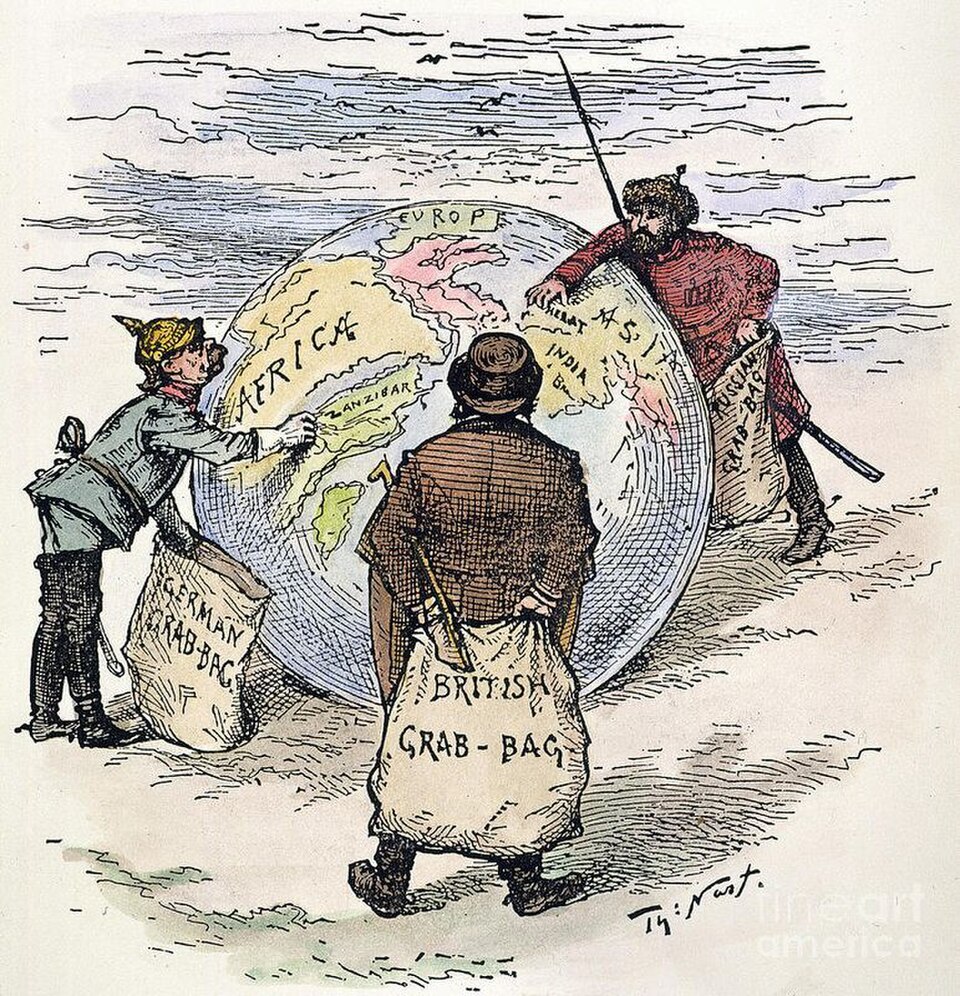
Second, the system went global. Before capitalism, the globe was divided among a hodgepodge of empires, kingdoms and principalities, city states and hunter-gatherer groups, some of which traded and clashed with one another. With capitalism, Europe’s states worked with mercantile and ecclesiastical actors, such as the Catholic Church, to build empires that spanned the world and brutally integrated all territories into a global system. The globalisation of capitalism produced a peculiar structure of global political power: an interstate system made up of nation-centred colonial empires which, from one angle, were in ruthless competition with one another, and, from another, formed a ‘club’ of mainly European states that dominated and plundered the rest. The two angles were reinforcing. To keep pace with rival empires, each was driven to annex more land and squeeze people and nature harder.
Third, capitalist empires constructed a worldwide economic and financial system. Unlike in previous modes of production, surplus extraction in capitalism operates through exchange relations which can, and largely do, take an ‘economic’ and ostensibly ‘non-political’ form. Exploitation relations criss-cross state borders. The implications for the interstate system are profound: each state is imbricated within a world economy whose movements it cannot control yet must seek to shape. Each competes within a world economy and world order it can influence but not control; the fortunes of its ruling classes depend heavily on processes outside its realm. Not only must it counter threats from other states (that was the case for many states in pre-capitalist systems too), but it is driven to reach beyond its borders, to seek influence over property and populations elsewhere, and to control or at least influence the frameworks (rights, rules and so on) that determine the prices at which its commodities will exchange. At this level of abstraction, every state in the capitalist world system has imperialist potential. In reality, however, a few imperialist states plunder, colonise, carve up and reshape the rest. This is because only the most powerful states have the capacity to shape the rules and institutions of the whole system and ensure that global political-economic processes serve their interests above all.
These points appear in two classic Marxist texts on imperialism, written during the First World War by Nikolai Bukharin (Imperialism and World Economy, 1917) and Lenin (Imperialism, the Highest Stage of Capitalism, 1917). For Bukharin, imperialism is a phase in the history of capitalism dominated by two tendencies. One is the upscaling of capitalist competition to the global level, with ruthless rivalry over markets, investment and raw materials (in today’s jargon: globalisation). The other is the increasing concentration and centralisation of capital, which integrates private oligopolistic capital closely with the state (in short: state capitalism). The interaction between the two tendencies fused capitals and states together, and corporate demands increasingly drove political and military rivalries on the world stage.
Lenin’s pamphlet introduced a revolutionary understanding of the political-economic dynamics of early twentieth-century imperialism. Its key insights can be summarised in three phrases: ‘The intensification of antagonisms between imperialist nations for the division of the world’; ‘Capitalism has grown into a world system of colonial oppression and financial strangulation of the overwhelming majority of the people of the world by a handful of “advanced” countries’; and ‘Imperialism leads to increased national oppression, and, consequently, to increasing resistance.’ Imperialism, Lenin argues, is both a system of competition among the Great Powers and their bloodsucking of the rest of the world. Therefore, nationalism in the colonies (later, the Global South) is a form of resistance.
Decades later, publishers and thinkers writing in service of the Soviet Union under Stalinism heavily adapted and bowdlerised Lenin’s pamphlet. To align imperialism theory with the interests of the (itself increasingly imperialist) Soviet state, they reinterpreted it to emphasise that any polity self-defining as non-capitalist is necessarily anti-imperialist. Maoist thought further adapted Lenin’s position to read imperialism as essentially the domination of poor peoples (the ‘periphery’) by the industrialised core (including Soviet Russia). In one respect, this nudged imperialism theory closer to Karl Kautsky’s earlier concept of ‘ultraimperialism’, a coalition of the Great Powers dominating the rest of the world, although for Maoists, unlike Kautsky, this was an unstable and fissiparous coalition.
From this potted history, what can we glean for theorising imperialism today? Lenin’s pamphlet remains a vital resource, at least when all three key points are kept in mind, in addition to his highlighting of the contradictions of nation-building. By this I mean that the struggles of colonised and oppressed peoples take the form of national liberation movements, yet the nation state is the organiser of capitalist power, ‘the rule and the norm of capitalism’, as Lenin put it in his 1914 pamphlet on the national question.
Lenin and Bukharin’s analyses did, however, contain hostages to fortune. They confused analysis of imperialism with ‘stages’ of capitalism, suggesting that imperialism is (in Lenin’s phrase) ‘the final stage of capitalism’, characterised by rentier states, monopolised industries and statism. In this, they highlighted the novelty of global power dynamics their generation faced. Fifty or eighty years earlier, by contrast, at the height of Britain’s hegemony and liberal economic management, relative peace among the Great Powers reigned. Their generation grew up amidst its collapse, marked by rising nationalism, economic protectionism and world war. By suggesting that imperialism is the telos of capitalism, rather than an inherent feature, they conflated their analysis of the era with that of imperialism as such.
It is more helpful to analyse imperialism as part of capitalism’s evolution rather than as its endgame, looking at its successive historical phases as well as what Andrew Wright calls the varieties of imperialism.
In Karl Marx’s day, the ‘phase’ was comparatively unipolar; British hegemony was at its zenith. Ranged against the British Empire were ‘contender states’ – notably Prussia and the US. One US commentator, Henry Carey, developed a theory of imperialism avant la lettre. Carey, a dependency theorist of his day, portrayed the world economy as dominated by a single malign imperium. The British system of so-called free trade, he thundered, ‘is a war upon the labour and capital of the world’. It wreaks ‘devastation and ruin throughout the world’, sowing ‘discord among men and nations’. Britain aimed to prevent its colonies ‘and the independent nations’ from industrialising, and to compel them instead to mobilise sweated labour to supply cheap raw materials for its factories and consumers. The response must be protectionism: the systems of tariffs behind which all other countries, including the US, could mobilise. The ‘labourers and capitalists of other nations’, in Carey’s words, ‘are forced to resort to measures of protection’. And when they do, they will enjoy rising profits and wages, while Britain’s attempt to live off ‘the labour of others’ will, like the earlier empires of Athens and Rome, come crashing down.
Marx, in the Grundrisse, offered a scathing critique. Carey, he notes, reduces all political-economic ‘disharmony’ to British imperialism, entirely overlooking the mode of production that underlies it. Carey was no tribune of the masses but merely a supporter of a rival capitalism to Britain’s, a rival state – and one whose power was daily increasing alongside ‘the centralization of capital’. Carey rages at monopoly and capital concentration, and their destructive consequences for weaker businesses, when these are global and British, but extols those same tendencies in his own country. Naively and nationalistically, he posits the contradictions of capitalism as they appear ‘on the world market as English relations’. In short, for Marx, a concept of global imperial power that lacks a theory of capitalism is hopelessly inadequate; it serves only the interests of national capital (in Carey’s case, US capital).
Carey’s ‘national developmental’ paradigm gained influence in the US and around the world, from Meiji Japan and Bismarck’s Germany to Canada in the late nineteenth century and Ethiopia in the twentieth. His followers in Hawaii transmitted his ideas to Sun Yat-sen, the founder of the Kuomintang, whose ‘neomercantilist’ (nationalist, statist) ideas remained influential in China in his own era and under Mao, Deng and Xi. The national developmental strategies we’re speaking of here – the US, Germany and Japan in the nineteenth century, China (along with South Korea, Taiwan and others) in the twentieth – emerged as state-capitalist ‘counterhegemonic responses’ to Britain’s global dominance. The Careyian premise they all held in varying ways was that concentrating capital within a country, under state aegis, would resolve capitalism’s disharmonies. Of course it did nothing of the sort, but in some cases such a strategy elevated states into challengers to the reigning hegemon: Germany and the US challenging Britain in the nineteenth century, Soviet Russia and later China challenging the US in the twentieth and twenty-first.
In this light, imperialism should be considered an uneven and combined phenomenon. Hegemonic imperialisms have tended to be liberal: the United Provinces, Britain and the US. Each gained a competitive edge in productive industries, bringing commercial success, financial ascendancy and geopolitical heft. Each used economic leverage and military aggression to transform global relations of capital and power, including the expansion of market relations into all corners of the planet. Each benefited from liberal rules (freedom of the seas, free trade, free capital flows), and its intellectuals presented economic liberalism as in the universal interest (Hugo Grotius, Adam Smith, Milton Friedman). Each presided over relative international stability during its era of productive pre-eminence, followed by a phase of hegemonic decline and the rise of ‘contender states’.
As ‘late developers’, such contender states as the US and Germany, then Japan and Soviet Russia, and more recently China strove to industrialise rapidly through leasing technologies developed elsewhere, institutional emulation, state-enforced capital centralisation and brutal regimes of exploitation. They all, in different ways, championed the unity of capital and labour, and most of them pretended – in Carey’s lexicon just as in Shumei Okawa’s or Stalin’s or Xi’s – that their rapidly industrialising state was acting in unison with the oppressed peoples under colonial rule (and, in China’s case, with their descendants in weaker, postcolonial countries). Ultimately, however, these were (and are) states engaged in cutthroat competition and the domination and exploitation of colonised and postcolonial countries. Their trajectories may be – and often are – less warmongering than those of the liberal hegemons, but they too are imperialist powers.



0 comments