

Guilty of organising: the crackdown on mass protest in Britain
Sam O •Sam O argues that the criminalisation of organisers like Nineham and Jamal is the state’s attempt to draw a line under Palestine solidarity, and part of a creeping effort to make protest that poses a real political challenge effectively illegal.
Palestine Solidarity Campaign (PSC) secretary Ben Jamal and Stop the War (StW) vice-chair Chris Nineham have been found guilty of breaching overbearing and repressive protest conditions imposed on 18 January 2025. The courts’ decisions should be understood for what they are: political judgments to discipline an effective mass movement.
Jamal and Nineham are two of the key organisers behind some of the largest demonstrations in British history. The conditions imposed on that protest were contested, inconsistently applied, and seemingly confused even police officers on the ground. They may not have been breached at all. The pair will appeal.
They were among around 100 people arrested at a PSC and StW-led demonstration in central London. Police moved in early, arresting myself and others within minutes for allegedly breaching protest conditions. The experience on the ground was not of a clear line being deliberately crossed, but of shifting and unclear restrictions enforced unevenly.
The Met Police claimed there was a “coordinated effort” to breach the conditions. This does not withstand scrutiny. As Labour MP John McDonnell put it, “We did not force our way through, the police allowed us to go through and when stopped in Trafalgar Square we laid our flowers down and dispersed.”
Among those arrested with me, the vast majority had their charges dropped. But we were not organisers, just participants. The contrast is telling. Those who helped build a mass movement are the ones being pursued through the courts.
This is not simply a miscarriage of justice, but an escalation of state repression. When protest can be criminalised based on unclear or disputed conditions, the law becomes a tool not of regulation but of deterrence. The aim is to make organising riskier, participation more costly, and to reassert control over a movement that has refused to be contained.
Beyond that, a more fundamental question is posed. Why do the police get to set the limits of political expression in the first place?
The right to protest is increasingly being redefined as a conditional privilege, one granted only if it remains within boundaries drawn by the state. In this case, those boundaries were not only restrictive but also unstable, open to interpretation, and ultimately subject to retrospective enforcement in the courts.
This logic is now being extended. The government’s proposed ban on “repeat protests” would take existing powers much further. Amendments to the Crime and Policing Bill would force police to consider the “cumulative disruption” caused by previous demonstrations when deciding whether to impose conditions.
This is a significant shift. It means that the right to protest is no longer judged based on a single event, but on the accumulated political inconvenience of a movement over time. In practice, this opens the door to arbitrary restrictions. Entire areas could effectively be protest-free zones simply because demonstrations have taken place there in previous weeks.
This matters because protest movements do not win through isolated events. From the struggle for women’s suffrage to the fight for trade union rights, change has always depended on sustained and repeated mobilisations. The state understands this. That is precisely why it is moving to limit it.
Seen in this context, the convictions of Jamal and Nineham are not an anomaly but a precursor. In the months leading up to their arrest, politicians and the media repeatedly complained about “weekly disruption” and the persistence of Palestinian protests. These arguments were used to justify increasingly restrictive conditions, despite serious doubts about whether such powers even existed in law. Now the government is moving to formalise and expand that approach.
The direction of travel is clear: from restricting protests, to managing them, to pre-emptively banning them.
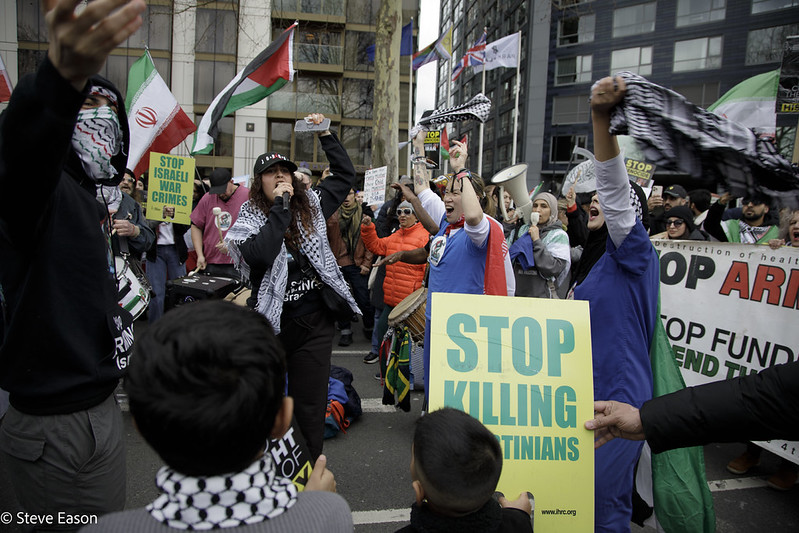
Recent protests in London underline how far this has already gone. The decision to impose sweeping restrictions on Al Quds Day, including banning a march, was justified on the grounds that it might “impact” the wider political situation. But isn’t shaping political debate a key point of protest?
Campaign group NetPol described this as showing an “extraordinarily casual disregard for why protest rights matter”. They are right. If a “volatile political situation” becomes grounds for banning demonstrations, then virtually any meaningful protest could be prohibited. The build-up to the Iraq War, the ongoing assault on Gaza, these are exactly the moments when protest matters most.
What we are seeing is escalating political policing. The Palestine movement has mobilised on a scale that is impossible to ignore. In doing so, it has exposed the alignment of the British state with Israeli violence. It is precisely this political challenge that the state is seeking to contain.
These developments underline something Marxists have long argued: the state is not a neutral arbiter standing above society, but an instrument shaped by the interests of capital. When protest remains marginal, it can be tolerated. But when movements mobilise at scale, disrupting politics and exposing imperialist alliances, those freedoms are curtailed.
The policing of the Palestine movement makes this dynamic clear. Faced with hundreds of thousands taking to the streets week after week, the response has been escalation in the form of restrictions, arrests, prosecutions, and now the threat of outright bans on repeated protest. This is not because these demonstrations pose a genuine threat to “public order”, but because they represent a political challenge the state is structurally committed to suppress.
The right to protest, often presented as a stable democratic guarantee, is in reality contingent and contested, expanded through struggle, and rolled back when that struggle becomes effective.
This repression is not abstract; it is lived by those pulled into the legal system.
The state works to isolate activists from their communities, workplaces and social lives by branding them as “criminals”, placing them on bail, and forcing them through opaque legal processes. But despite this, there have been significant shows of solidarity, from support for high-profile cases such as Jamal and Nineham, Kneecap’s Mo Chara and The Filton 24, to grassroots police station pickets.
This solidarity matters. It shows those targeted that they are not alone in what can be an intensely isolating experience. It is also what allows these sections of the movement to continue organising and resisting. Personally, police station support, solidarity from rs21 comrades, and advice from groups like Green and Black Cross were crucial in enabling me to remain politically active.
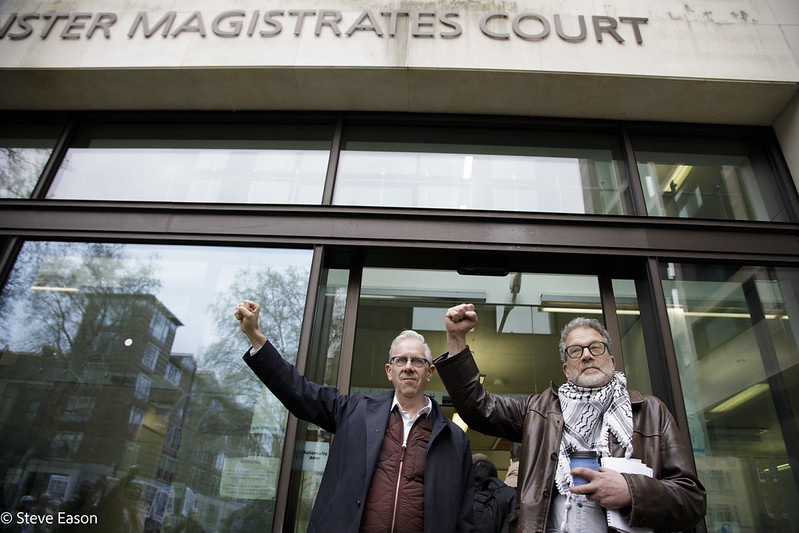
At the same time, the response from PSC and StW has been uneven. Support for those arrested alongside Jamal and Nineham has been limited, and defendants have had to organise themselves. Protests called in support of the defendants outside Scotland Yard were not backed by PSC or StW. The only practical solidarity offered to me was a PSC-led defendants’ meeting, but this came after a legal firm had already organised one. When we called on PSC to launch a legal fee fundraiser, we were told they lacked the resources. It is hard not to ask: how difficult is it to set up a GoFundMe?
It’s regrettable that I have to write this, but it is my experience. Crucially, if repression is escalating, solidarity must scale up to meet it.
The convictions of Jamal and Nineham do not mark the end of this cycle of struggle. They are a sign of its intensity.
If the state is escalating, it is because it feels the pressure of mass mobilisation. The answer cannot be to retreat into safer, more restricted forms of protest that remain comfortably within police limits. It must be to deepen and extend the movement, resist criminalisation, and assert in practice that our rights are not granted from above but won from below.
The task now is not to step back, but to push forward.


0 comments