
Iran, the ‘ceasefire’, and the crisis of American hegemony
Asmar Rafiq •Asmar Rafiq argues that the confrontation with Iran – momentarily interrupted by a ceasefire – expresses a deeper crisis of US hegemony, which is marked by an inability to translate military superiority into lasting political outcomes.
| This article was written immediately following the ceasefire |
Donald Trump presented the announcement of a two-week ceasefire with Iran as proof that the situation was under control. In reality, this pause reflects neither a clear victory nor any stabilisation of the Middle East. After weeks of strikes, threats of escalation and disruption to energy flows, Washington has achieved none of its core objectives. What was meant to be a show of strength instead exposes a deeper inability to convert military superiority into a lasting political outcome. For the US, this war has turned into a trap, where the stakes go beyond the outcome of the operation itself to something more fundamental for the United States: the very credibility of its hegemony over the international order.
A crisis-ridden order, a war to sustain it
The aggression against Iran must be understood within a broader reconfiguration of American hegemony. For decades, the United States structured globalisation by controlling energy flows, logistical infrastructure and a monetary hierarchy centred on the dollar, allowing it to capture a central share of global profits. That order is now under strain, challenged by China’s rise, the emergence of partially autonomous trade and energy circuits, and Washington’s growing difficulty in securing consent to its dominance. In this context, Iran occupies a strategic position: it weighs on Gulf energy flows, integrates into Eurasian corridors linked to the Belt and Road, and exports part of its oil outside traditional circuits, thereby undermining American centrality.
This also clarifies the parallel with Venezuela. In both cases, the objective is not simply to weaken dissidents but to regain control over key energy nodes in a broader global competition while targeting China’s alliance system. The initial assumption was straightforward: trigger a rapid collapse of the regime and install a leadership willing to align with Washington, as in Venezuela with Delcy Rodríguez. More than a limited operation, this was an attempt to reassert a form of global dominance that is increasingly contested.
Tactical gains, no strategic resolution
Operationally, the US–Israeli alliance has inflicted real damage on Iran, but the central point lies elsewhere: there has been no regime collapse, no surrender, and no emergence of a compliant alternative. Tehran has held, reorganised its capacities and adopted a strategy aimed at internationalising the conflict, raising its political, military and economic costs for Washington and its allies. At the same time, it has retained key levers – notably its ability to disrupt energy flows through the Strait of Ormuz. Worse for Washington, Iran has demonstrated its capacity to strike back: despite tactical setbacks, it destroyed military equipment – two C-130 aircraft and two helicopters – targeted US bases in the Persian Gulf to the point of rendering some inoperable, and hit strategic infrastructure in allied Gulf states. In other words, US military superiority has not prevented a sustained capacity for retaliation.
The provisional balance is therefore unfavourable to the United States. Stated objectives – regime change, full ballistic disarmament or dismantling of the nuclear programme – appear out of reach without a major escalation carrying uncertain consequences. Faced with this impasse, Washington seems reduced to a form of restless adventurism: multiplying strikes to mask the absence of strategy, while becoming trapped in a dynamic where deeper involvement makes withdrawal increasingly costly. Trump refuses to accept defeat, yet each additional step narrows his exit.
In this context, the ceasefire does not reflect any Iranian capitulation. On the contrary, it marks a pause imposed within a confrontation whose dynamics and consequences the United States has failed to control.
At the heart of the hegemonic crisis: America is no longer steering – and the crew is drifting
The core issue lies here: the crisis of US hegemony does not stem primarily from Iranian resistance, but from Washington’s growing inability to organise an international order to which its allies consent. Increasingly, the United States is seen not as a guarantor of stability but as a source of destabilisation, including by its own partners – a shift reflected in mounting tensions within the imperialist bloc.
States long embedded within the US orbit still participate, but now hesitate, delay and negotiate as rarely seen before – particularly regarding energy flow protection or broader regional pressure on Iran. Countries approached by Trump – France, the United Kingdom, South Korea and Japan – to deploy naval forces to force open the Strait of Hormuz have either refused, avoided clear commitments or acted below US expectations. Spain has also stood out by restricting the use of some of its bases, despite the contradictions of Pedro Sánchez’s position.
This crisis is evident in Washington’s inability to assemble a coherent coalition. Trump’s repeated and crude attempts to pressure other states into involvement increasingly resemble a pathetic spectacle of weakness. What once appeared natural – such as Blair’s full alignment with the Iraq war – no longer is, as shown by the hesitations, however hypocritical, of leaders like Starmer.
The same difficulty is visible in attempts to indirectly widen the conflict. Washington sought to activate various proxies and partners – Iranian Kurdish groups, Azerbaijan, Syria, Gulf monarchies – yet none have engaged in any decisive way. The alliance with Israel remains central but exposes growing contradictions: Trump needs a short, controlled war, while Netanyahu operates within a logic of a permanent, multi-front conflict.
At the same time, regional initiatives have begun to emerge outside the US framework. The 29 March 2026 meeting in Islamabad (Saudi Arabia, Turkey, Egypt, Pakistan) shows that some states are attempting to contain escalation, signalling that Washington no longer sets the political tempo alone. This growing difficulty in securing allied alignment forces the United States to rely increasingly on coercion.
From hegemony to domination
It is not the use of coercion itself that reveals the crisis of US hegemony, but the need to rely on it constantly to achieve results. Washington appears increasingly unable to sustain its position in the international order or mobilise its allies without resorting to intimidation, escalation and displays of force. In doing so, a weakened hegemon shifts the balance once maintained between consent and coercion decisively towards the latter. The war against Iran illustrates this clearly: it does not reflect a stable hegemony, but an increasingly reckless forward flight, with no clear exit. Force may still impress in the short term, but it erodes credibility when it fails to produce a stable order. The issue at stake in this war is therefore not simply military victory, but the condition of US hegemony itself.
This logic of permanent coercion is also evident in recent US practice. Over the past months, Washington has multiplied strikes and interventions in Iran, Yemen, Somalia, Mexico, Colombia, the Dominican Republic and Nigeria, in a pattern where displays of violence substitute for strategy. The current war is an extreme condensation of this tendency: rather than resolving the crisis of American authority, it exposes it.
The Persian Gulf: a strategic node in a crisis-ridden order
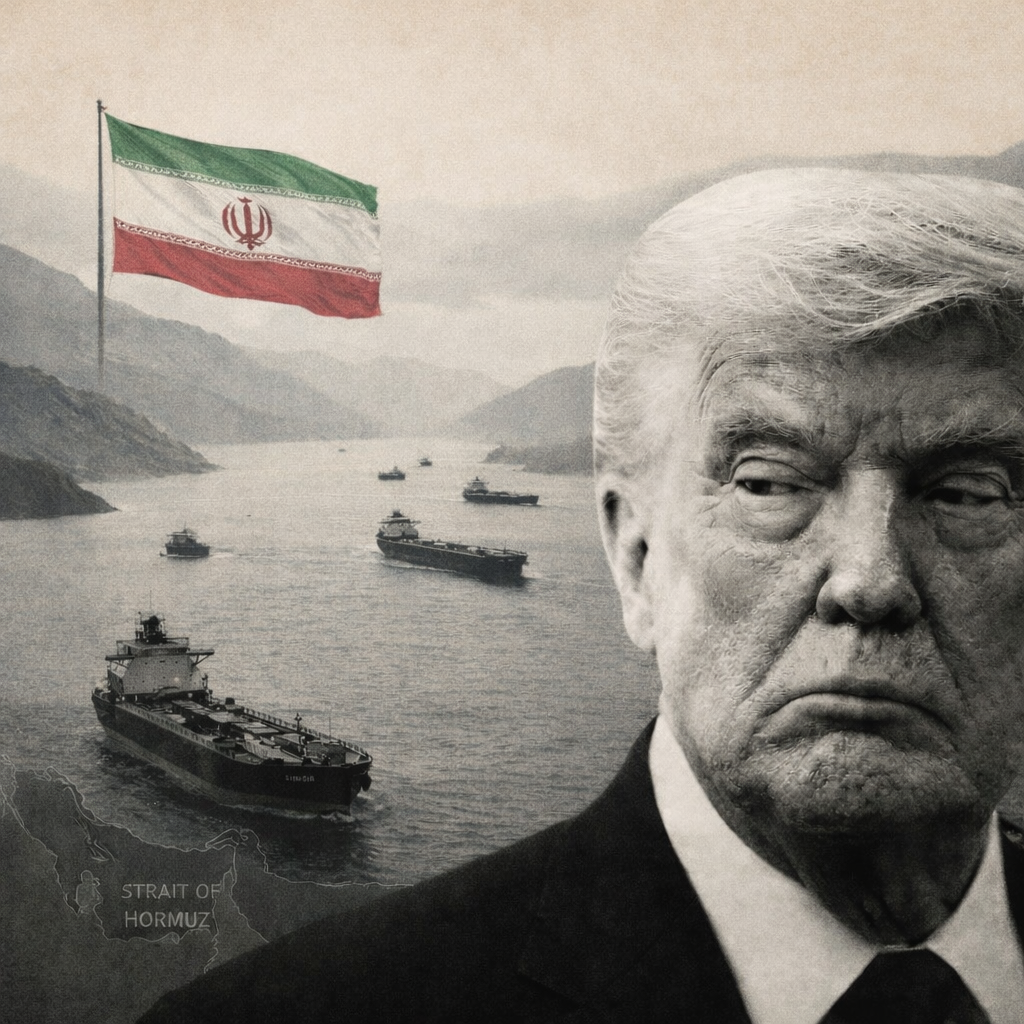
One of the most significant outcomes of the war has been to deepen the disorder it was supposed to contain. The closure of the Strait of Hormuz – through which around 20% of global oil transits – triggered a major energy shock, pushing prices above $100 a barrel and reviving fears of stagflation. Trade disruptions have multiplied, transport costs have surged, Europe’s gas supply has been strained, and the very idea of sustained military escort for oil flows now appears absurd, given costs largely exceeding the value of the cargo.
Such disruptions directly affect Washington’s allies. Iranian strikes have shown that the United States cannot fully protect either its own bases or critical regional infrastructure. For the Gulf monarchies, the message is blunt: US protection and bases can also draw war onto their territory. Their image as safe havens is eroding, investor confidence is wavering, and sectors such as real estate, megaprojects, tourism, logistics and digital hubs are increasingly exposed. Capital outflows towards Singapore or Hong Kong are already being considered, while data centres and cloud infrastructure now appear as strategic targets. In this context, Oman – long seen as the “Switzerland of the Middle East” – has broken with its traditional neutrality, openly criticising Washington and Tel Aviv.
At its core, the issue is control over global flows. The selective closure of Hormuz challenges a central pillar of US power: its historical dominance over global circulation. By immediately internationalising the cost of the conflict, Iran has partially achieved its objective: making the war prohibitively costly for Washington and its allies, pushing them towards negotiations. At roughly $1 billion per day for US public finances, the war is becoming a heavy burden, fuelling domestic discontent (with 54% opposing the war) and scepticism within the MAGA wing. One notable sign of this crisis is the resignation of Joe Kent, director of the National Counterterrorism Centre. In this context, the upcoming midterm elections are shaping up to be particularly difficult for Trump.
Ceasefire: Lifeline, Not a Solution
The two-week truce announced by Trump – tied to the reopening of the Strait of Hormuz and secured under diplomatic pressure, notably via Pakistan with China in the background – appears less as a turning point than as a pause in an escalation that had become increasingly difficult to control.
Tehran, for its part, has entered negotiations without recognising the end of the war, while demanding compensation and asserting control over Hormuz flows. This stance reflects not weakness but relative strengthening, grounded in its ability to close and condition the reopening of a key strategic chokepoint.
China also stands to benefit from this situation. By encouraging Iran towards an agreement without overturning a balance of power unfavourable to the United States, Beijing helps contain escalation while presenting itself as a stabilising force. As US imperialism is increasingly perceived as producing destabilisation rather than order, China is positioned to present itself as a more coherent and reliable alternative pole of global power.
At the same time, the ceasefire highlights the growing asymmetry between Washington and Tel Aviv. While the United States seeks to contain escalation, Israel continues to intensify its operations, particularly in Lebanon, openly pursuing long-term occupation objectives – even invoking the transformation of Beirut into a “new Khan Younes”.
Fire on the imperialists? Fire on the imperialists!
While the weakening of US hegemony may be welcomed, it guarantees neither an Iranian victory nor the failure of US and Israeli direct regional ambitions. Militarily, Washington retains significant escalation capacity, and the outcome remains uncertain.
That said, this hegemonic retreat creates openings. In the present context, a consistent anti-imperialist stance implies aligning militarily with the oppressed nation while maintaining political independence from the reactionary Iranian regime – all the more necessary as its internal repression weakens the population’s capacity to sustain a coherent struggle against imperialist aggression. Conversely, a defeat of the imperialists could open space for contestation and fuel anti-imperialist sentiment.
In this context, building a movement for the defeat of the US and Israel is particularly important within imperialist countries. Such mobilisation cannot be reduced to support for existing states. The Spanish case highlights the contradictions of a so-called “progressive” government which, despite its symbolic and critical rhetoric, continues to participate in the US–Israeli strategic architecture – notably in Lebanon, where Spain deploys the largest European contingent under Operation Libre Hidalgo to fight Hezbollah (effectively alongside Zionist forces), while also sending the combat frigate Christopher Columbus. Likewise, no illusions can remain regarding international law, which has rushed to condemn Iran’s justified retaliation.
Against these contradictions, forms of mobilisation from below offer concrete leverage. The Genoa dockworkers, refusing to handle arms shipments, demonstrate that it is possible to intervene directly in the mechanics of war. In countries like Britain, this dynamic can connect with the social consequences of the conflict – rising food and energy prices in a context of record corporate profits (Total alone has made close to a billion since the war began). This creates a terrain where opposition to war intersects with the concrete social demands of the working class.






1 comment
Really interesting analysis, look forward to reading more from this contributor