
From Hinterland to Hellworld: Interview with Phil A. Neel
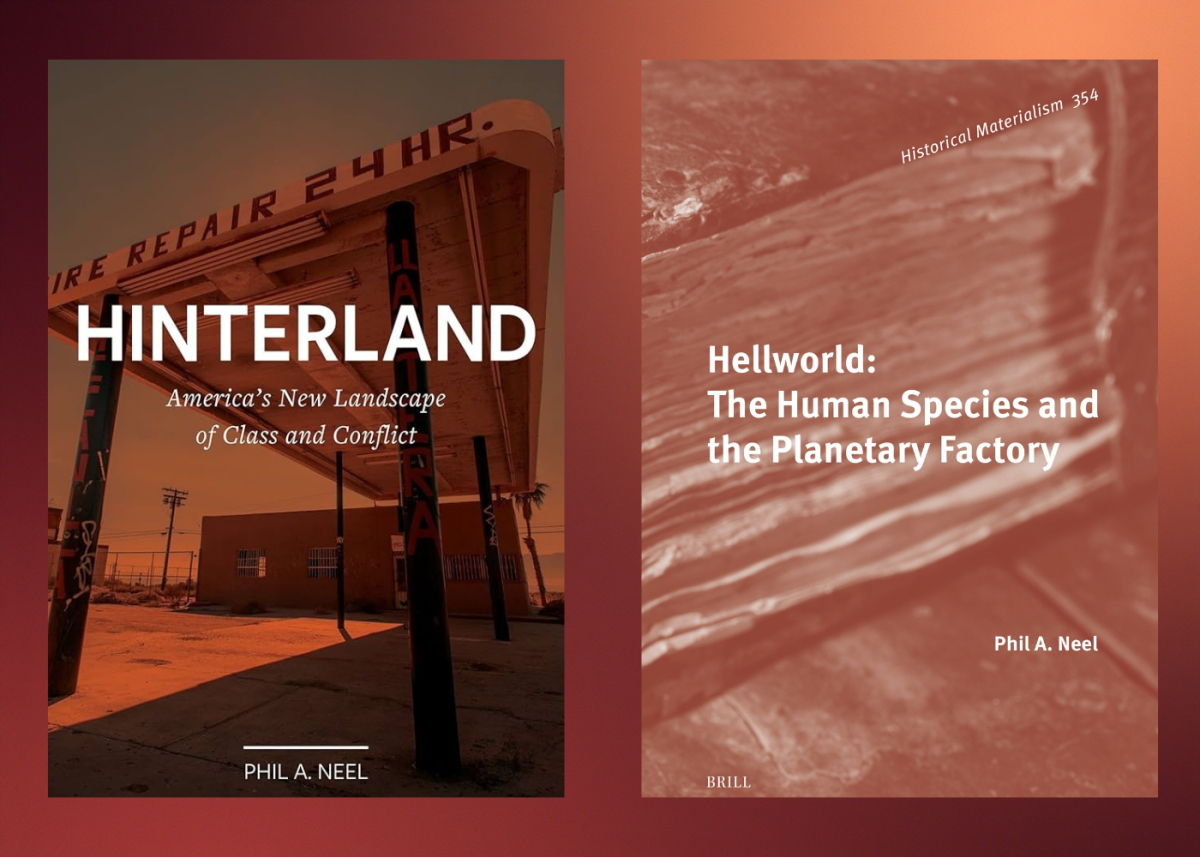
Phil A. Neel •Phil A. Neel is a communist geographer and author of Hinterland: America’s New Landscape of Class and Conflict and Hellworld: The Human Species and the Planetary Factory. In the first of a two-part interview, rs21 speaks with Neel about geographies of class, from the warehousing districts of Seattle to the industrial zones of China and Tanzania. Part two covers communist organisation, the theory of the party and the prospects for left politics
Q: What was your motivation behind writing Hinterland? What is the story that you wanted to tell?
Phil A. Neel: The first time I permanently moved out of the rural US was in 2011, when, after seasonal work in Northern Nevada, I had enough saved to move up to Seattle. The first week, I was sleeping in the forest an hour or so outside the city and driving in to look at apartments. After I found a small basement room to rent, I spent another week or so looking for work and found a minimum wage dishwasher job at a wholesale kitchen down at the city’s southern edge, right next to a railyard south of the Port of Seattle in a large warehousing district near Boeing Field, which is also the city’s freight airport. Then, another week or so later, Occupy Seattle started, and I got a crash course introduction to the city’s geography and political scene. It was one of those weird things where I learned most of the streets in the city from marching down them during demos. But it was also a strange phenomenon because Occupy was so centred on the downtown core and remained very separated from both daily life in the bulk of the city and the city’s key economic flows.
So, I’d have to commute up from where I was working and living to go join these protests at Westlake Park, which would then weave around the mostly-empty streets under these office complexes. And, although it was conflictual, many people realised it wasn’t really ‘disrupting’ or ‘occupying’ anything other than an empty patch of cement. Eventually, people became aware that this was a problem that was starving the movement and everyone was trying to figure out how to make neighbourhood-level connections but, bizarrely, they targeted the already-gentrified neighbourhoods that had once been the redlined ‘inner city’ areas, and acted as if these were still the main places where the city’s lower class strata lived when, in fact, most of the poor population had moved further south into peripheral areas on the urban fringe or to the inner ring suburbs. The furthest the occupation got was moving up into Capitol Hill, the historic gay neighbourhood, which by that time was already becoming one of the wealthiest residential areas in the central city. More interesting was the attempt to shift attention toward the economic realm with the port shutdowns, first in Oakland and later across the West Coast, including the Port of Seattle. This drew at least some attention to these industrial-logistics corridors on the urban periphery. But it also demonstrated how little organising was being done in any of these locations and how thoroughly they were ignored by “activists,” “leftists,” “socialists,” etc. and even by conventional political institutions.
This practical experience basically revealed the extent to which everyone across the American political spectrum (not just ‘the left’) was operating according to this extremely archaic cognitive mapping (of class, of race and migration, of industrial location, etc.) that worked hand in hand with the ‘creative class’ mythos of the city as a professional tech-and-service hub. While there was some attention to the issue of how this myth emanated from material dynamics of redevelopment in the urban core via the process of gentrification, there was essentially no attention at the time to the opposite end of that equation: the suburbanisation of poverty, the fact that most of the foreign-born and poor population in most American cities now lived in suburbs or on the urban fringe, and the mass migration of the previously redlined ‘inner city’ populations out to these new suburban ghettos.
This was also accompanied by new patterns in inequality and racialisation, as segregation in many cities now followed class lines very cleanly but tended to divide between ‘low-to-moderate-diversity upper-income’ and ‘high-diversity low-income’ zones. And this entailed a genuine, albeit only moderate, diversification of those upper strata within any given city, as the dismantling of the old redlining infrastructure and the massive recruitment of particular migrant populations with high levels of education allowed for certain slivers of the racialised population to enter into those upper strata of the urban power hierarchy via sectors like real estate, tech, or media. Nonetheless, at the political level, many people still imagined American cities to be laid out more or less like they were in the postwar period and therefore appraised them in the musty terms of the boomer New Left: the ‘suburbs’ were a ‘white’ space full of ‘middle class’ people operating according to conformist cultural norms (in the leftist imaginary) while the ‘inner city’ was full of crime, ‘diversity’ (derogatory), drugs and immoral artist-types (in the right-wing imaginary). And yet, outside a few remnant Rust Belt cities where elements of this older pattern persist, every single trend in urban development was actively transforming these cities in the exact opposite direction.
Q: I’m fascinated by the distinction you make between ‘far’ and ‘near’ hinterlands. Can you unpack that a bit for us?
PN: The distinction is simultaneously geographic and systemic, in the sense that what we’re measuring is both the literal distance from metropolitan cores and the structural distance from the administrative centres of accumulation. This then allows it to take on a kind of fractal character as well: we can think of lower-tier cities as ‘hinterland cities’ relative to the upper-tier cities, for example, even while they themselves contain their own metropolitan core and hinterland structure. The divide between ‘near’ and ‘far’ is crucial because it indicates very different industrial and demographic dynamics driven by very different structural ‘distance’ from accumulation and therefore drastically different ways in which these territories are ‘operationalised’ by the administrative centres of capital. In many respects, this is simply articulating older core-periphery logic into a more rigorous geographic framework. At the same time, however, there’s a key difference, insofar as the ‘periphery’ was understood to lie at the edge of the capitalist system itself and therefore to often include an ‘articulation’ of different ‘modes of production’, rooted in the persistence of peasant production or ‘feudal’ elites.1 By contrast, the hinterland is always a technical space of capital, operationalised for the global production of value. It’s not the ‘edge’ of the capitalist system, and even in the global case, there aren’t multiple modes of production being articulated in the far hinterland; it’s just capitalist society.
Thinking of a single metropolitan structure, ‘near’ hinterland areas are these urban fringe and inner-ring suburban neighbourhoods in cities that are physically somewhat distant from the administrative centres of production (which are in the downtown core and/or in wealthier tech suburbs) but which also serve as the disavowed centre of accumulation, in the sense that this is where the material flows of ‘the economy’ are concentrated – where the production and transit of value occurs. These are areas dominated by logistics and industrial infrastructure: railyards, freight airports, freeway intersections, sea and river ports, etc. They are also where you’ll find a ton of factories despite any given region’s more general deindustrialisation. Finally, these industrial concentrations are encircled by proletarian settlements due to both proximity (we call this the ‘gravity model’ in geography: people tend to live near where they work when possible) and due to the simultaneous decay of the old postwar housing stock (in the US case) and the progressive opening of cheaper land allowing for cheaper development costs for new housing, leaving these as the only relatively affordable areas in many cities. This also means that, in addition to the many people living and working in these suburbs, there are also a lot of poorer people who live in these areas and commute up into the city to work in the lower tiers of the service economy. For example, when I was doing worker organising at a fast-food restaurant in central Seattle, one of my coworkers was riding the bus for 1.5 hours every day, one way from one of these neighbourhoods just to get to work. These are those ‘high-diversity low-income’ areas I pointed to before.
The ‘far’ hinterland refers to areas that are even more distant from the administrative centres of accumulation and, while they might be sites for extractive industries, are rarely sites of high-productivity, intensive manufacturing or logistical work. These areas are usually distant in the geographic sense but, crucially, they would also describe extreme cases of internal sacrifice zones, as in cities like Detroit (Michigan) or Gary (Indiana) – which, not coincidentally, see rates of demolition that appear to ‘re-rustify’ them, opening massive overgrown fields in the heart of what used to be a major global urban centre. Most often, however, these far hinterlands are what most people would understand to be ‘rural’ areas. Unlike the older notion of the periphery, the key point is that these areas remain fully subsumed within capitalist society. They are in many ways ‘sacrificed,’ ‘abandoned,’ or ‘operationalised.’ Although they take a certain pride in their supposed ‘self-reliance,’ this is almost always vastly exaggerated, and they aren’t in any way exempt from the basic social relationships that define capitalism. If you live in these places, you still need money to survive, you’re still subject to the same legal regimes, you’re still dependent on the same global supply chains, etc. Meanwhile, in many cases, you’re also directly participating in these global supply chains and in the broader reproductive apparatus of capitalist society in the sense that the far hinterland is composed of ‘technical lands’ purpose-built for extraction, imprisonment, entertainment, etc. Locally, these tend to be ‘low-diversity, low-income’ areas, but as a whole, the far hinterland is actually much more diverse than people assume – it is absolutely not in any way an exclusively or even primarily white space. It’s simply more segregated and, spread out over so much space, this produces a lot of large stretches of local low diversity.2
But in many ways, I’m not sure that I did a good enough job distinguishing some of these points in the book or pointing to key exceptions such as the simultaneous siting of administrative hubs in downtown cores and certain tech-and-admin suburbs or the existence of rural outposts of the elite like Aspen, Jackson Hole, or Whitefish. In particular, I think the category of ‘exurbs’ has been confusing to people. These are the points where the near hinterland interfaces with the far hinterland. They’re basically the ‘suburbs of the suburbs’ and often pretend to be rural, performing a certain cultural appearance of ‘rural life,’ even though they are, economically, completely dependent on the metropolitan core and most of the income they get is derived from higher-paid workers commuting into the city to work. Notably, these are the only portions of US cities where local population growth is driven by textbook ‘white flight.’ Structurally, they’re very important zones because they are often higher-income areas sitting just outside the poorer ‘near hinterland’ but not quite within the much-poorer ‘far hinterland,’ and their workers staff things like the prison and policing complex, run contracting companies fattened on asset bubbles, etc.
Q: What was the inspiration behind expanding your focus for your second book Hellworld, or Capitalism as a Planetary System?
PN: On the one hand, this was just kind of a natural next step, demonstrating how, when we expand this fractal geography to the planetary scale, the result is an inherently imperialist international division of labour. On the other hand, it offered a good way to zoom out to appraise capitalist society as a whole and consider its abstract logic (much of the first half of the book is concerned with this) while also situating these specific conjunctural analyses (much of the second half of the book) within this more abstract schema. Finally, I’d also been doing a ton of field work in China and Tanzania, looking at industrial relocation, and these offered natural case studies. So, this all came together as a large, literally global project looking at the planetary structure of capitalism, both as instantiated on the ground in these industrial districts and as manifest as these abstract, superimposed imperatives that seemingly emanate from this eldritch entity called ‘the economy,’ which we all sacrifice ourselves to.
This is the first part of a two-part interview. Part 2, covering communist organisation and strategy, will be published soon
- For one major example of this, see the debates within the Nigerian left over how to interpret class dynamics in the North, as summarised in: Adam Mayer, Naija Marxisms: Revolutionary Thought in Nigeria, London: Pluto Press, 2016. ↩︎
- Sometimes people get confused by this claim because, in colloquial usage, we tend to think of ‘diversity’ as the antonym of ‘segregation.’ In fact, areas can be segregated and diverse, because diversity is an overall measure of population composition while segregation is a measure of how that population is sorted. Think, for example, of Chicago in much of the 20th century, where you had people from all over the world who were also living in fairly clearly-defined ethnic enclaves. Obviously, we would call that a diverse city, even though it is also segregated. For this reason, in geography, we don’t use measures of “diversity” (such as an Index of Heterogeneity or Diversity Index) to appraise the degree of segregation or desegregation but instead measures of spatial “similarity” (namely, the Dissimilarity Index). ↩︎




0 comments