

Struggle and Strategy in the Platform Economy
Morgan Rhys Powell •Workers in the platform economy are fighting back, but how can sporadic, dispersed strikes be turned into a sustainable platform workers’ movement? Drawing on his experience of organising with workers in ride-hailing and food delivery, rs21 member Morgan Rhys Powell provides an analysis.
The platform economy is an attempt by capital to intensify its exploitation of labour. Firms like Uber, Bolt and Deliveroo did not spring from the imaginations of their ingenious founders, they are not inevitable results of the forward march of technology, and it is no coincidence that they proliferated in the years following the 2008 financial crisis.
Corporations hoarded vast amounts of cash in the wake of the crisis, leaving them with money to spend when things appeared more stable. High unemployment created a large reserve army of labour at a time when trade union power was in sharp decline. The stage was set for experimentation, and on stepped finance capital – empowered by years of deregulation searching for new ways to make money given that low interest rates meant low returns on their existing financial assets.
Several of the key players in the platform economy have backgrounds in finance, such as Will Shu in Britain and Damien Bon in France. Others emerged from the startup technology sector, such as Tony Xu and Travis Kalanick in the US. Much as they try to portray themselves as remarkably unique innovators, these men personify the coalition of two capitalist class fractions – finance capital and big tech – which, together, sought to build a new outlet for hoarded profits.
Platform firms aim to extract profit by charging more from customers – and, in food delivery, from restaurants – than they pay workers, as well as by commodifying the vast amounts of digital data that they gather, processing payments, and other secondary revenue streams. Yet, for most of their existence so far, platform firms have been unprofitable. They survive with injections of funds from finance capital, promising investors eventual profitability through monopolisation of their respective markets – something which, in some ways, they have achieved. Both the traditional food delivery and taxi industries have been transformed, and efforts at competing with the established brands have been forced out of the market, even when backed by such large corporations as Amazon.
In response to intense pressure to meet their promise of profitability, platform firms run an austere ship. Platform workers are, for the most part, classified as self-employed, even though their pay and working conditions are dictated by the firms which recruit them. This means that workers are denied entitlement to things like the National Living Wage, sick pay and paid parental leave, that they must provide their own work equipment – such as smartphones and vehicles – and that they are responsible for their own tax returns, ensuring huge savings for platform firms compared to traditional capitalist employers. Crucially, this also means that workers are paid per-task, rather than receiving a regular wage, that they can log on to work whenever they like, and that they experience little or no in-person supervision.
This is a deliberate effort to strip the employment relationship down to its bare bones. The employer pays the worker for only the basic amount of time needed to fulfill the task, leaving workers without pay while they are awaiting orders, travelling to the starting point of a task, or when they are injured as a result of their work. This arrangement is not new. Dockers in the 19th century were paid per-task.
Self-employment hugely increased in the construction industry from the 1960s onwards as a means for employers to avoid taxes. And we can trace platforms’ use of data and algorithms in their managerial practices through factory work, car manufacturing and more. As in those sectors, platforms’ stripping back of the employment relationship has also inadvertently sparked fierce resistance.
A strike-prone sector
Relying on a spuriously self-employed workforce leaves platform firms with a problem. When demand is high, a large workforce will need to be logged on to take orders – but there is no obligation to log on at any specific time if you are self-employed. This is why platforms charge fluctuating fees and pay workers fluctuating wages. There tends to be a base rate of pay – often calculated based on the distance required to undertake a journey or make a delivery – which is garnished by a “boost”, “multiplier”, “surge price” and other such terms for a bonus.
When customer demand is high, that bonus increases in an effort to get more workers to log on and complete tasks. Workers receive push notifications informing them of the bonus when they aren’t logged on, and in-app maps can show where to work to receive the highest bonus – where customer demand is highest.
Logically, the lower the number of workers logged on to the app and accepting jobs, the higher the bonus will go. Here, the kernel of an idea emerges amongst workers: if we coordinate logging off at the same time, we can push up pay. In other words: if we withdraw our labour, we can force a change at work. When other issues arise – for example, when companies change their payment arrangements in an effort to further lower their costs, when workers are mistreated or deactivated unfairly – this idea is ready to be deployed.
Because they are classified as self-employed, platform workers have no obligation to obey draconian anti-strike legislation. To strike, they only need to agree to coordinate a simultaneous log off together – a decision that can be collectively made in the car parks where workers await orders, or the digital chats in which they share day-to-day advice on the job.
As such, small, localised wildcat strikes are a regular feature of the platform economy, many of which unnoticed beyond the industry. In Oldham, in the summer of 2022, a delivery worker experienced rude treatment by a McDonalds staff member whilst picking up an order. This was not the first time that this had happened at the restaurant, and news of this incident spread quickly amongst the Just Eat and Uber Eats workers who regularly picked up deliveries there. By 9pm on that same day, dozens of workers had gathered outside the restaurant and were turning away those who came to pick up orders. They were effectively picketing, without placards, banners, or any kind of union involvement – and within days they had agreed terms for better relations between restaurant staff and delivery workers going forward.
Scenes like this are replicated around Britain and the globe, often with little to no press attention.

From wildcat strikes to a nationwide movement
In Britain, the first documented strike amongst Uber drivers took place in October 2014, just two years after the firm launched in London. Food delivery platform workers were initially slower to act, but in 2016 they organised a boycott of Byron Burgers after the restaurant chain collaborated in an immigration raid targeting their own staff, and then led a dramatic strike at Deliveroo which, temporarily, fought off an attempt to slash workers’ pay.
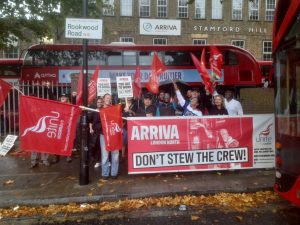
The beginnings of workers’ protest in these industries coincided with another emergent trend in British industrial relations: the formation and growth of new, independent unions. The Independent Workers’ Union of Great Britain (IWGB) had been founded in 2013, growing out of Latin American cleaners’ organising efforts in London and splits within Unite, the Industrial Workers of the World (IWW) and UNISON. Whereas early collective action amongst both Uber and Deliveroo workers initially emerged outside of unions, angry sections of each workforce eventually found themselves in the IWGB’s Private Hire Drivers branch and Couriers and Logistics Branch respectively.
The past decade has subsequently seen multiple waves of strike action, where workers strike in multiple locations simultaneously. Whilst some of those waves were deliberately coordinated by the IWGB and other organisations, others emerged with little to no planning as workers responded to workforce-wide issues, and others involved a mixture of both – with the IWGB developing a strategy of locating where workers were taking wildcat action and aiming to integrate them into coordinated campaigns.
Alongside strike action, a range of other tactics have been deployed to pressure platform firms. Drawing on the IWGB’s use of direct action, workers and their supporters have protested and occupied the offices of platform firms and their most lucrative clients. Worker-led legal action has seen major changes in the sector, ultimately resulting in Uber drivers being classified as “limb (b) workers” – a legal category which grants some basic employee rights but with the worker still being able to log in and out of work as they please. In response, platform firms have made continuous alterations to their working conditions, such as when Deliveroo ended their policy of mandatory uniforms for delivery workers as one means of proving that they were self-employed.

There have, however, been no end of obstacles to channeling workers’ anger into a sustainable, nationwide movement. Union initiatives aimed at organising platform workers have emerged and collapsed, including the IWW Couriers’ Network and the local groups built by the IWGB in multiple cities in England, Wales and Scotland – most of which had become defunct by the time the Covid-19 pandemic began to subside. As such, concerted efforts at platform worker unionisation tend to be highly focused in specific cities, particularly in London where the IWGB is headquartered. Elsewhere, platform workers may have some awareness that such initiatives exist, but may conceive of them as distant ventures with little relevance to their locality.
In 2020, the IWGB suffered an acrimonious split with the App Drivers and Couriers Union (ADCU) – which has since faced its own internal challenges. Shortly after, in 2021, the large, general union GMB signed a recognition agreement with Uber, blindsiding those who had been organising in the sector for years. A year later, in 2022, the same happened at Deliveroo, and then again in 2024 at Uber Eats. In each case, there is little evidence that GMB had many members working for any of these firms when they struck agreements. Deals were made behind closed doors, allowing GMB to claim that it is “the only union” representing platform workers in exchange for the firms claiming that they are union-friendly. GMB has grown its membership in each workforce following these deals, but there remains a widespread sense amongst workers that, beyond acting as another form of insurance, GMB is not the effective, combative union that workers need given the exploitation they experience.
Smaller initiatives regularly pop up, such as the UK Private Hire Drivers Union, made up primarily of Somali Uber drivers in London, and local non-union groups like the Oldham Private Hire Association. But these struggle to reach beyond the sections of the workforce in which they have built their base.
Building a workers’ movement in a relatively new and chaotic sector is no easy task. Disagreement is rife amongst workers, and – without established structures for collective decision-making – can be fatal. Whilst platform workers can all agree on the need for higher pay, issues like employment status, overhiring, gaming the apps, and taxi licensing regulations fragment the workforce and can severely disrupt efforts at collective action when aired in the open.
Given platforms’ heavy reliance on a racialised and migrant reserve army of labour, workers often cluster into ethno-lingiustic communities within the workforce, which act as sources of mutual aid. Those communities can be either conducive or adverse to collective action, and it takes work to carefully build coalitions between them. In Middlesbrough, for example, during the Stuart Delivery dispute of 2021-22, Romanian delivery workers took the lead in picketing, but struggled to build involvement beyond their cohort. In Hartlepool during the same dispute, collective action was severely undermined by the widespread sense amongst South Asian delivery workers that Romani workers were manipulating the apps to receive more orders. Organic leaders within such communities can be hostile to unionisation and difficult to win around, and the gendered nature of the work can foster cultures of competitive machismo.
And then, there is the issue of expectation. It is hard to exaggerate the speed at which platform workers experience their working days – broken into discrete tasks, aiming to accept as many of those as possible in order to maximise income. In the culture that this fosters, it is no surprise that workers develop demands for swift action and expectations of quick results. Short bouts of wildcat action can achieve this by temporarily pushing up bonuses, but bigger wins require concerted campaigns, which in turn demand patience. In the context of decades of overall trade union decline, workers may have little awareness of successful campaigns from which they can draw inspiration. As a result of these factors, the same sentiment arises again and again when discussing strike action with platform workers: “We’ve tried this before and it didn’t work. Why try again?”
Given such challenges, it is down to the hard work of militant workers, trade unionists and their socialist supporters that any antagonistic organisational forms exist in the platform sector at all. Nonetheless, ten years since the first known strike amongst platform workers in Britain, this remains a movement struggling to be born.
The years ahead
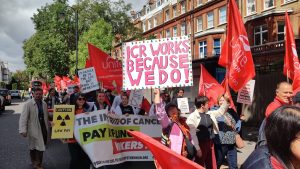
The most recent private hire drivers strike on May Day gave us a glimpse of what a coordinated platform workers’ movement could look like. In a gesture of goodwill, both the GMB and ADCU were invited by the IWGB to call their members out on strike. GMB ignored this, but, under pressure from their rank-and-file, the ADCU participated and brought their members to the May Day march in London. The trouble is that we have seen no shortage of glimpses like this before. Getting to a point where there are sustainable, far-reaching organisational structures, decision-making processes and accountable platform worker leadership still requires a great deal of work.

Yes, this is the same challenge facing the left more broadly – that of capacity. In calling on socialists to help build a workers’ movement, the IWGB is calling on those who are already often stretched thin, committed to no shortage of struggles such as the fights for Palestinian liberation, against transphobia and the Labour Party’s new push for austerity – to name just a few of the most urgent – and divided into our own bubbles.
But this is also a question of strategy. The frequent strike action in the platform sector must be explicitly understood as an opportunity to begin building long-lasting, structured campaigns, rather than as ends in themselves. Leading worker militants in different areas have to be integrated into those campaigns. Turnover is a challenge, but workers often stay in the sector for years – in some cases, for longer than many workers stay in traditional jobs. Those long-standing workers can often be found leading action – as they recall times when pay and conditions used to be better – but they can also be the hardest to convince that workers can ever be sufficiently united to put up a concerted fight. The coming years are likely to see the consolidation of the platform sector. Capitalists continue to hoard vast amounts of wealth and may continue to both prop up existing ventures and drive the platformisation of other industries. The challenge for workers – and for their supporters on the organised left – is to also ensure the consolidation of a new labour movement, well-organised and militant enough to win workers’ demands for control of the wealth that they create.




0 comments