
Interview | Party of the Radical Left
Lachie A •Lachie A interviews a member of the PRL on the next steps after the Student List’s victory and the attempts to build an organised left in the country
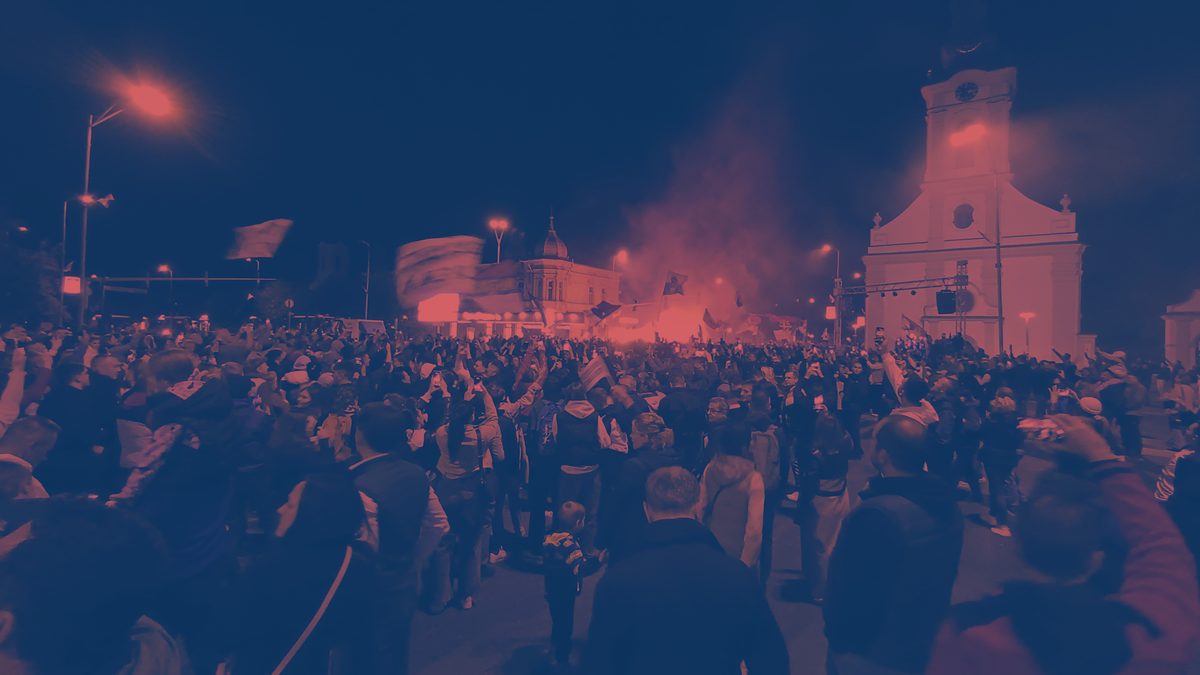
I met Marko Crnobrnja — The Party of the Radical Left’s International Secretary — at a protest outside the Ministry of Justice on a Friday evening, ten days after a slate of candidates backed by the Serbian student movement (‘The Student List’) won the national election.
The demonstration was organised by the anti-eviction organisation Roof Over Head (‘ZA krov nad glavom’). Marko introduced me to his comrades as well as a woman who (he tells me later) had bought a house — only to find out that it had actually been sold to someone else too when bailiffs arrived at her door to force her out. This is not uncommon in the country, and the organisation has defended many people in these kinds of situations.
In the early 90s, the social housing stock in Serbia that was developed under the former Socialist Republic was made available to tenants to purchase (like Thatcher’s ‘Right To Buy’) to fund the war in the region. Most who could took the opportunity, and the rest had to struggle over the following decades in an aggressive and exploitative privatised housing market, often taking on loans from crooked foreign companies in the process.
Today, the vast majority of people in the country own their own homes (over 90 per cent). However, many are also poor and indebted, with their homes used as collateral in exchange for credit.
In 2011, a new law drafted by a group of unelected ‘experts’ and The United States Agency for International Development (USAID) introduced the use of private bailiffs to collect debts, citing the use of public court bailiffs as ‘inefficient’. The obvious and disastrous consequence has been traumatic evictions inflicted on the working class. Not only do private bailiff companies expropriate housing and resell it well below market rate but they charge tenants eye-watering amounts of money for their ‘services’ (sending letters, bailiff visits, processing paperwork, etc.). This law is merely a single part of a legal architecture shaped by USAID that essentially outsourced public authority to private entrepreneurs and further eroded the nation’s sovereignty.
The 300 or so people assembled outside the Ministry of Justice — no doubt using the momentum of the recent election — delivered and listened to powerful speeches and, at the end, ceremoniously pinned a document to the doors of the office. This document was a restatement of the manifesto of the Student List, which, crucially, included a pledge to bring private bailiffs back under court control.
After the protest, I joined activists at a community centre owned by an individual supportive to the organisation (‘We don’t have as many community spaces as you do in Britain’, Marko mentions in passing). We found a quiet room and sat down to chat.
Could you tell me the Party’s perspective on the recent election results?
From our perspective, it’s a great victory for grassroots organising. Yes, the movement was very heterogeneous, and we would not call it ‘radical left’; however, nation-wide street-level mobilisation motivated people to come together and organise.
During the campaign, we supported the Student List conditionally. There are many influences inside the movement which we do not approve of, and of course, we know there are many ways in which any new government will be constrained by the nature of the state in Serbia. This movement is not a radical break with the previous regime; in a way it is a continuation of what has been going on in Serbia for the last 26 years.
However, we do feel that the promises that were made during the election were ones the new Government to be held accountable on, such as social issues, an embargo on arms exports to Ukraine and Israel, and the abolition of the bailiff system as it is.
On this last point, this is something we have been struggling over for the last eight years, even before the Party was formed. So this is a core issue for us, and we are hoping that we can put enough pressure on the next government to actually abolish the bailiff system as it is now.
Overall, we are cautiously optimistic about the outcome and the prospects of the next Government.
How has the Party of the Radical Left been intervening in and around the student movement to try to push your demands?
What I think we did right with the movement is that we did not try to intervene in the way that many other groups and organisations did. We respected the integrity of the movement, the student committees, the neighbourhood committees, and so on.
At the start, many leftists reacted, saying that the movement was astro-turfed by the NGOs and the opposition media, and distanced themselves from it. Others thought that it could be a revolutionary movement, saying that it just needed the correct political articulation and it could make a revolution, or whatever.
We were more realistic because we stuck to the facts. We did our research, investigated, and saw what could and couldn’t be done. We went to the committees, and we presented our politics, and recognised that not everyone was on board with what we were standing for; but we also saw that there were some people who might listen to what we had to say.
We did not try to criticise harshly, nor try to inscribe some of our hopes into the movement. We tried to analyse it for what it is: a grassroots movement, which broadly reflects the opinions of the society as a whole.
We respected their integrity in how they tried to assert their independence from existing forms of NGO organising, opposition parties, media, and so on (we believe this was a key factor in their election win). However, it was important for us to criticise the forces attempting to intervene, corrupt, co-opt and turn the process towards pro-NATO and pro-EU liberalism.
We basically kept an open mind. We were not prejudiced; we were not trying to get our hopes up; we were not expecting a new messiah to come from this; we were not tailing the movement, and we were not leading it either; but we were following what was going on. We tried to go along with the movement when it was going in the direction that we wanted, and when it wasn’t, we stuck to our own path. Essentially, we maintained our political integrity and respected the integrity of the movement.
We think that our approach gained a lot of respect from people in and around the movement. They saw that we respected what they were doing and did not try to subvert it for our own ends.
Also, our party got a lot of public attention during the campaign, because we were scapegoated by both the Government and the opposition as the secret power behind the movement. They called us radical leftists, Bolsheviks, anarchists, whatever and blamed everything on us. For example, the opposition said that we were pushing the students away from them.
It did get some attention, and many people were starting to tune in to what we were saying. They saw that our analysis and predictions were correct, because we spoke truthfully about what was going on in the student committees. That was a very good thing for us, and we have a lot of people coming in just thanks to that.
Now that the election has happened, what do the next few weeks, months, years look like for your organisation?
The situation is such that it’s bound to be the case that there will be many disappointed people soon, because many people put all their hopes into this new Government. I think it’s caused by the movement’s belief that everything will now radically change — which we don’t think is true.
We will try to go along with the people who were involved in this journey, and not try to judge them or call them fools for believing in such a thing, for getting hopeful. We will also not reject people who did not go along with the movement; we understand that many people had their own fears about what would happen after the elections; many people were afraid of change.
After this, we believe that the movement will probably splinter since there are contradictory tendencies within the Student List. To add to that, we expect a lot of instability in the coming years, both here and globally.
So, we will try to build something from the many people who got radicalised through this process.
We have a big congress coming up. As always, we’re trying to build our cadres, strengthen our capabilities, and develop our political line.
What are the key questions that you’re going to be discussing at your upcoming congress?
We are changing our programme. The way that we created the organisation in 2020 was a bit of a compromise between a few groups which were more inclined towards a coalition with the Green Party and joining the liberal opposition as kind of a ‘red add-on’.
So our current programme is democratic socialist. The new programme will be more authentic. We’re not stuck between two opposition factions trying to work for something, but we can create a programme which really fits our current worldview and outlook.
Could you describe the ecology of left organisations in Serbia?
Since the fall of socialism, Serbia hasn’t had a real, organised left.
What was the ruling party during socialism — the League of Communists of Serbia — was transformed into the Socialist Party of Serbia, which took on a pro-capitalist, pro-nationalist position during the 90s and especially after 2000. So all the organisations had to be redeveloped after this point.
Now, the trade unions are not very militant, and the social movements are not very developed. There are a few small groups and tendencies.
However, our housing movement is promising. We came out of the movement against industrialisation and privatisation in the 2000s and 2010s, when workers were defending their own enterprises. Many workers, who got their own stocks and tried to elect their own management, tried to defend against the state selling their enterprise to some criminal and tearing the factory down and turning it into real estate.
The Party of the Radical Left is pretty young. It is mostly made up of activists who joined the housing struggle. It doesn’t have a mass character right now — it’s mostly made up of younger activists who are trying to bring in more people who are engaged in the modern-day workers’ struggle.
We try to look back at our own revolutionary history, our own anti-colonial history, our national progressive tradition, and build a party which would express that.
What is the most significant lesson you have learned about how to organise from this experience?
Don’t be afraid to be in the minority. At the beginning, we were usually in the minority in committees and occupations and were often outvoted, like other activists.
However, since we were established in our analysis and the positions we took, people grew closer to our camp, recognising that we were right.
So I’d encourage you to be patient, fair, and truthful. Even if people aren’t hearing what you have to say at first, persist with them, and they will come to you when they understand their class interests more deeply.




0 comments