
Liberation or amelioration? Critical reflections on organising for Palestine in Edinburgh – Part 1
AM •What can we learn from the intensive organising around Palestine over the last three years. In the first of a series of three articles AM provides some critical reflections from their personal experience organising in the movement in Edinburgh.
More than three years have passed since Operation Al-Aqsa Flood and the beginning of Israel’s genocidal response. The resistance operation on October 7, 2023 recentred Palestinian liberation as the spearhead of emancipatory and anti-imperialist politics internationally, galvanising and mobilising millions across the world. Despite a big shift in popular global opinion on the question of Palestine, the solidarity movements which (re)emerged have failed to halt the genocide or weaken imperialist state power domestically and internationally. The genocide and siege of Gaza continue, the annexation of the West Bank is accelerating, Southern Lebanon is facing ecocide, ethnic cleansing, and a sustained occupation facilitated by a collaborationist Lebanese government, and Southern Syria has been occupied on the pretext of defending religious minorities. All this is being directly supported by the governments of the imperial core, specifically the UK and the USA.
This is the first in a series of three articles that takes a critical look at Palestine solidarity in Edinburgh. Instead of looking at individual organisations, the series is written around the most prominent forms of action taken by the movement as a whole. This method reflects the fact that the liberatory political ecosystem in Edinburgh is small with great overlap between actors and/or similarities in the repertoires of contention and strategies (or lack thereof) utilised. The result of this thematic analysis is the series does not completely reflect the diversity of activity in Edinburgh.
The central contention is that the movement for Palestinian liberation in Edinburgh has taken an ameliorative and not emancipatory character. This has left the movement weak and unsustainable. Far from being defeatist, the piece is written from a position of self-critique and aims to highlight weaknesses that must be addressed if we, in our respective organisations, are to play an active role in Palestinian liberation by confronting the UK ruling class. While specific to Edinburgh, the reflections found within might resonate with Palestine solidarity movements elsewhere.
This first article of the series highlights the weakness of the mass protest movement. This includes the failure to build a coalition and transform mobilisation into more sustained forms of engagement. The second article critiques the practice of “direct aid” and fundraising for displaced Palestinian families which has de-politicised the movement. It also reflects on attempts to build a mass response to the arms industry. The third article assesses the individualistic cultural dynamics underpinning the movement before drawing some conclusions and lessons learned.
The protest movement
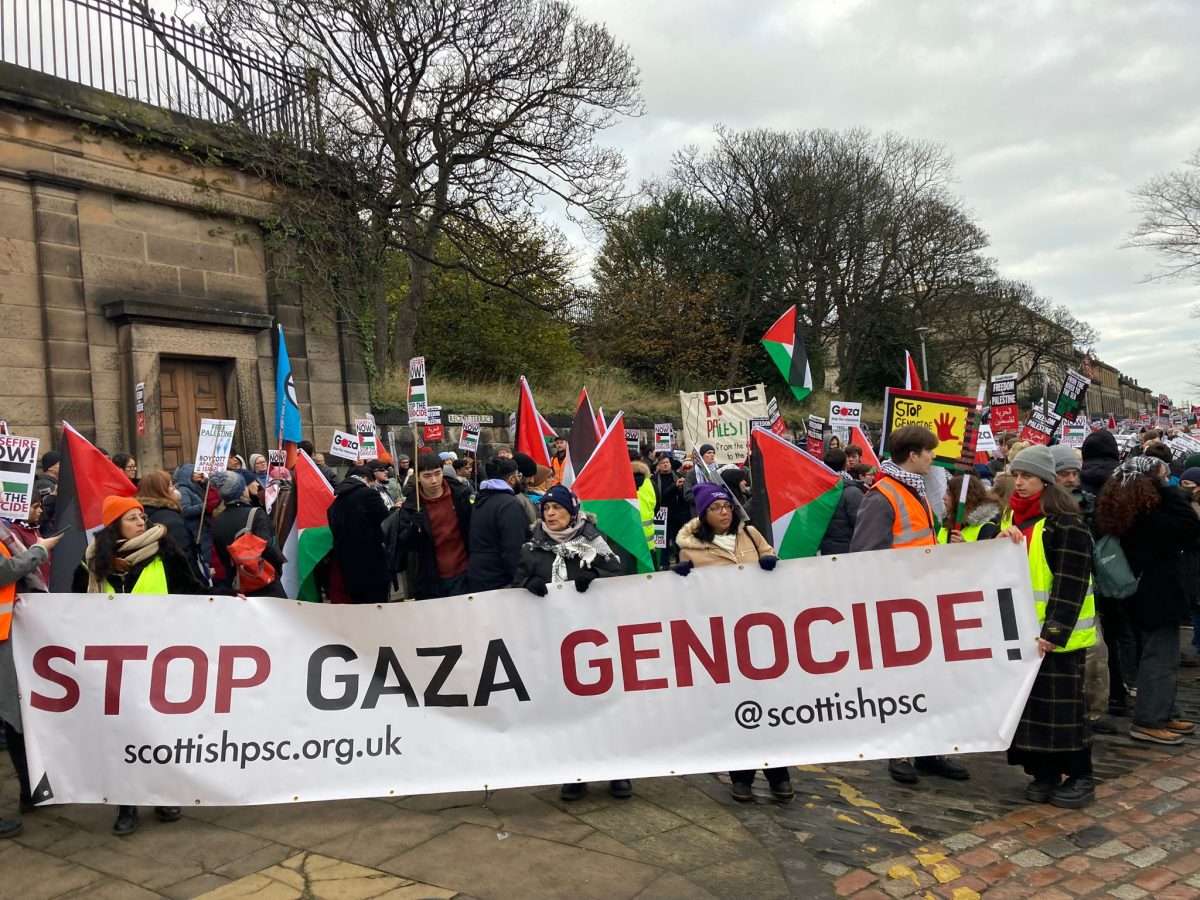
The central feature of the Palestine solidarity movement in Edinburgh has been mass protests. Soon after October 7, 2023, weekly protests began to be organised in central Edinburgh to oppose Israel’s genocidal response. These efforts were spearheaded by the Scottish Palestine Solidarity Campaign (SPSC) who have been mobilised on the issue of Palestinian liberation since September 2000. Their long-standing commitment to the cause meant they had access to resources, labour power, and experience allowing them to mobilise quickly and effectively.
To ensure the sustainability of the movement, the SPSC sought to build a coalition with other groups and organisations under the banner of the Edinburgh Gaza Genocide Emergency Committee (EGGEC). By March 2024, around 20 organisations had joined the coalition, each represented by two delegates to help plan protests, carry out logistical tasks, mobilise volunteers and make group decisions. EGGEC also collaborated with their Glasgow counterpart holding national demonstrations which saw thousands attend. The Scottish national protest settled into a pattern of alternating on a monthly basis between Edinburgh and Glasgow.
In the early days of the movement, mass protests were well attended and had a militant tenor. Mass protests would pass through or occupy infrastructure points such as Waverley train station, confront businesses on the Boycott, Divestment, and Sanctions list, and were generally carried out without coordinating with the council or police making their unpredictability disruptive by nature. It’s worth noting that in addition to these mass protests, a plethora of smaller protests were consistently being organised across Edinburgh.
The movement’s first test
A wave of police repression washed over the movement shortly after the coalition’s establishment. As early as April, organisers were being arrested and charged, some at the end of marches under the guise of organising illegal protests and others in their own homes. While these charges did not stick, they succeeded in creating a rupture within the coalition on how to respond.
Some groups argued that the arrests required escalation and confrontation to force the state to back down. For them, this was the first real test of the movement’s longevity and the response to this repression would set the tone of the movement. Will it be militant or collaborationist? For others, these arrests were unnecessary risks, and the debate was a distraction from what needed to be done, ensure that protests continued without disruptions from the state. Edinburgh Council was already waiving the 28 days it usually required for planned marches in the instances that they were informed, so why not work with a Council that has shown its willingness to accommodate the movement?
Eventually, and under threat of some of the organisations leaving the coalition, the collaborationist position won out. As expected by those opposed to working with the council and the state, the 28-day requirement was slowly introduced and increased state intervention followed resulting in certain march routes being rejected or altered in ways that make them less disruptive. While protest arrests ceased, so did the militant tenor of the protests. Instead of individuals being arrested, the movement as a whole was now handcuffed into performativity.
Repression presented a perfect opportunity to widen political participation among attendees and draw them closer to the struggle. This could have been done by centring repression at the protests that followed and involving protesters themselves in the decision of collaboration vs. militancy through meetings or even by transforming a protest into an assembly. Instead, a top-down approach of decision making was taken, reproducing power dynamics which treated protesters as nothing more than pawns of the movement to be mobilised as and when the coalition desired. As part two illustrates, this tendency wasn’t confined to the protest movement alone.
By choosing collaboration, the movement failed to transform protests and their attendees into a cutting edge, but the coalition was also marred by other weaknesses. Decision making processes were blurry and unity of action was not guaranteed. It was also unclear if decisions were binding on coalition members or if they maintained independence. For example, a constant point of tension was found around the national demonstrations alternating between the two major cities. Groups were split on the question of whether mobilisation should be focused on getting the largest number of people to one location, or if protests should cover the largest number of cities possible. When national demonstrations were called in Glasgow, some organisations continued to call for local demonstrations which was viewed as ‘splitting the movement’ by others. Attempts to formalise procedural issues such as these were largely sidestepped and organisations continued to act individually or simply stopped showing up.
Coalition of whom?
There were also structural issues with the coalition itself. Most of the groups represented on EGGEC were small and had little access to resources or the ability to mobilise others. In some instances, the two delegates attending the meeting were the entire ‘organisation’ they were supposedly representing. This had several implications; pre-existing resources were concentrated in the hands of one organisation giving it overwhelming leverage. Attempts to fundraise for the coalition as its own entity required the participation of organisations with established infrastructure such as bank accounts, reproducing the problem. On the other hand, organisations with little to contribute to the movement had equal say on decisions even if it would end up being others implementing them. This resulted in a lack of trust and coordination. Today, only a handful of the 20 organisations remain in EGGEC.
The above raises important questions on the viability of coalition building. First, is it possible or even necessary to attempt building a coalition with groups that themselves barely function? Coalition building makes sense in a situation where the coming together of various groups creates a multiplier effect. However, the concentration of resources and experience began and remains in the hands of more organised groups. So what did the coalition advance other than the image of unity? Is that image even important? For a public unaware of the component parts of the coalition, EGGEC appears as its own organisation. Second, despite internal divisions, the coalition could have become a platform for discussion, mitigating potential friction between groups. However, EGGEC largely confined itself to planning mass protests instead of trying to formulate a coherent strategy for the city. Discussion of a political nature was limited to shutting out organisations which have shown inconsistent stances towards Zionism such as the Socialist Worker Party and their front groups. As such, these discussions were negative in nature related to other organisations’ positions on Zionism. Outside of this, EGGEC sought to build the broadest possible coalition which necessitated ignoring methodological differences. Could a coalition built on a clearer structure and political direction been more successful?
Protest as tactic
Another point worth addressing is criticism directed at the mass protest movement for not directly confronting state complicity. This criticism misunderstands the objective of protests, which serve as platforms for mass political education, networking, and morale. To this effect, protests have been mostly successful although it’s worth noting that they have remained small when compared to the anti-war protest movement in 2003 contemporary protests in London (even after adjusting for population differences) and even some Edinburgh mobilisations for Gaza in the 2010s. Nevertheless, they have displayed great resilience over several years.
Where the protest movement, and more particularly EGGEC, has failed, is in confining itself solely to the task of organising and promoting protests instead of becoming a staging ground for sustained campaigns across the whole of Edinburgh. This could have included something as simple as liaising with other protest groups to launch marches from different neighbourhoods to a central location or setting up coordinating units within different neighbourhoods encouraging protest attendees to take the protest back with them into their communities and workplaces.
The weakness of EGGEC’s constituent parts and a lack of clear political vision of the coalition foreclosed growth in this direction. Nevertheless, protests remained recruitment grounds for other parts of the solidarity movement including attempts to confront the arms industry in Edinburgh. This is discussed in part two.



0 comments