
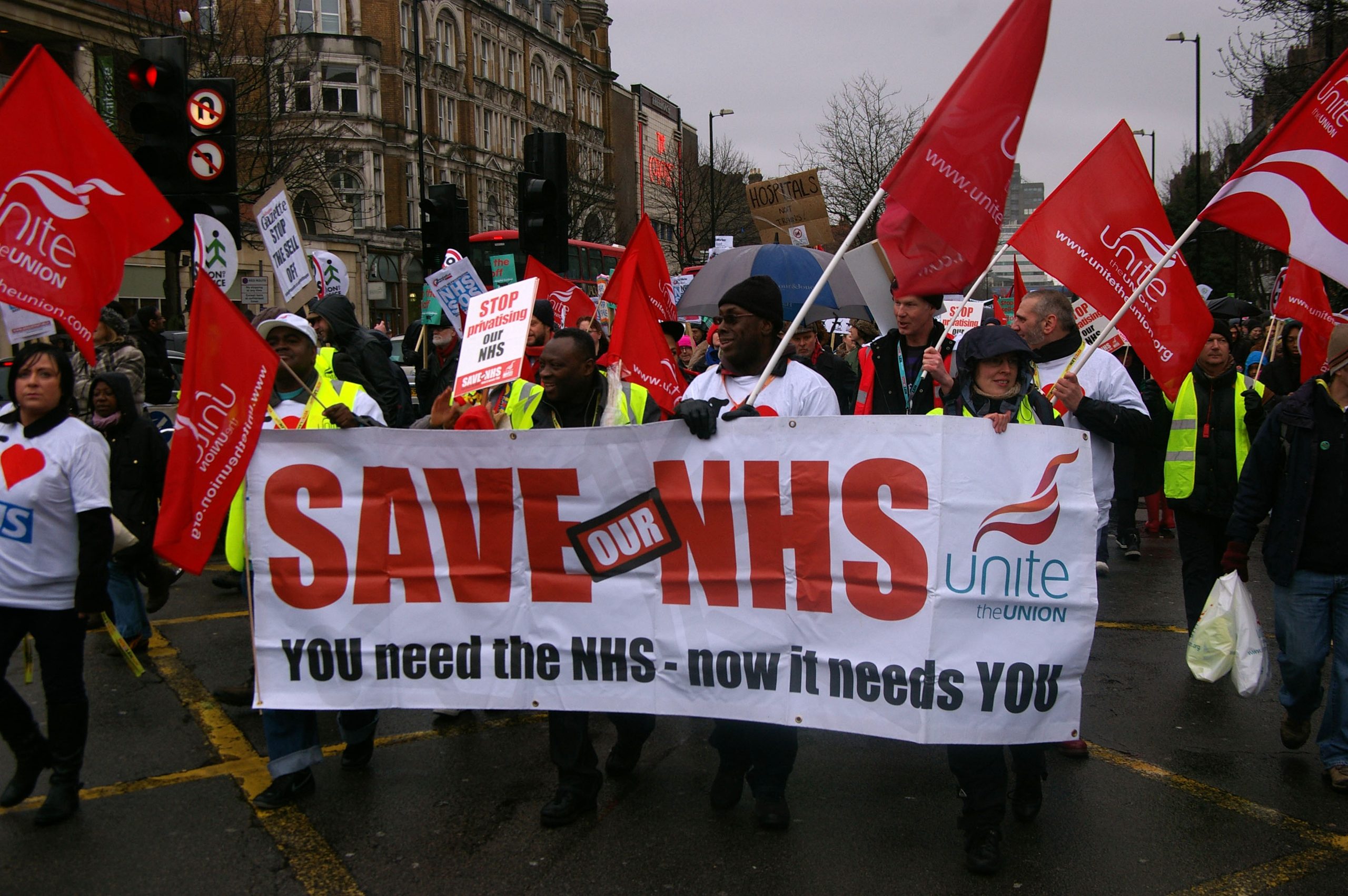
Fighting the ELFT job cuts: A view from the frontline
Jane R •A worker at East London Foundation Trust and a Unite rep, Jane R gives an overview of the fightback against job cuts in the health system.
As a recently new Unite member and rep in East London NHS foundation trust, I have become part of the campaign to fight against East London NHS Foundation Trust (ELFT) proposed cuts to make £24.9 million efficiency savings, equating to 331 Whole Time Equivalent (WTE) posts. Alongside our campaign against the proposed cuts, we are also campaigning for the reinstatement of Unite branch secretary Mark Dunne after he was made redundant from his substantive clinical role in the Finance Department. The trust have labelled these ‘cuts’ under service redesign as part of the ‘Going further, Going together’ financial sustainability initiative, and have been reducing headcounts in piecemeal type methods. Staff cuts are being made across all boroughs, Tower Hamlets, Hackney, Newham and Luton and Bedfordshire. Labelling these ‘cuts’ as ‘service redesign’ allows the trust to avoid the consultation process, avoiding backlash from union bodies. ELFT have previously faced heavy criticism due to their lack of formal public, staff, or political consultations from sites such as The Lowdown.
Origin of financial pressures
North East London Integrated Care Board (ICB) is responsible for planning, funding, and managing local health services across eight London boroughs, including Barking and Dagenham, City of London, Hackney, Havering, Newham, Redbridge, Tower Hamlets, and Waltham Forest. ELFT are being asked to make these cuts to reduce deficits across the London region, stating that:
NHS North East London (NEL ICB) is managing significant financial deficits through a dedicated recovery plan, focusing on cost improvement programs, shifting care to the community, and strengthening financial controls.
The justification for this has come from a significant deficit in recent years, as can be seen in the table below.
| Financial Year | Reported Surplus/(Deficit) for Year | Adjusted Financial Performance* |
| 2020/21 | £3.692m surplus | £4.325m surplus |
| 2021/22 | £2.759m deficit | £0.155m deficit |
| 2022/23 | £4.741m deficit | £0.876m surplus |
| 2023/24 | £12.124m deficit | £5.758m deficit |
| 2024/25 | £15.131m deficit | £12.689m deficit |
The numbers above reflected a wider trend in the NHS during the pandemic years. According to a report on NHS funding by The King’s Trust:
Trusts were briefly in surplus during the pandemic, due, in part, to additional Covid-19 funding and new financial management arrangements that were put in place to help the NHS deal with the pandemic. However, in 2024/25, NHS trusts were, overall, in deficit by £0.78 billion.
The evidence for cuts might seem overwhelming, from the perspective of economists and politicians. But it doesn’t reflect the reality: the £24.9 million figure for East London NHS Foundation Trust (ELFT) is a target for financial savings and budget cuts, rather than actual financial deficit. The trust is currently in a good financial position with over £150 million in reserve!
The facts are this: ELFT has maintained a balanced budget without central deficit support.
The debt ELFT experienced in 22/24 was largely due to the withdrawal of covid funding along with managing increased demand on mental health services, rise of inflation, cost of services and resources. Despite this, ELFT reduced the deficit through making cuts, service redesign, including vacancy freeze. As of 25/26 ELFT as a trust are in a ‘healthy’ financial position, no longer in deficit and not requiring further intervention from central support. ELFT has a financial reserve of £150 million. Despite this, they continue to aim to make efficiency savings of £24.9 million,, which includes cutting a further 331 jobs, on top of reported £70 million over the last two years. Despite increased demand for MH services, ELFT continues to make efficiency savings in line with national targets, involving plans to reduce head count numbers in adult mental health, CAMHS, where current waiting lists are a year plus. These financial pressures are coming from NHS England through London’s integrated care systems.
At the level of executive management, the plan is that:
NHS North East London Integrated Care Board (NEL ICB) is targeting efficiency savings through a 50% reduction in running costs, a £42m transformation fund for community and preventative care, and an ongoing governance and structural review.
But an article by Denis Campbell in the Guardian earlier this month stated that such cuts:
will involve the “redesign” of at least 10 key services such as child and adolescent mental health care, talking therapies, addiction support, help for adults undergoing a mental health crisis and community programmes, including for ethnic minorities and poor people.
Staff are at risk of being stretched, under resourced with demand ever increasing, When unemployment is high, more likely reduction of quality of living standards, mental health is likely to and is being impacted. We know from the above data that reduced staffing levels lead to increased safety risks for patients. Shortage of beds mean patients aren’t admitted due to lack of beds, meaning they could be waiting at home unsafe as a suicide risk. This was the case of Martin Bryant in 2026 and Sapphire Bernard in 2023, who both took their own lives whilst waiting for a bed to be made available.
These cuts are on top of the recent £70 million pound cuts as part of the ‘Going forward together’ cost saving program.
Next Steps
ELFT union reps and members continue to meet weekly to discuss progress and next steps, including arranging walkabouts to ELFT sites, Mile end, Newham and Hackney. As a Union we plan to continue campaigning against the cuts, reinstatement of Mark Dunne who was made redundant from the 31st July. We have now formed a strike committee to discuss next steps forward, a strike ballot, then depending on the outcome of the ballot will move to strike action. We recently had some lunchtime demos at both Mile end and Newham sites. At our Mile end site, we had Ted Reese, author of ‘Socialism or extinction’ and ‘Abundant wealth for all’ talk in support of the work we are doing. Our next demo is on Wednesday 9th September at 8am at Alie Street.

0 comments