
A New Era in UNISON?
rs21 unison member •An rs21 Unison member reports back on the recent Unison conference.
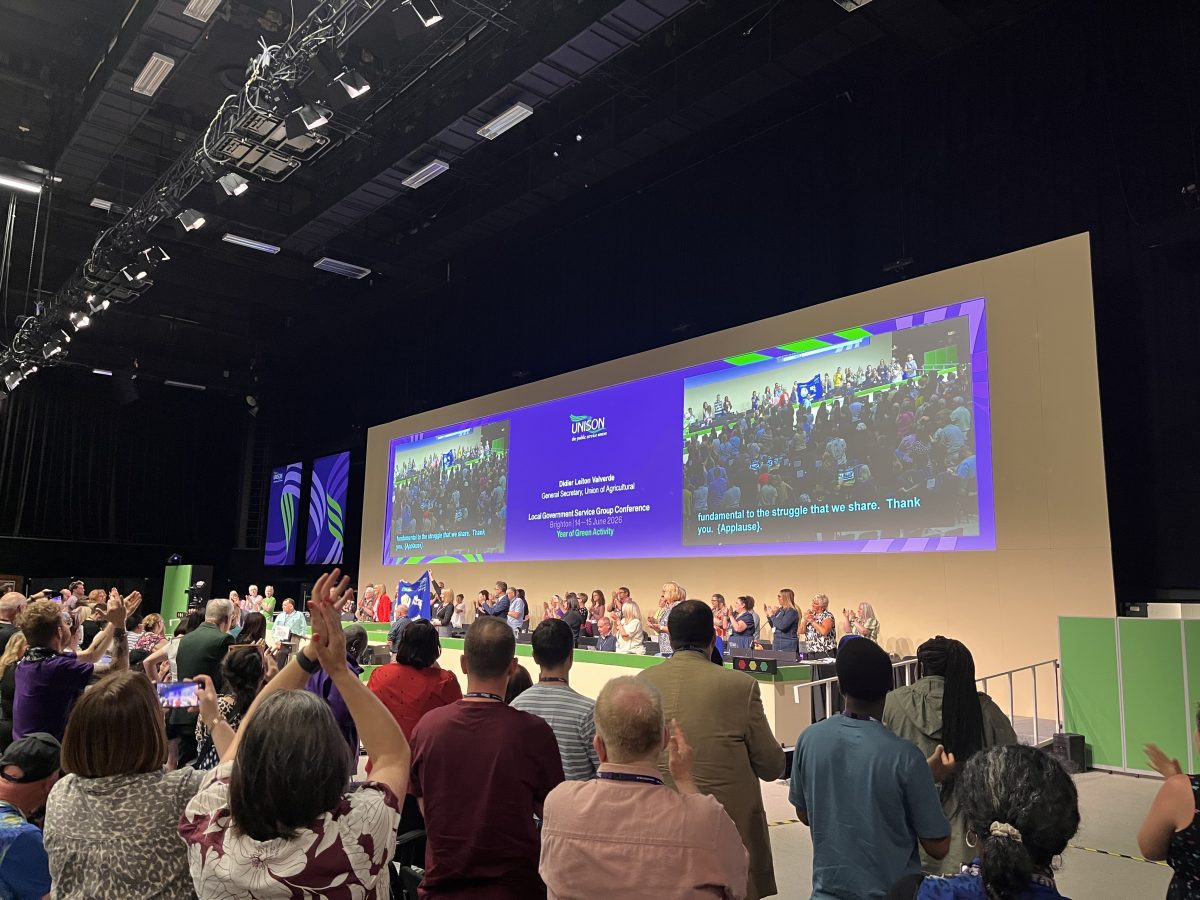
On the second day of UNISON’s 2026 National Delegate Conference the first leader from outside the salaried machine of the UK’s largest trade union addressed thousands of delegates in Brighton. Earlier this year Andrea Egan won UNISON’s General Secretary election. She defeated incumbent Christina McAnea, the continuity candidate of UNISON’s right-wing and permanent bureaucracy whose primary concern remains upholding the status quo, neutering industrial militancy in favour of partnership with employers and placing good relationships with the Labour Party in the political driving seat. Egan distinguished herself in the campaign with a manifesto written in partial collaboration with her supporters in the Time for Real Change (TfRC) faction. The demands in that manifesto and in the figure of Egan, a Bolton social worker and branch secretary, cohered the reform project in the union. They served to unite UNISON’s broad left and the far-left groups who organise in the union – importantly including the Socialist Party who previously preferred to run its own candidates.
There were several themes in the manifesto. The first of these was to drive forward an organising agenda started during Egan’s 2022 term as UNISON President, building on significant campaign victories amongst low-paid NHS staff with a McAlevey-inspired approach to trade union organising, placing servicing in the background where it belongs. Secondly, Egan promised a degree of independence from Labour. Related to this was the commitment to uncompromising support of migrants, LGBT+ (particularly trans) workers and strong positions on international solidarity. Thirdly was a commitment to democratise the union, ensuring conference decisions are actually carried out unobstructed. This was rounded off by a commitment (the one which anecdotally cut through most) to remain on a social worker’s salary rather than the £181k of her opponent.
Egan’s speech would not have surprised anyone who had followed the campaign – she essentially reaffirmed in no uncertain terms her manifesto commitments. What was striking was the forthrightness with which Egan spoke. She talked in openly antagonistic language towards the government on issues such as the draconian changes to Indefinite Leave to Remain status, committing to making the union ‘a thorn in the side’ of Labour. Egan argued that the prominence of migrants in UNISON’s membership and organising (primarily low-paid health and social care workers) necessarily put ‘our union at the front of the struggle against racism in our country’. On the attacks against trans people that have heated up again following the updated Equality and Human Rights Commission (EHRC) guidance, Egan stated that discrimination was not an ‘add on’ to the workplace agenda but front and centre. Industrially, Egan stated her desire to learn from previous failures to reach legal ballot turnout thresholds, with upcoming ballots of local government workers as the big national test for the organising agenda. She summarised the project like so:
… it is up to us to turn UNISON into an industrial force to be reckoned with… And just think what that will mean if we do. The power to take what is ours, not waiting around to be handed it. Real force behind our demands, no longer just empty asks, and a deep pride to be part of UNISON, to be part of a historic project.
These are big words of a kind we don’t hear often from the leaders of the contemporary workers’ movement.
Challenges
What to make of all this? Egan was elected as General Secretary on a reform agenda and has only been in office for around 100 days. Even the most embattled leader should be able to maintain manifesto commitments in their first address to conference. The common thread that ran through her address, and what was most encouraging about it, was that she took the first steps towards articulating a political independence for the union built on renewed industrial strength. But before we get too excited we should sound a note of caution. Egan’s strong rhetorical positioning against Labour subservience was softened by its framing that heeding our demands would be ‘for their [Labour’s] own good. Acting in our interest is in their interest.’ True enough, but this does bring into question what will happen to UNISON’s baby-steps towards political independence if presented with a more reforming Labour government. The open question is how far Labour would have to tack left before Egan, her team and TfRC’s (minority, at least for now) National Executive Council (NEC) see it as ‘good enough’ to throw their weight behind the government. Egan has made positive noises in the direction of soon-to-be-coronated Andy Burnham, and it is a lot easier to be critical of a discredited figure such as Starmer than someone who many see as the only thing standing between the country and Nigel Farage. Even in the short-term, the Labour party isn’t going to give into demands from unions against employers and the state on big reforms like a mooted second Employment Rights Bill for free, so the pressure on Egan to compromise the union’s independence in return for legislative reform will be great.
None of this has to provoke doom and gloom though. The very fact it is an open question is positive. Egan coming to address the faithful at the TfRC fringe rally is an encouraging sign she recognises the potential risks of being isolated at the top. Egan alluded to the fact that she took some heat for addressing the faction meeting, still despised by UNISON’s right as a bunch of trots, loony lefties and divisive malcontents. At that meeting the call was clear from Egan: ‘you put me here, so don’t leave me here.’ The repeated message was that rank-and-file activists and sympathetic lay officers need to bring the reform agenda back to branches. This open criticism towards internal obstacles was also included in Egan’s speech to conference, stating that ‘change won’t come easy in UNISON. Not everyone wants to see the changes we need as fast as we need it’, which is another positive sign when the union’s right generally circle the wagons in response to criticism of staff.
Egan’s speech was a statement of intent, but there are several obstacles ahead. One is the bureaucracy-aligned Member’s Together faction which controls the union’s NEC. They are supported by the ‘Organised Left’ faction which, while containing several excellent workplace organisers, serves to prop up the union’s right (presumably to keep in the good graces of union officials while turning their noses up at anything that smells vaguely of ‘leftism’). TfRC’s focus has now turned to winning back the NEC majority it lost last year. The left has never held both an NEC majority and the General Secretary position together, and one can obstruct the other. An uncooperative NEC can simply not deliver on motions passed by conference, or can implement decisions so half-heartedly it barely counts as implementing them at all. The GS can use bureaucratic processes to obstruct the NEC or remove key members. Both need to be pulling in the same direction to move forward the reform project at any pace and scale.
There also remains a large contingent of national and regional bureaucrats, both elected and paid, who are extremely possessive of their fiefdoms. Branches often run into difficulties with delays and obstruction to moving forward with industrial action, with the blockage usually coming from this layer rather than the NEC’s Industrial Action Committee which ultimately has responsibility for approving ballots, action and strike pay. These structures are hard for the rank and file to control, because they are elected through multiple layers of the structure which tend to be filled by people with lots of facility time (time off work for union duties and activities), who form a ‘lay bureaucracy’. Workplace militants are understandably reluctant to give up lots of time to contest these positions in Byzantine and opaque layers of bureaucracy, so lay bureaucrats can occupy positions uncontested for years. Egan has begun well in using her position as a public figure to push the union’s more independent line in the media, but the GS also acts as the most senior manager in the union’s bureaucracy. Difficult challenges could arise here. She was complementary of new staff appointments such as the Director of Organising, but if a strategy exists for tackling any remaining staff obstruction, it has not been articulated publicly.
Same Old UNISON?
While Egan’s address was possibly the most notable part of this year’s conference agenda there were four days full of other business, and in many ways this was business as usual. UNISON’s Standing Orders Committee (SOC), who control what gets on the agenda for conference, is notorious for barring contentious motions on grounds that they put the union into legal jeopardy. When asked what these legal risks entail, the SOC cite client privilege and refuse to answer.
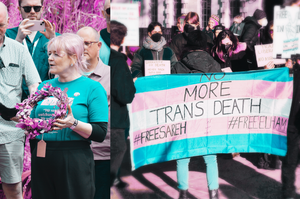
The primary drama this year was a Lambeth motion on trans rights which was ruled out by SOC and not printed. After gamely but unsuccessfully challenging SOC from the floor, Lambeth delegates took it upon themselves to print and distribute the motion outside of conference and were summarily ejected the next morning. This was clearly an overreach by a President and SOC who felt their authority had been undermined. The major outcome of Lambeth’s ejection was that they could no longer move their amendment (28.7) which would have committed to the union producing anti-Reform UK material in languages other than English and Welsh. Given the prominence of migrant-worker organising in the union, this was a huge disappointment, and shows the right’s overriding commitment to maintaining their authority. It’s likely that the Lambeth episode was a Pyrrhic victory for the right though – it’s doubtful that they won over any neutrals in their approach.
Nor would they have won many over in their approach to victimised union reps Tom Barker and Ameen Hadi. The president cut the mics of delegates calling for more robust support from the union against victimisation, preventing them from even saying the names of these reps in solidarity, again citing the legal risks involved that could potentially jeopardise ‘live cases’. This was confusing given that Barker (who sits on the executive of the Local Government Service Group) received a standing ovation for his organising at the UNISON Local Government conference which took place the day before NDC and several motions against victimisation were strongly supported. Motion 4.1 commits the union to both placing victimisation within an organising framework and to campaigning for victimised reps at the national level. Both of these give activists good backing to mobilise support within branches if these cases continue to proliferate – likely if the union makes good on its word to turn towards an organising strategy.
Political and industrial problems don’t just lie in UNISON’s bureaucracy. At Local Government Conference, delegates debated Motion 7, innocuously titled ‘A Wales School Support Staff Negotiating Body’, referring to the move towards a specific bargaining unit for School Support Staff, who are currently included in local authority bargaining by UNISON, GMB and Unite, despite few schools still being local authority controlled. The motion had very little to say about the School Support Staff Negotiating Body (SSSNB) however, and served as an attack on the National Education Union (NEU) for recruiting (largely non-unionised) school support staff. GMB, Unite and UNISON have been getting very agitated lately at the NEU’s success in recruiting these staff and have repeatedly complained to the TUC who have now fined the NEU twice. The complaints even defined balloting existing members for strike action as unacceptable organising activity. The motion now makes it UNISON policy to ‘robustly challenge’ the NEU recruiting these staff, and stated that conference was ‘appalled’ by their organising of school support staff, deciding that NEU should be excluded from the SSSNB.
Speakers in favour of attacking the NEU showed an unjustified level of entitlement towards workers who they had so far largely failed to organise. They emphasised the breaking of top-down agreements with the TUC who decide which unions these workers ‘belong’ to, failing to reflect on why these staff may want to join a union with active reps amongst its teaching base in schools who have developed a reputation for combativity. Unity between all school workers, whether teachers or support staff, is clearly in workers’ interests and NEU has more reps in schools than the local authority unions, who have more support staff members. Workers would be best served by cooperation between the unions and joint efforts to recruit the many non-members rather than a turf-war between union bureaucracies. Speakers against the motion rightly pointed out its deceptive framing, the placing of a sectional interest over the needs of school staff as a whole and the idea that perhaps we could learn something from the NEU’s success. However the argument which seemed to cut through most basically amounted to ‘how would they feel if we tried to recruit teachers?’ The motion passed fairly handily. There is work to be done here to make the argument for cooperation, especially in local government branches.
Left Momentum
If it was my first conference I would have likely walked away somewhat disappointed. Most motions were positive if uncontroversial developments on previous ones, or essentially duplicates of campaign motions we repeatedly pass without much resulting from them. However, I got the sense that on many issues over the last few years, we can fairly confidently say that the union’s left has won the argument amongst the active membership.
On trans rights, alongside the new campaign, the vocal transphobic minority are fighting a slightly more organised but rearguard effort against trans-inclusion. Unfortunately this vocal minority was also far more aggressive, with two openly transphobic speakers, one of whom revealingly stated that they had their speech written for them, but instead decided to freestyle and promptly had their mic cut after taking their inarticulate transphobia too far. Ghost-written speeches revealed the organised effort at arguing against trans inclusion most clearly and other speakers also had pre-prepared lines. One of these was to argue we should run a consultative survey amongst the entire membership to approve the new campaign to change the law in favour of trans-inclusion, which would obviously undermine conference as a sovereign body. The motion passed unanimously, which isn’t to say a developed position is held amongst every delegate, but it does demonstrate that transphobes now recognise their minority status.
There was another strange effort to bypass the union’s democratic structures with one branch bringing a motion to have guaranteed seats on the NEC for LGBT+ candidates. This motion was presented without prior approval or discussion from within the union’s self-organised LGBT+ section, who rightly protested that doing so undermined the principle of self-organisation for oppressed groups in the union. It is revealing that on both these motions that there was an appeal to a kind of populism, that active sections of the union are unrepresentative of the wider membership and that on ‘controversial’ issues they would be unfit to make the final call. In a way this mirrors an argument often used by employers that stewards who get too bolshy are representing their personal opinions rather than that of their members. Layers of the membership who are motivated on particular issues may continue to try and bypass the union’s democratic structures knowing that they cannot win the argument against even vaguely progressive positions in spaces made up of activist members.
On Palestine, SOC regularly rules out of order motions that are deemed too strongly anti-Zionist or questioning of the two-state solution. However, delegates did take the opportunity of motion 73 to speak on working beyond a two-state solution which received positive reactions in the room, showing that a move towards a more anti-Zionist position seems winnable in the near future. There was however a concerning set of speeches against the ‘Welfare not Warfare’ motion on national security grounds which swayed a handful of delegates on the day. I suspect this was partly because speakers supporting the motion had not prepared for any arguments against and proved unable to directly address them. While the contingent persuaded by this argument was small, we should not get complacent and continue to argue for anti-militarism in the union.
What next?
Members Together have been licking their wounds after their defeat in the GS election, bitterly consoling themselves with the low turnout – not that this was a problem when they ran the show. It’s delicious to see them so despondent, but they are correct. The turnout was miserable (around 10%) as it is for most internal elections, and it is possibly this low engagement that animates the idea that the wider membership have to be ‘consulted’ in ways that bypass democratic structures. Despite Egan’s virtues, TfRC has been unable to reach beyond engaged activists and expand the union’s voting electorate to any significant degree. Egan’s victory (over 60%) was a resounding one, but was in part a result of status quo voters melting away. They were neither especially animated against Egan (as they had been against previous left candidate Paul Holmes), and McAnea’s ties to a Labour Party which has disgraced itself repeatedly amongst most trade unionists and public sector workers were too clear.
The reform project may not be killed but it could be significantly undermined by the right’s continued control of the NEC. The NEC elections next year will be important, and a supportive NEC could drive the reform project forward for the remainder of her five-year term. This victory is not assured though and timing could be crucial depending on how successful Burnham is in at least posturing left early doors. It’s conceivable that a moderately reformist Burnham government could reinvigorate pro-Labour positions and candidates in internal elections, especially in the face of the Reform threat, or that Egan, if the UNISON right mobilise more effectively than the left, could fall in behind Labour and in doing so weaken the drive to political independence. Egan’s campaign was helped by Labour’s dreadful performance in office and the pressure will be great to pile in behind Burnham as the only alternative to Reform UK.
Despite big challenges ahead, it’s worth considering the scale of Egan’s stated ambitions:
The workers movement was described at its dawn as a movement of the immense majority in the interests of the immense majority. Comrades, that’s us. Every single one of us in this hall, every single member, that is our power. When UNISON members stand up for ourselves, we are standing up at the same time for the working class, home and abroad. We have all the ingredients to make history. We’re transforming this union, not for the sake of it, but to build the power of the working class. Power not just to improve things for ourselves in the here and now, but to win a more equal, peaceful world for everyone.
Fundamentally this is only possible if the short term focus for activists is bringing home Organising to Win in branches. The strategy has taken top billing in every conference since it was announced and a number of targeted areas have demonstrated its success. Even the most embedded bureaucrat can no longer argue against a turn to organising in industrial strategy, and coopting the language is the best and last defence they have been able to muster. This represents the left’s most significant victory and biggest opportunity. However, union-wide it remains UNISON’s strategy more in theory than in practice. Motion 1.4 this year heavily emphasised its rollout as a standard part of branch planning and development, but that won’t happen by itself in many branches that remain ossified from years of grinding out casework and fighting losing battles against austerity. There is new energy in the union, and this must be where its focus lies.
A possible horizon is a reinvigorated union, confident, skilled and unobstructed in the workplace, and able to push an increasingly independent working class politics nationally, backed by genuine industrial weight. Egan closed her speech by saying ‘we’ve got a union to transform together, a country to change together. I want everyone to leave this hall feeling united, determined, with hope. We have a world to win and conference, we can do that. Are you with me?’ We should be with Egan as far as we can, and begin to consider how we might push on without her if (or when) the headwinds become too strong.





0 comments