
Interview | STAT Magazine on Vermin
STAT MAGAZINE •rs21 interviews STAT editor Pete Mercer on their recent cultural event Vermin.
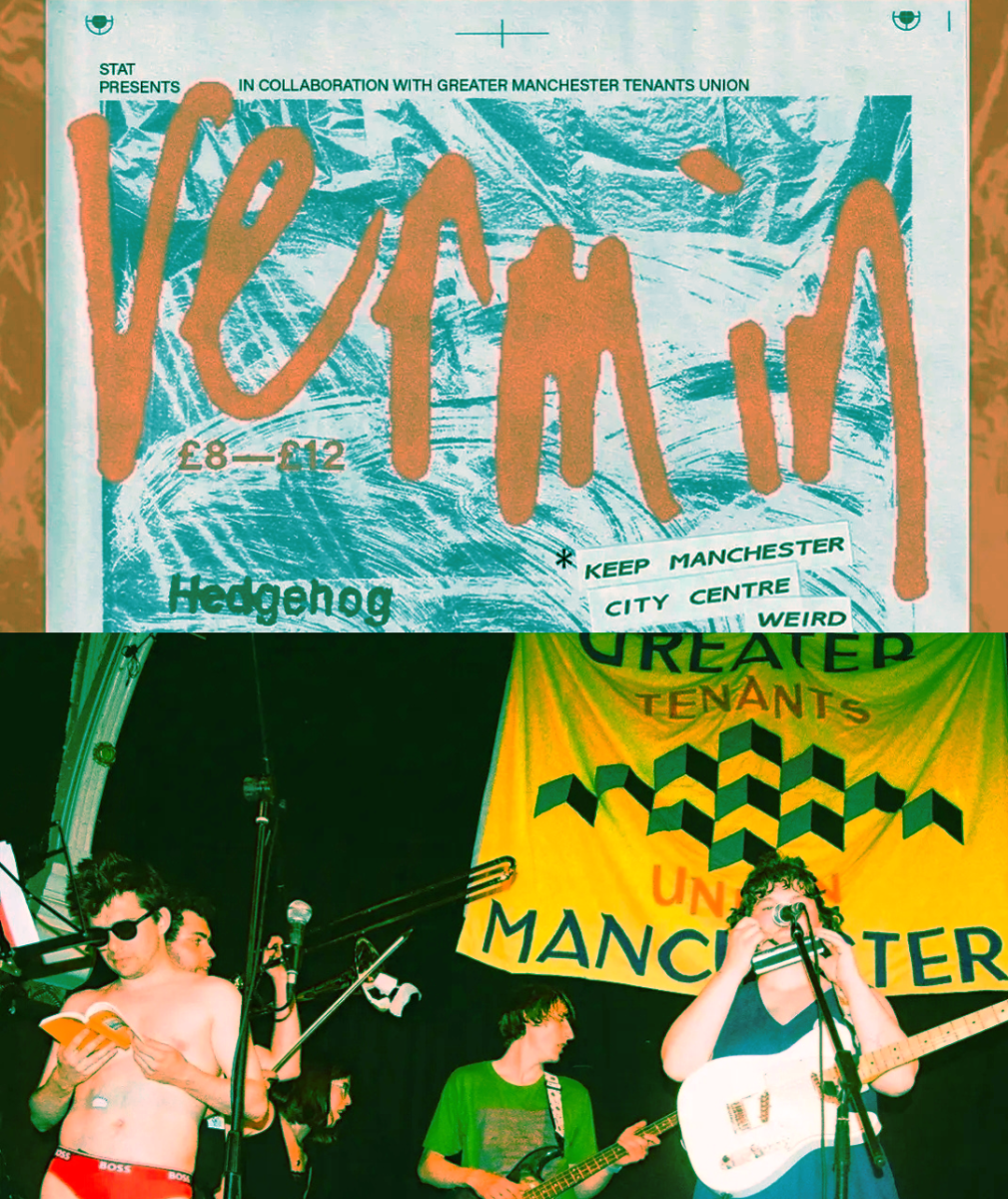
Members of Manchester rs21 recently attended the cultural night/gig Vermin, a collaboration between STAT Magazine and Greater Manchester Tenant’s Union. Afterwards we spoke to its founder and editor, Pete Mercer, who is a designer and writer based in Leigh, Lancashire. You can find them at peteontheweb.blogspot.com.
rs21: First things first – What is STAT magazine? Who are you guys, what do you do, and why do you appear to hate Manchester so much?
STAT is an anti-profit arts and culture publication for the North of England. We place an emphasis on covering towns outside of the big urban centres like Manchester, towns which have been left behind. Places which, still reeling from deindustrialisation, have lost a coherent cultural identity thanks to the gradual chipping away of regional idiosyncrasies.
As someone who still lives in Leigh, on the very edge of Greater Manchester, it’s quite easy to get wound up about over-centralisation, to feel bitter about your mates disappearing off to the city for jobs and that there’s this huge disparity in cultural and social infrastructure. It can be lonely and thankless out in the satellite towns, the people who live out there deserve more attention. The drain from these places is what’s got us into this mess with Reform and the like.
We make a point of championing radical and left-field, “weird” arts in these places and our view of culture is less restricted to art galleries and concert halls, more focussed on stories from the next street, modern folklore, common experience. Graffiti and pub loudmouths are culture just as much as Henry Moore. Culture also informs politics, so everything we do has this redistributive, anti-capitalist angle to it.
rs21: What were the aims of the event?
I’m keen on the idea of culture as a vehicle for politics. Even if that’s as simple as putting on a gig, when the intention is there and things have been done right, the result is you get a broad group of likeminded people in one room who might then go on to do the more gruelling political work the week after.
STAT was founded out of loneliness and frustration, we live in a very individualised society, and I think it’s important to create spaces for people to socialise and engage with culture within a broader political project.
With respect to this event specifically, we worked with GMTU as a way to promote their work as a tenants union. In order for political outreach to work, you have to provide spaces attractive to those people who might not ordinarily attend a GMTU meeting. VERMIN was our first attempt.
rs21: What does the name ‘Vermin’ mean to you? Why did you choose it? The opening speech by James Varney referenced Kafka’s The Metamorphosis, and the way workers are made to feel like scum, but what does it mean for you guys in particular?
A lot of STAT’s editorial tone and image revolves around the idea of decay and disrepair, the bleakness and melancholy that exists across northern England. Vermin, rats, are quite an obvious symbol for this, and given that two of the event’s performers had rodent-esque names it made a good fit.
It also sounds quite disgusting. Vermin aren’t pleasant. Provocation plays a big part in the way we approach things – this disregard for optics and good taste – I think when you exist in desperate times there’s a part of you that thinks if there’s any reason for art at all, it’s to provoke a response, to provoke action in people.
rs21: Why did you choose the types of artists that you did? Why not the usual kind of musical acts you see at left wing events?
Again, there’s something in the provocation. I’m of the view that weirder, more confrontation art provokes more interesting responses. If something is unexpected or uncomfortable, you’ll probably have a stronger reaction to it, and through that you can better assess what you think is good and what you think is bad.
To be transgressive and (at least partially) socially unacceptable in the present is part and parcel of advocating for a progressive culture and politics. I find it inconsistent that as leftists we advocate for a new world and yet so often fetishize the past – surely the point in pushing for new economics is that we can move beyond endless rehashes of Billy Bragg or heavy-handed “punk” which wasn’t all that effective the first time around. Truly progressive music is new, at the very forefront of experimentation.
rs21: In your article ‘We Paid Someone to Give our Gig a Bad Review’, Will Fisher highlights the reliance of experimental artists on a kind of neo-dadaist, internet-era irony, to the extent you could say the event was poisoned with it. What would be your response to that?
I’m not here to argue with Will, because part of the reason for commissioning that piece was to make clear our commitment to critical engagement. Some of what he was saying I do agree with – there is a reliance on irony and detachment in much of the experimental scene as it exists today – but I’m not entirely sure it applied in the case of VERMIN. The framing of the event was very much one centred around collectivist politics and opposition to rent extraction and the night was littered with humour – Philip’s Rat softening the edges of high-art through clowning and song. My personal criticism would be more one of overstimulation towards the end.
rs21: But to take a different stance on this point of humour, the French artist Antonin Artaud described laughter as a liberatory force, comedy as having the potential to unmoor sensibilities from established reality. Would it be a fair criticism to say you didn’t go far enough?
Maybe it could have been funnier, maybe it could have been more sincere. But some might argue it could have been more serious and methodical! The beauty of art is that it provokes differing responses in all of us, and not all art can be for everyone, I think it’s important to remember that. Any cultural or political vehicle worth their salt needs to accommodate a variety of themes and aesthetics – we can always put on more, different gigs. I think in the sense that it provoked a response, and brought people together under a political theme, it was ultimately a worthwhile activity. Art and culture is where we should be hashing out, and understanding our similarities and differences – it’s just one big experiment to see what we should do next.
rs21: Now, the event seemed to get a good attendance, from what I saw. But art events can often seem like they’re reaching people, only for it to be just the artist’s mates. Do you think you were actually expanding peoples palettes, or just preaching to the choir? How can we break away from the latter?
It’s something I’m always aware of, engaging the right people. Because really the whole point is getting people culturally and politically engaged in the present day. But it’s quite difficult to know who exactly your audience is unless you’re willing to pass out annoying data collection forms.
What I do know, through putting on a variety of STAT events over the past few years, is that I always emerge out the other end with at least one new connection, so it must be working to some small degree.
I think it’s worth highlighting that even if we platformed two bands and the audience was entirely composed of those two bands’ fanbases, connections will be formed between those two fanbases. The beauty of putting on more artists and performers per event is that it broadens the pool of attendees and therefore the potential for new connections. It’s very simple when I put it like that, but I think even that is something we’re lacking more widely at the moment. We need more collaboration, more overlap, and sometimes you can’t be super precious about it.
rs21: You did this event as a collaboration with Greater Manchester Tenant’s Union (GMTU). What are the pressing issues facing Manchester tenants, and what can readers do in solidarity?
I don’t doubt that your readers are familiar with the perils of renting. Even in spite of the recent Renters Rights Bill, rent rises continue to be a problem – there’s a study that showed your average Manchester tenant had worked every day so far this year just to cover their rent (as of last week).
Of course I’d encourage anyone living in Greater Manchester to become a member of GMTU. Besides offering help on an individual basis, they’re building opposition to rent increases and advocacy for rent controls and council house programs. Their latest campaign encourages renters to challenge rent increases. At worst this delays a potential rent increase by your landlord and at best results in a lower rent than your landlord proposed, and that has the knock on effect of keeping market rents lower. You can find out more at Resist Rent Rises.



0 comments