
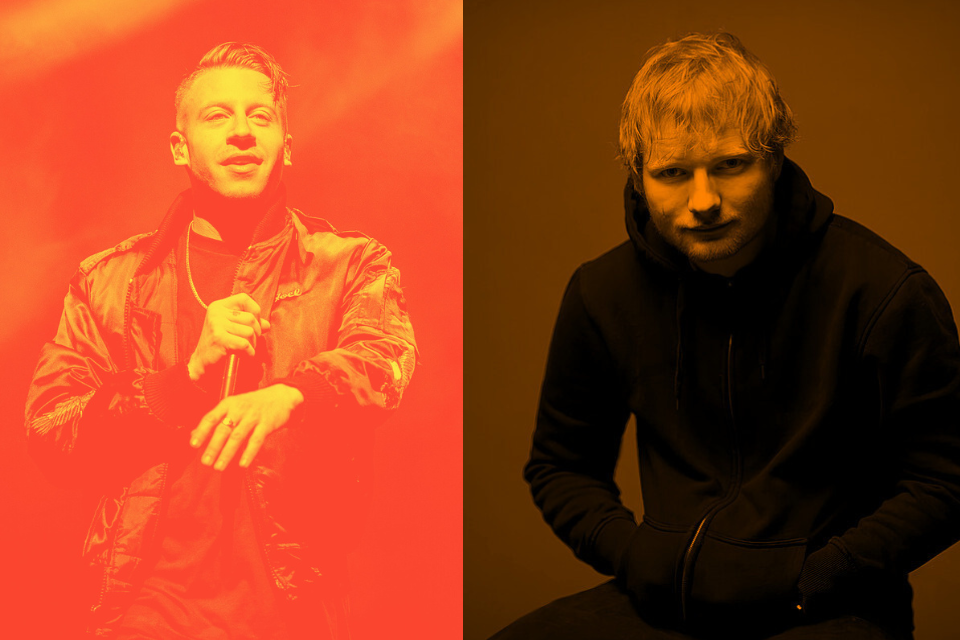
Right image: By Greg Williams – https://wmgno.mynewsdesk.com/images/ed-sheeran-slaar-streaming-rekord-741491, CC BY 3.0, https://commons.wikimedia.org/w/index.php?curid=179670172
Edited by rs21
Breaking the loop: On Macklemore and Ed Sheeran
Sam O •Sam O writes that recent events during Ed Sheeran’s tour reveals that what is needed in to win the battleground of culture is organised solidarity from below
The fallout following Macklemore’s removal from Ed Sheeran’s stadium tour continues to resonate in the media cycle, but the core lesson extends beyond a simple news story. What unfolded on that tour is an example of capitalist cultural policing. It shows how music industry bosses dictate who and what gets platformed and what this control does to art as a whole.
Billionaire venue owners and music promoters have made their position clear: performance is welcome, but solidarity with Palestine is not. When venue boss and Donald Trump ally Robert Kraft declared Macklemore unwelcome at his stadium, threatening a coordinated lockout across other stadiums, Sheeran’s management predictably capitulated to protect tour revenue. This is how capitalists control culture. Free expression is permitted only if it doesn’t threaten corporate bottom lines or imperialist alliances.
Yet Kraft’s attempt to enforce obedience backfired. The withdrawal of Sheeran’s support acts and backing musicians including Beoga, Aaron Rowe, Lukas Graham, and Finneas, alongside statements from former support act BIIRD, shows that owning the venues does not get you complete control over the cultural workers inside them. Bottom up solidarity remains a powerful weapon.
This conflict shows how the ruling class fears protest art. Powerful political art works by incorporating irony, performance and raw truth fluidly. Macklemore’s anti-genocide lyrics resonate precisely because working class youth see the reality of Zionist occupation on their feeds daily. For music industry executives however, art cannot spill into genuine political liability. When political expression threatens profit, we see actual ‘cancel culture’ from the top down.
As Jordan Stephens, of hip-hop duo Rizzle Kicks said, “There is nothing I’ve ever experienced in my life that has led to more removal of earnings and opportunities than standing for Palestine.” Artistic freedom is now reduced from a human right to a financial risk metric.
This is not an isolated incident; it is a structural feature of capitalism. From the British state taking Irish rap group Kneecap to court, to police investigations and venue cancellations targeting Bob Vylan after their Glastonbury set, the state and venue owners routinely collaborate to suppress inconvenient politics.
One impact of cultural policing from the top down is the self censorship of artists. When artists know that speaking out risks losing income and the loss of their passion, many choose the safety of silence. Artistic potential is muted, and the public is left with algorithm optimised, vanilla entertainment (cough, cough, Ed Sheeran), designed to never challenge power.
It’s great to see so many call out the Macklemore ban hypocrisy. While Kraft labeled Macklemore’s speech unacceptable, the AT&T Stadium in Dallas, one of the venues involved in the lockout, will soon platform Kanye West despite his antisemitism and Nazi iconography.
And it’s also great to see lots of people hitting back at Sheeran’s claim that he does not use his “professional platform for politics”. Remember when he headlined 2022’s Concert for Ukraine? The distinction is purely economic and geopolitical. Standing with Ukraine aligns with NATO strategy and Western state policy, making it entirely safe for corporate sponsors and artist income. Solidarity with Palestine, by contrast, directly confronts Western imperialist and economic interests of billionaires like Kraft. In this context, “neutrality” is simply compliance with the oppressor.
The suppression of radical artists mirrors the broader crackdowns on workplace organisers and street demonstrations across Britain and internationally. Terrified by the scale of popular opposition to imperial genocide, the ruling class uses every tool to silence dissent. Whereas once organised workers were locked out from their workplaces, now the tactic finds a renewed purpose in the cultural industry. On both occasions, it has been used to quell or crush a political threat.
While we don’t rely on pop stars to lead the struggle, and we might cringe when musicians shout “music is revolutionary”, culture remains a vital battleground. We must defend targeted artists, expose the billionaires enforcing censorship and keep the focus on Palestine. More importantly, we must build an independent culture from below. Bosses can attempt to silence an artist, but they can’t silence the mass movement for Palestine.


0 comments