

Interview | Black Lives Matter UK
Kojo Kyerewaa •At The World Transformed (TWT), rs21 members interviewed a range of activist groups. In this article Eve spoke to Kojo Kyerewaa on BLM UK’s approach to electoral politics, strategies for antifascist and antiracist organising and the struggle for a free Palestine.
Eve: Could you speak to us about what you discussed on the BLM UK panel?
Kojo: Our panel was about Black Lives Matter five years on – from the global uprisings that followed the murder of George Floyd in 2020 to the current situation of rising fascism. We’ve got more deportations than in any of the last eight years and the Labour Party are boasting about it. The 2020 movement demanded defunding the police and anti-carceral politics in Britain – now, the Labour government is planning to build more prisons, when we’re already imprisoning more people than any other country in Europe, outside Russia and Turkey.
What we’re experiencing now is in some part a backlash to what happened in 2020. Those uprisings scared the ruling class and showed that there is popular resistance to the racist logics that undergird capitalism. The ruling class, particularly tech billionaires, have been funding a movement to roll back those gains. There is a slogan in Silicon Valley – ‘repeal the 20th century’. Musk, Trump, Farage – those are their far right politics.
What was the world like, prior to the 20th century? It was the height of empire, the height of colonial rule, and that is what we see when Trump talks about taking back the Panama Canal – a naked grabbing of resources and land, removing all blockages that are frustrating that, whether it is international law, environmental legislation, workers’ rights or human rights, as we can see in Palestine.
We explored how we got here and the financial crisis of 2008. We also discussed the people who inspired BLM in Britain – our elders, the black radical tradition and the people who came before us.
Eve: Can you say how BLM UK is structured and how can people get involved?
Kojo: We were inspired by BLM in the United States and we had close relationships with that organisation, but we are completely independent from them. The organisation now is completely different to the people we were in touch with when we started in 2016.
In 2020 we got a £1.2 million windfall through a GoFundMe and incredibly 36,000 people donated to that, and as a result we went from being an entirely voluntary and nebulous organisation to formalising into a community benefit society structure. We are constitutionally bound to benefit what we’ve defined as the Black African community and diaspora in Britain and elsewhere. We have a coordinating group of nine people, which I am one of. We also have staff and affinity groups that are forming across the country. Right now, it’s Leeds and South London, people in North West London and East London are thinking about formalising, but it’s quite new.
The way that we establish these things is by running our political education programme called Project Timbuktu. They are largely black-led but not exclusively, we have multicultural groups and online groups that are open to everyone. If people are interested in getting involved, we would encourage them to register for our Timbuktu sessions – they can even train up and become facilitators running their local area. There’s an eight-week course where we discuss abolition, the police, reparations, gender, the need for radical inclusion in our politics, Palestine, freedom dreams and radical imagination.
Eve: Can you speak about BLM UK’s support for Palestine and how that was perceived by the British press?
Kojo: We tweeted a statement of solidarity in 2020 at the height of the protest when Israel was bombing Gaza, for which we got a lot of hate. It was clearly the weaponisation of antisemitism, but we could have worded the tweet a bit better. Subsequently, the Campaign Against Antisemitism targeted us and we had the likes of Gary Lineker defending us. He said something like maybe we haven’t got the right wording here, but he knows what we were trying to say. He’s been consistent on that, actually, and he didn’t need to be. He went out of his way to come and defend us. We saw Corbyn was being attacked under similar lines. We saw that anti Zionism was being conflated, as it still is, with antisemitism. We believe that black liberation is bound up in the liberation of all people, so we are against all forms of oppression.
Eve: In light of the current moment, given the recent developments in Your Party, and particularly given a few weeks ago where we saw very large numbers on the Tommy Robinson demonstration in London, what are BLM UK’s thoughts on electoral politics?
Kojo: I’ve always seen electoralism as a tactic, not as a principle. I’m not wedded to the electoral system, I don’t think it serves working class interests. When organised well, it can obviously improve the worst aspects of capitalism, for example, through the welfare state. But I’m a revolutionary, I don’t think we will get our salvation through the parliamentary system, rather, the parliamentary system acts as a brake on our liberation.
How do we defeat fascism? I don’t think we’re going to defeat it through the electoral process but we do need to use electoralism as a platform to get our message out and to find people we can organise with. We can’t fix the NHS without massive investment and state reorganisation. What I believe this moment calls for is for us to work out how to organise with each other in our communities and provide meaningful solutions in the here and now. What we have to do – if we’re going to build a movement that will win these demands – is to meet people with the needs that they have now and try to show that we are offering material relief to the issues that they’re facing.
Take the organisation Lesbians and Gays Support the Miners (LGSM) in the 1980s. That radical solidarity showed that you could build the working class, and build the solidarity that we need to win wider and deeper gains. They didn’t wait for the miners to say that they agree with them. They just offered solidarity through that material action, we know that the National Union of Mineworkers supported repealing Section 28, gay marriage and LGBTQ+ rights more broadly. It’s not going to be through clever electoral sloganeering or great speeches said by leading politicians. It’s going to be through the relationships we build in our communities and we need to get that across the country.
A way of doing that could be through the party form, it could be through Your Party branches but it can’t just be that. We have to create a patchwork of lots of different antiracists and antifascists – organising our communities for power. That’s what I think this moment is calling for and that is what the far right is effectively doing. They are funding nappy banks in communities. The BNP at its height in 2006-7 and towards its decline in the 2010 elections, were organising football clubs and bus services. Fascist parties like Homeland were doing prisoner solidarity demonstrations for the people who were imprisoned in the 2024 race riots. They are doing mutual aid and support – that’s why their movements have got sustainability and the fact that billionaires are funding them. But it’s not just the money, it’s the level of organisation that people see that these guys care about them.
If we’re wondering ‘why are we failing? – maybe it’s because we’re spending a lot more time on academic arguments or political points than actually connecting with our communities. We’re facing colonial violence that is old and well-rehearsed and really shapes the world we live in today. The way that it has been beaten back is through anti-colonial resistance. I’m talking about the African National Congress that organised a multicultural coalition against apartheid, the anti-colonial movements that pushed Britain out of India, got Britain and other European empires out of Africa and caused them to fall. They didn’t win entirely, but it did create a greater freedom and sense of peace that we had across the world and we’ve got today. By learning those lessons of how those anticolonial movements build themselves or how they knit together what became the freedom charter or what became the fall of apartheid? That is about organising in the community and scaling up from there. If they can do it then, we can do it now.
Eve: There is a new antifascist coalition just beginning to be organised in London. Can you tell us about plans for that?
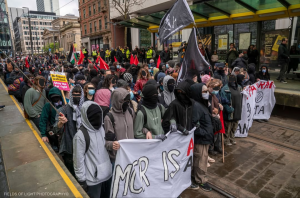
Kojo: When 100,000 people were on the streets for the Tommy Robinson march, there was a counter-demo. Let’s acknowledge that – comrades organised that but were unfortunately outnumbered 20 to one – it was quite a horrifying experience for people. Counter mobilisations that rely on our existing networks are not enough. There is a popular movement for the far right whether we like it or not, and the strategies that we’re currently employing are not working.
The two strategies I would characterise are: the Stand Up to Racism strategy, and the Hope Not Hate strategy. What is the Stand Up to Racism strategy? Capture the leading heights of the trade union movement and get them to give you money to mobilise existing networks to get people out on demonstrations against the far right. That’s not necessarily bad, it’s an important thing, but it’s clearly insufficient. To some extent it can become a cycle of demoralisation and self-defeating. Because you are mobilising people just to respond to a growing movement – you’re not providing any alternative. You’re basically saying: let’s just celebrate multiculturalism, let’s not talk about the actual problems that are driving people towards the far right. Then actually you’ve got nothing to say to the people who are worried about asylum seekers. They shouldn’t be worried, but we should be clearly saying: ‘Actually, you need to be more concerned about the super-rich who are defunding our services, or the landlords who are hiking up your rent,’ etc. If we’re not saying something that’s distinctive, and more importantly, if we’re not actually organising in those communities, then we’re not going to win those people over.
The other side is the Hope Not Hate strategy, which is we need to shore up the political centre, and say basically: if you’re Labour, if you’re Tory, if you’re Lib Dem – as long as you’re not Reform – we will support you, because you represent better politics. That strategy isn’t working either, because what you’re doing is reinforcing Reform’s argument that ‘they’re all the same, we’re the only alternative’. That might have worked 10 or 15 years ago, when it was the BNP, which had politics that were marginal. Now the ideas of Reform are much more normalised. So this strategy means we essentially keep shouting at the fascists, and we don’t do any organising and connecting with people in those communities, or we keep shoring up the political establishment – but the centre isn’t holding, it’s crumbling.
What we need are not just networks of explicitly antiracist groups, but community organising groups for power. You can be a Green Party activist and get involved in what we’re calling the Anti-Racist Network (ARN). The name might change – we’re not decided on that yet. We’re having our inaugural meeting in London on 30 October – it already sold out within 24 hours, so we found a new venue and it is still sold out. People in Staffordshire, Cumbria and Liverpool are organising livestreams to participate. It’s not going to be a table-top meeting where you hear speakers, you feel a little bit more energised and then you go home and do the same thing you were doing before. What we’re trying to do is organise something where we’re going to talk about not only the problems, but ask: what do you know about your community?
We’ve been privileged to be involved in the late Jane McAlevey’s organising for power training, which is in a union context, but a lot of those ideas are applicable in our communities as well. In the meeting we’re going to do mapping exercises where we’re going to start thinking about ‘how do we organise?’ We need to understand, like you would do in a unionised workplace, what are the common grievances that people share, and who can we find in our communities that are organic leaders who are respected, and how can we bring them towards us so that we can resolve some of these issues, and also inoculate our communities against the far right.
That’s even more important when we’re living in an age where white supremacy is being pushed by black and Asian faces. There are older black and Asian communities and elders who are saying, ‘maybe it’s the new migrants’. It’s ironic – the same arguments were used against them when they first migrated to Britain. This is the magic of nationalism and naturalisation, people becoming integrated into the nationalist ideology – you end up submitting to the same ideas that were used against you or your parents because they can present nationalism or far right ethnonationalism in a race-blind way. People don’t realise that these arguments are going to be used against them. The reason that it’s so seductive is because of the economic situation we’re in. What we’re trying to do is develop antiracist communities from the ground up. That means we need to work with tenant unions who are active, local trade union branches who are active within their communities, but we also need to incorporate people who are not organised, who may be volunteering at the food bank or are a regular user at the food bank, and bring them in community with those who have a political analysis that we agree with, and help them materially through three ways:
- Relief – build actual material relief for people, to gain trust, to build solidarity. Once we are organising people and identifying those leaders who will bring people into conversation and organisation with each other to get power, and to get relief, it goes into the second stage.
- Repair – to collectivise the above activities into institutions of repair. What the institutions of repair are doing, is by learning to organise and to work together within our communities, we are repairing solidarity. We are doing what LGSM did – to recognise that our destinies are bound up in each other. I realise that I’m not going to be free without your help, and vice versa, and we scale that up into collective institutions. The Party form may or may not be a part of that.
- Restructure / Revolution – we are restructuring our reality. By organising these institutions of repair, and building power, we are restructuring our reality – that may be articulated in the form of demands, or in the form of dual power. That we have got so much power, we are challenging the state in its legitimacy. Restructure can also be named by another word: Revolution.
The situation that we’re in means that we need to build a mosaic of the diversity of all the forms of resistance and organising that is going on, we need to collectivise that – maybe we do it in the Party form, maybe we need social movements, maybe we need both and can’t choose one or the other; I think it is both – and that’s what the new antiracist network is an experiment in trying to build, and we’ve got some support from quite a lot of new activists but also existing organisations that we’re really humbled to be in community with.
Please find more information about BLM UK’s new initiative ARM – The Anti-Racist Movement here.





0 comments