
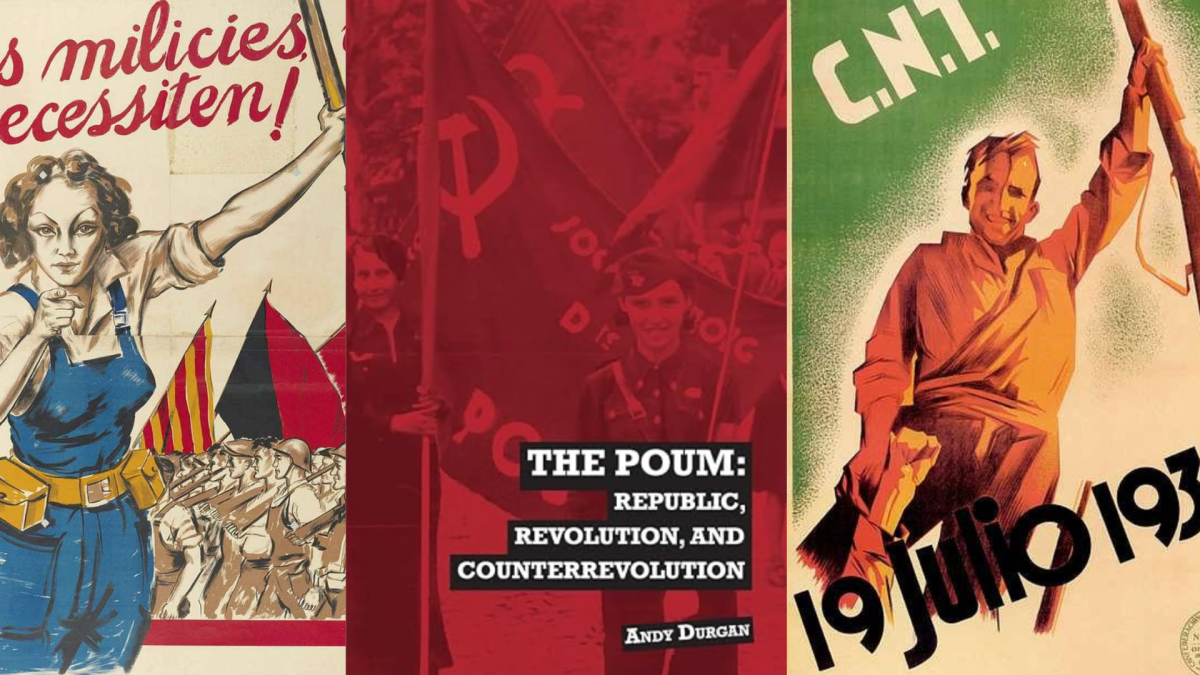
Video | The POUM: republic, revolution and counterrevolution
Andy Durgan •Author Andy Durgan discusses his new book on the Spanish Civil War and highlights the relevance of the experience of the revolutionary organisation the POUM for today.
Andy Durgan is an activist and historian living in the Spanish state and a member of the revolutionary group Anticapitalistas.
Transcript
The POUM, the Workers Party of Marxist Unification is known perhaps for three reasons, or three sources mainly. One, George Orwell’s book Homage to Catalonia. Secondly, some of you, I expect, would have read about them in Trotsky’s writings on Spain. Thirdly, in general history of the Civil War, where they are presented, correctly in fact, as victims of Stalinist repression. However, there’s a lot more to the POUM than those three aspects. Orwell’s book, probably the most read book in the world connected with the Spanish Civil War, is a wonderful book, but doesn’t really do the POUM much justice, especially to their militias. Trotsky was, I think, poorly informed about the POUM. A lot of his criticisms are not very convincing and based on poor information. And finally, the POUM was a lot more than just a victim of Stalinism. There’s an attitude in a lot of history, standard histories, that dismisses the POUM as just some minor party.
The POUM was formed in September 1935, only 10 months before the Revolution of July 1936 on the base of two organisations, the Workers and Peasants Bloc and the Left Communists. The Left Communists had been the Spanish section of the International Left Opposition. They had a few hundred members. Their strong point was that they had nucleuses, little groups, all over the Spanish state. They also had some of the most capable communist activists of the time, several founder members of the Spanish Communist Party. The Workers and Peasants Bloc, which provided about 90% of the new party’s membership, was based in Catalonia. It had the pretension of building a statewide organisation, but it hadn’t really broken through. It had very little strength outside of Catalonia, mainly in the Valencian region.
The Workers and Peasants Bloc, BOC in Catalan, was the biggest workers’ party in Catalonia. Not the biggest organisation. The biggest organisation by far, of course, was the CNT, the anarchist trade union. It had an important base outside of Barcelona, in the smaller industrial towns and in the countryside. Although it was a small organization, 5,000 or 6,000 members at the time of unification, the BOC and after it, the POUM, would grow to 40,000 members during the Revolution. It had an important role in the revolution, because of the strategic importance of Catalonia, where half the working class was concentrated and half of Spain’s industry was centred. So, they had a relevance way beyond just being victims, which they were, of course, of Stalinism.
The other thing to say about them in introduction is that their two principal leaders, Joaquin Maurin, who had been the leader of the Workers and Peasants Bloc, and Andreu Nin of the Left Communists were by far the most capable Marxists of their time in the Spanish state. Spanish Marxism was pretty weak, and they and their writings were, without doubt, the most advanced of the time, and certainly the most coherent.
To understand the history, you must understand the context, of course. There are two elements to this to mention. One is obviously the situation in the Spanish state, and the other is the fate of the Russian Revolution. Spain at this time, in the first decades of the 20th century, compared with its neighbours, is a fairly backward country, socially and economically. It had been at the turn of the 20th century essentially an agrarian country, and this was beginning to change, but the agriculture sector was still very strong, especially in quite a few regions of the country. It’s really an example of combined and uneven development, which Trotsky describes in detail in his writings in relation to Russia before the revolution. It did not have anything resembling a normal bourgeois democracy until 1931, when the Republic was founded. The Republic, 1931 to 1936, was extremely unstable and would result in the Civil War, which began in July 1936 with the military uprising, a far-right military uprising. This, in turn, provokes a revolution especially in Catalonia, centred in Catalonia, which is one of the great revolutions of the 20th century, and in a sense ends a cycle of revolution that began in 1917. If anything, the working class in Catalonia, Valencia and the east of Aragon went further than the Russian workers went in the first weeks of their revolution, with the taking over of a large amount of industry. Eighty per cent of industry and services in Barcelona, which was the centre of the revolution, was collectivised under workers’ control But also the revolutionary flow was reflected in many other things, the arming of the workers, the creating of militias, the creating of internal security, the repression of perceived enemies of the revolution, taking over urban space, the occupation of buildings, and in particular the involvement of women. For the first time, on any sort of scale in Spanish society, women would enter into politics, into the unions, into political organisations, massively, and in some cases even went to the front to fight. This is one of the great symbols of this revolution which, of course, we know would be defeated internally within the first year of the Civil War.
Now Nin pointed out how the workers and the peasants at the beginning of the revolution, in five days, with arms in their hands solved the problems which the Republican government could not solve in the previous five years. The question of the relationship with the church, the national question, the question of the army, educational reform and so on and so forth, and above all, the agrarian question – there was a massive collectivisation of agriculture.
The other aspect that needs to be considered is the Russian Revolution. The POUM, as I’ve mentioned, has its origins in the communist movement. By the 1930s, there are different groups, fragments, some of them very small, some not so small, which have broken with the official communist movement, a rejection of Stalinism because of the degeneration of Russian Revolution, and the conversion of the communist parties into parties which are totally subordinated to the needs of Russian foreign policy. This, of course, is going to be highly significant, both because the POUM defended itself as the true heirs of Bolshevism in Spain. And also, because, of course, with the Russian intervention in the Spanish Civil War which was at various levels. On a military level, Russian aid saved Madrid in November 1936. But with this aid and the international brigades, of course organised by the Communist Party, came political conditions, and a political and Secret Service intervention, which was directed specifically at the POUM and at the revolution in general. One thing that Stalin did not want was a revolution, which would overshadow the Soviet Union and show an alternative to Stalinism.
I’m going to mention two aspects of the POUM’s politics prior to the war, which I think are very relevant to understanding their contribution. One being their analysis of what is happening in Spanish society and in the economy, and the other being their analysis of fascism and how to fight it. What is shown by Maurin – Andreu Nin is more well-known because he was, of course, murdered by the Stalinists, but really, the key leader to the POUM was Maurin. Maurin was quite outstanding in his analysis. He wrote three books, two of them very important on the development of revolution in the 30s. And it shows without question, how it would not be possible to build a stable bourgeois democracy in the Spanish state. This, in particular, after the events of October 1934, when there was the revolution of the Asturian miners to avoid the extreme right entering the central government, which led to the three-week commune in Asturias and massive repression. But did not lead to the defeat of the workers’ movement, as would be clear in July 1936. One reason the workers acted so quickly and so violently, when threatened, when the military rebellion took place is because they’d seen exactly what was going to happen to them after the repression of the Asturian miners.
Maurin argued, and the POUM argued – Maurin was the central leader – that the alternative open to the working masses in Spain was either socialism or fascism. This is particularly relevant when we consider what happens in the war with the polarisation between the idea that the war was about the defence of democracy. The idea was defended by Republican Socialism and particularly by the Communist Party. And on the other hand, the POUM and the CNT defended the idea that war and revolution were connected. They did not, by the way, argue that the revolution was more important than war, which is something that’s repeated endlessly in histories of the civil war. This is worth considering, if you try to understand what happened between 1936 and 1939. The weakness of the middle classes, so-called, the fact that the bourgeois democracies were never going to support a republic, points to the revolutionary alternative being a viable alternative in a general sense. There’s absolutely no guarantee a revolutionary war would have triumphed, but when we consider that the basis for a liberal democracy did not exist in 1936, or at least this is argued very strongly by Maurin, I think we can see the relevance of that.
The second question is fascism. The Spanish workers movement did not take the fascist threat particularly seriously at first. The Socialist Party, which is the other great movement with the anarchists, you know, the two great movements, the socialists and the anarchists. The socialists, initially at least, argued that there was no threat from fashion. They would change radically on this question with the impact of the right-wing victory in the elections of late 1933. But initially, their position was that this couldn’t happen. The anarchists dismissed the threat of fascism on the basis that they were opposed to all governments, and they described all governments as fascist, not only Germany and Italy, but also the Soviet Union, even the Republic itself. So, they were not taking this question at all seriously. The Communist Party, following the position of the Communist International until 1934, said the main enemy was the Socialist Party. Of course, this was the characterisation which had been given down from Moscow since the late 20s. The socialists were social fascists and that was the problem. And of course, as is known, this led to a complete catastrophe in Germany in 1933 with the division of the strongest workers movement in Europe at the time. Now what the forerunners of the POUM argued was that you needed a united front of workers’ organisations. This took the form of the Workers Alliance, which was set up, promoted by the Workers and Peasant’s Bloc, late 1933, and would be behind the revolution of 1934. This was essentially an alliance of non-anarchist workers’ organisations. The CNT refused to take part which posed not only that you needed unity specifically against fascism, but also that there was a need to replace capitalism with a social revolution.
With the defeat of the 1934 revolution and the change in the Communist Party position to the Popular Front in 1935, they now suddenly took an 180-degree turn, and argued that what was needed were broad popular fronts against fascism, including the middle classes, which were just defending democracy. A position which stems above all – I say above all, because given the disastrous previous position, there was movement inside the Communist Party towards some sort of anti-fascist unity, essentially, it is an extension of Soviet foreign policy. It wasn’t anything to do with the specific analysis of the situation in any particular country.
Now if we come on to the war. The key question that needs to be addressed and which really affected the POUM is the question of power. The revolution had taken place. As far as the anarchists were concerned it was a fact. They controlled the factories and the land. But there was a real problem, of course, because there was no revolutionary power. In the summer of 1936 before the republican state really managed to rebuild itself, what you had was not dual power. This is often argued particularly by the Trotskyists, that there was dual power. What you had was a fragmentation of power. A series of committees of all types – anti-fascist committees, workplace committees, supply committees, militia committees – which acted in a fairly disconnected way. There was nothing as the equivalent of the Soviets. The thing to say about these committees, because some people say there are committees, they must be like the Soviets. But they weren’t. Most of them were appointed from above, nearly all of them. Many of them were Popular Front committees, in fact, with the addition of the CNT. And even in the workplaces, the committees, elected or not, that ran the collective, tended to be the trade union committee from before the war. So, you have a sort of de facto dual power. The POUM argued in this situation that we need to unite the committees, even though they were not perfect and call a constituent assembly with delegates from the committees, from the soldiers, peasants and workers’ committees and form a worker and peasants’ government.
Of course, this was very difficult without the support of the CNT. And this is the key question. the central question, central problem for the Spanish Revolution. The Spanish Revolution to a large extent, takes place because of the CNT, and it’s also defeated because of the nature of the CNT. So, the CNT faced with this situation of fragmentation actually considered whether they should take power on their own or what they called collaboration, which meant collaborating with the Popular Front. There wasn’t a class position, you know, the working class as a whole, the united front organisations should take power. The CNT said you could either have an anarchist dictatorship or we would collaborate, and as, of course, they opposed all forms of dictatorship, they ended up collaborating.
Now, there’s a practical side to this. They were faced with the fascist army, and the war needed to be fought, so in the absence of an alternative power, they ended up collaborating with the Republicans and entering the government. Obviously, unheard of, four anarchist ministers in the republican government after November. This is a problem for the POUM. The POUM argued in its press what was needed but they were frightened of losing their relationship with the CNT leadership This is why they, in fact, end up in the Catalan government. Briefly, late September to December in 1936, when a new united Catalan government was formed. Prior to that, there’d been two points of power. The Central Committee of Anti-Fascist Militias, which not numerically, but politically was dominated by the CNT, and then this moved on to the United Catalan government. The CNT accepted this idea, and the POUM, essentially – it’s more complicated than this – but essentially, they said, well, we have to go into the Catalan government because the CNT is there. They justified it by saying, well, there’s a majority of workers’ organisations in the Catalan government and the Catalan government has a socialist program, which it in fact did. The economic program of the government was written by Nin himself. But the reality of the situation was that the majority inside this new government was opposed to the revolution, and what it proved to be is one more step to rebuilding Republican authority. The POUM was expelled in December 1936.
The POUM then continued to argue that this was just a transitory position, and you need to build power from below. It became increasingly obvious that this wasn’t going to happen. You have to remember that the soviets were not built by the Bolsheviks, or built because the Bolsheviks called for them. They emerged from the need of the working class to have some sort of organism to organise themselves during the revolutionary process. In the Spanish Revolution, it was the unions which played this role, which had the trust of the working class. Obviously, nothing like the Russian unions. Quite large radical, and verbally revolutionary organisations.
This problem was not solved and in May 1937 there was a clash in the streets of Barcelona known as the May Days. Now, the May Days is like the last act of the revolutionists. It’s a provocation by the Stalinists to cause a situation. The CNT defence groups reacted by putting up barricades and coming out onto the streets, and you have 5 days of violent struggle in the streets of Barcelona with several hundred deaths. The CNT leadership calls for a ceasefire and retiring from the barricades, and which the rank and file accept. Which, in itself, is very significant, because it showed once more to the POUM, how difficult it was to win the rank and file from the influence of the leadership to which they were loyal.
The aftermath of May is basically the repression of the POUM. On June 16th, the police moved to dismantle the POUM, accusing them of being in league with fascists. There’s a massive bombardment of Stalinist propaganda, accusing the POUM of being infiltrated by fascists. And after May 1937, the POUM was called by the Stalinists a fascist organisation per se. So that was the context for their repression. Hundreds of their leaders were arrested. At least a dozen of their members would be murdered. In particular, Andreu Nin, who was kidnapped by police brought especially from Madrid to do this and would eventually be murdered. Held by members of the Soviet Secret Police in a secret jail near Madrid. This caused an international outcry. One of the reasons, in fact, more POUM members were not murdered was, in fact, because of the international outcry over Nin’s disappearance and what was suspected, quite rightly, to be his murder.
Now I’m just going to finish, because I’m only speaking for half an hour. Of course, there are many, many things we could talk about, but I will finish with a quote because I think it’s highly significant and shows the relevance of the POUM. This is from Maurin’s book,Towards the second revolution. Apparently, there is an English translation from the 1930s somewhere, but unfortunately, it hasn’t been translated since, but it is an extremely important book. We’ve recently republished it here in the Spanish state. Maurin concluded his writing at the end of 1934. And you have to consider that really hardly anyone else understood what was happening at the time, in terms of the significance of the collapse of the Republic and the threat to it, by reactionary forces. Maurin states,
The regime it built around the monarchy has failed. The bourgeois republic has failed. Fascism is riddled with contradictions that, for the time being undermine it. But if the proletariat fails to surpass itself, if it is unable to understand its mission by adopting a correct strategy and tactics, and focus on the ultimate goal, the seizure of power, then the current generation will be crushed by the counter-revolution.
This is, of course, highly prophetic. Because it’s exactly what would happen, the generation of working-class militants and activists, thousands and thousands of them, would indeed be crushed by the counter-revolution. First, by the Stalinist counter-revolution, and then, of course, even more so by the fascist counter-revolution and 40 years of fascism. A terrible disastrous defeat of the Spanish working class. And I think one of the things – there are many things to be said about the Spanish Revolution and about the experience of the POUM. But I think one thing that’s particularly pertinent given the situation today internationally, is the need, obviously, to fight fascism. But also, to provide an anti-capitalist alternative to fascism at the same time given that the roots of fascism lie within the capitalist crisis, the degradation of people’s living conditions and the endless frustrations of parliamentary reformists who failed to deliver, because, of course, they can’t deliver because the economy is not in their hands. So on and so forth. This whole experience and argument about how fascism has to be fought is particularly relevant if history is not to repeat itself.
The POUM: Republic, revolution and counterrevolution is published by Resistance Books.

0 comments