
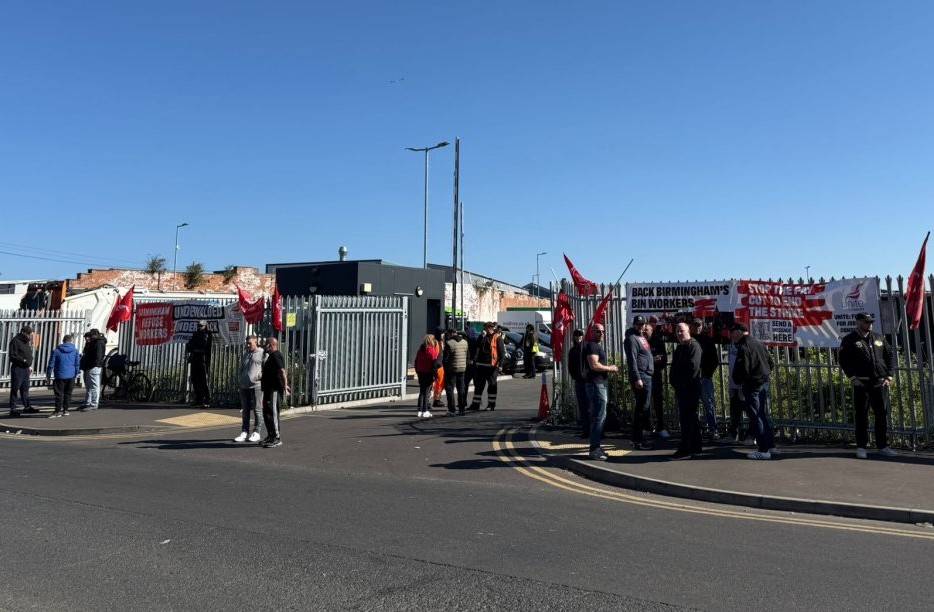
Interview | On strike with Birmingham bin workers
Hamza •As Birmingham’s bin strike continues, proposed cuts threaten to leave hundreds of workers worse off. In this interview, Steeven, a striking worker, speaks to rs21 member Hamza about the fight to protect their pay and the solidarity on the picket line.
More than 350 Birmingham bin workers began strike action on 11 March 2025 in response to proposed changes to their roles that would result in significant pay cuts. The dispute centres around the planned removal of the Waste Collection Recycling Officer (WCRO) role, a move that trade union Unite estimates would leave approximately 150 workers £8,000 worse off annually. The union fears that the current proposals could lead to further changes to jobs, pay, and conditions in the future.
Although negotiations between Birmingham City Council and Unite resumed on 1 May, Unite claims that the Council has missed three successive deadlines to submit a revised pay proposal. The deadlock has prompted government intervention, with military personnel being deployed to assist with waste collection leaving some workers bemused by the over-the-top reaction.
Now one of the longest-running strikes in Britain in recent years, this dispute has reached a crucial point. In this context, rs21 member Hamza meets Steeven, one of the many striking bin workers, to hear firsthand why he and his colleagues are standing firm against the cuts.
Hamza: Can you introduce yourself? What’s your role, and why are you out on the picket today?
Steeven: I’m a bin man, and we are out striking today because bin workers face losing between £2000- £8000. Drivers are also facing pay cuts from up to £10,000 to £12,000 a year.
Across the country, it appears that councils are on the verge of bankruptcy, with many workers at the risk of having their job or pay slashed. What do you have to say to that? And why is winning now vitally important to Birmingham bin strikers?
I truly believe that it’s crucial to the future of society, but also for the public as well. I mean, at the end of the day we’ve got the public interest at heart, not like most of these bosses, who only have numbers in mind. The majority of us are Birmingham residents and we love the city that we live in, and we also love the job that we do. To take a quarter of your wage is a lot of money. I mean, for anybody to lose £650 a month is a lot of money. It’s literally your rent money, your mortgage, money, your bills, or even your food for the month. It’s a lot of money for anybody to lose.
The media coverage has been showing piles of rubbish, often alongside images of local mosques situated within working-class communities, and hardly ever about your demands. What do you make of that coverage and the type of narrative that the media are trying to build?
Certain areas are obviously going to be a lot worse than others. But it’s the same way with rats – they have never been a non-existent issue. They’ve been alive from the beginning of time, and I’m pretty sure they’ll be here long after we’re gone. But again, I feel like there’s two ways of looking at the videos that have been out and about, circulating on social media apps, and the media in general. You can either look at it to say, oh, there’s 30 tons out in Birmingham, or you can see that’s how much the bin men take on a weekly basis. But each truck, roughly, takes eight tons per day. We have 100 trucks. So you do the maths. I mean, it’s a lot of waste that we collect.
Basically, the media are trying to pit the people against us. But everyday working class people, literally, they all stand with the bin men. It’s a very important service that everybody needs. It’s not just houses that we do – we do schools, we do hospitals, we do shops, we do tower blocks. And at the end we are not asking for more money. We’re just asking to keep hold of our money. But the media narrative is that we are holding Birmingham City hostage or ransom – that’s not the case. Majority of us are Birmingham residents ourselves, as much as we’re Birmingham bin men, we are residents first. So us holding Birmingham hostage? We’re holding ourselves hostage. And then to also say that we’ve been threatening agencies. The majority of us full timers have got family members that are working for agencies. Why would we attack them on the picket line and then go home and pretend like everything’s all hunky dory?
How are you and the strikers challenging the narrative and building your own narrative?
By solidarity and by explaining the truth and nothing but the truth, and explaining to guys that listen, it’s a pay cut. It’s not a pay increase that we’re asking for. A lot of people have adopted the narrative that we are asking for £8000 more, which is not the case. We’re facing losing £8000, which, let’s be real, nobody can face losing such a huge amount of money.
The government has called for the military to intervene in the strikes. What do you make of that tactic, and how do you think that is affecting the relationship between Unite and Labour?
I think it’s a very silly tactic. You wouldn’t have the fire department help the hospital department on a strike, or anything like that. So yeah, I think it’s absolutely crazy. I mean, the world’s on the brink of war, so why would you get the army to come help a situation that’s got nothing to do with them?
The union is just basically trying to fight for their members and get what we want. The union has been absolutely brilliant. I mean, a lot of people talk a lot of crap about the unions, but without the unions, let’s be real, the majority of us would either have to accept or reject the offer and then lose your job. So with unions in place, I feel like they give the voiceless a voice.
What type of solidarity have you seen? Can you speak about those who have turned up at the pickets, as well as the type of support you and the strikers have received outside it?
We’ve had people from Bristol, we’ve had people from all over the country come down to the picket lines. We had a mega picket last Friday, where over 400 activists and different unions from all around the country came. And it was just an absolutely beautiful atmosphere. The support has been more or less overwhelming. Say, 80 per cent of the support has been absolutely brilliant, from everyday Brummies and others. But there have been a handful of people who are not happy with what we’re doing. But no matter what you do, you’ll never be able to get everybody on your side. With a few of them, we explained the situation, and they turned around and said, ‘Oh, well, you know what? We couldn’t face taking such a pay cut too’. So, yeah, it’s very unfortunate what’s going on. But if it was up to us, we wouldn’t have gone on strike for a day, and we would have kept our money and our health and safety critical grade three role.
What would it mean to you to win your demands?
It would mean a lot, especially for the brothers and sisters and the work colleagues that I work alongside with. The majority of us, if we lose this, the majority of them and their kids could be homeless, because the majority of them have got mortgages and stuff like that.
And how can we support the strikers?
By solidarity. And even if you don’t truly understand what’s going on, come down. Visit your local picket line. These are your bin men. Come and actually speak to the people who are facing these issues. Because, you could speak to a hundred different bin men, and I promise you, you’ll get a hundred that give the same answer. We’re not asking for much, but it seems like we’re asking for the world. All we want is for us workers to be paid our fair wage and not take any losses, but unfortunately, we’re facing these pay cuts.
Send a message of solidarity to the workers. The strikers are sending delegations to raise support in other towns and cities.


0 comments