

In English this means ‘Paris 8 in struggle: make Macron and the bosses retreat’, though it is also a pun on retirement (‘la retraite’). Paris 8 is a university in Saint-Denis, one of the most diverse universities in Paris. Photo credit: Clément Mouhot, 2023.
France: standing up to Macron
Clément Mouhot •Following recent strikes and demonstrations in France over pension reform, Clément Mouhot writes about the causes of the most recent wave of protest in France.
Macron and his government have finally come back, after a failed attempt in 2019-2020, to what seems to be the only real objective of the second presidential mandate: increase the number of years workers must work before they can receive a full pension. In the French pension system, a full pension requires two things: a minimum number of years at work (now 43 years for those born after 1973), and a minimum age (now 62). These two thresholds have been increased through several reforms in the last two decades. And Macron’s project is to push the minimum age to 64, with suggestions of further increases in the future. At the same time, the average life expectancy is highly unequal. People with white collar jobs die, on average, 6 years later than blue collar workers, but this number only hints at a more violent inequality: the average disability-free life expectancy of white collar professionals is 10 years longer than that of blue collars. Those with the most physically demanding jobs are also those who start working younger, without much higher education, and who face unemployment the most in their old age. Intellectuals and managers on the other hand are virtually unaffected by the change in the law, since most of them study until 23 or later, and the number of years at work required by pensions rules means they already have to work beyond 64. This blatant injustice has not gone unnoticed: the government has declared a war on the lower classes, with working class women even more negatively affected by the proposed reform than men.
But this reform alone does not explain the level of anger. The context resembles England’s in many ways, and the same causes produce the same effects on both sides of the channel. These causes are familiar to everyone except the very privileged classes. The annual pay cuts due to inflation have been eroding salaries for decades, and have brutally accelerated these last two years with the explosion in the price of basic goods and heating. And then there is the political and media harassment of all those that either provide public services or depend on them: nurses, teachers, postal workers, pensioners, disabled people, social housing tenants and others. Politicians from all mainstream parties have been relentlessly pushing reforms to cut the funding for health, pension, school, housing – all that gives dignity to the lives of those not born wealthy. The redistributive funding of public services by taxes largely escapes to the markets. And here, as in France, governments, left and right, have devoted most of their time to reducing how much of the national wealth is dedicated to redistribution, or in other words, that is socialised and thus freed from the logic of profit.
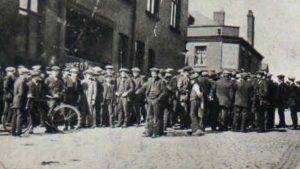
In France, unlike in England, the anger has been directed at the national level over pension reforms because the pension system is still largely national and state-organised. The recent movement does not come out of the blue. It would not exist without the red winter of December 1995, when the working class reminded Juppé’s arrogant government that it is still the source of all labour, and blocked a pension reform through a combination of public transport workers’ strikes and mass demonstrations, with overwhelming public support. This red winter was followed by other mass movements in 2003, 2010 and 2019-2020, again against pension reforms that tried to reduce the amount and length of pensions. Together with the two mass movements against reforms to casualise the workforce in 2006 and 2016, these mass movements have rejected neoliberal policies, with polls showing support for the movements from a majority of the population. Which is why, in France as in England, even the most conservative politicians have stopped focusing electoral propaganda on neoliberal reforms; instead, they focus on racist or nationalist issues to continue winning elections.
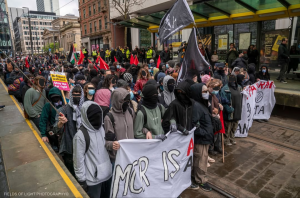
The two recent days of collective action, on 19 and 31 January, have seen some of the biggest demonstrations in the social history of France. [Read more about these strike days in an interview with a worker here.] In fact, the government’s official number for 31 January, 1.272 million people across the country, is the largest number ever recorded for a demonstration since systematic counting was introduced in the 1990s. It is larger than the numbers at the peak of December 1995 and November 2010, and is twice as large as the numbers of demonstrators in the beginning of the movement of December 1995. What is maybe even more striking is the historic numbers recorded in middle-sized and small-sized towns, with often the largest demonstrations ever seen. This is definitely not a movement restricted to urban intellectual centres, but one deeply rooted in all parts of society, and in particular among manual workers and in the peripheries. This is confirmed by polls that show more than 70% of the people support the movement and oppose the reform. A staggering 93% oppose Macron’s reform when the poll is restricted to the working population.
On the demonstrations this week, there was definitely a feeling of happiness at reuniting, a sense of collective strength, and a joy at interrupting the continuous anti-worker discourses in the mainstream media. As the writer Annie Ernaux wrote recently in Le Monde Diplomatique, there was the feeling of ‘lifting up our heads’ again, as in 1995. But unlike social movements in the 1960s, 70s and 80s, it is mixed with an almost pragmatic and pessimistic determination. Political and economical rulers have clearly stopped playing the ‘negotiation game’ with social movements, when compromises or victories were granted in proportion to the sizes of demonstrations and public support. These rulers have long given up any hope of winning majority support for their neoliberal reforms, so they have just learned to ignore or exhaust or slander the opposition movements, or divert attention by resorting to racist discourse (this week, Macron is proposing a new bill against refugees and migrants). All this has enormously weakened the intermediate layers of representatives and bureaucrats in unions, associations and political parties, since they don’t have much ability to negotiate to satisfy their rank-and-file.
So mass movements have been in search of winning strategies. The strategy in December 1995 was to combine the indefinite strike of a small better-protected layer of powerful workers (the transport workers) with mass demonstration and occasional one-day strikes by less-protected workers, with also a determined battle to win the public opinion. But politicians and establishment media have learned to counter such strategies. More recently, the yellow jacket (gilets jaunes) movement used regular disruption through occupation of public spaces on a long-term periodic basis. Some more radical layers of political and trade-union activists argue for a general strike as a possible solution, but this does not solve the problem of how to reach the required level of coordination and strike commitment for such a general strike to happen, in an hyper-casualised and fragmented society. Each wave of the movement nevertheless brings new experiences, new ideas and a new breath of confidence to layers of trade-union and political activists. And this search for winning strategies has already led to many valuable rank-and-file democratic traditions, reducing the ability of trade-union bureaucrats to demoralise the movement. These include general assemblies and coordinations between different sectors.
Two sectors have been playing an increasing role since 1995: the workers in the oil refineries – organised by the largest French union, CGT – and high schools and university students, with more and more attempts to coordinate demonstrations and strikes with occupations of schools and university campuses. They might be key to the outcome of the current movement.









0 comments