
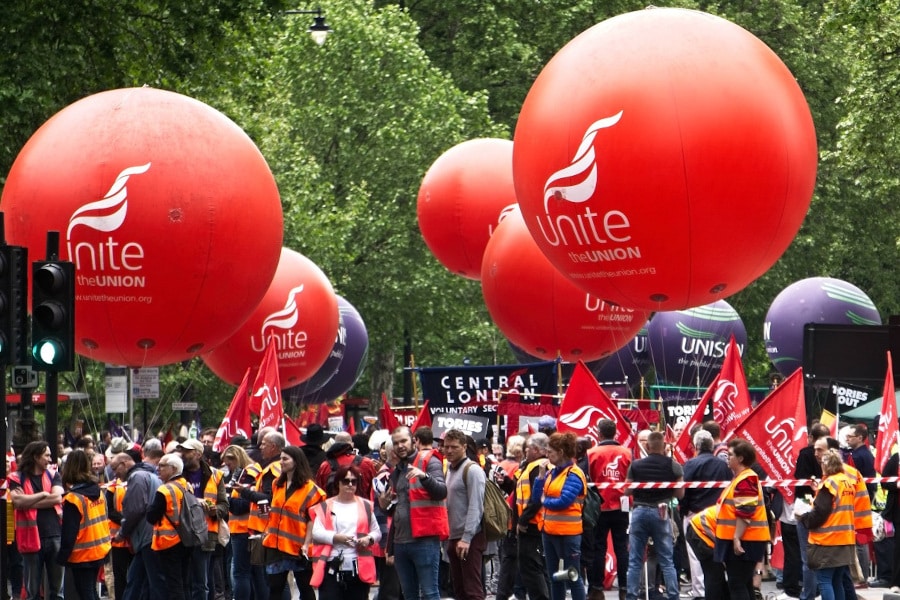
The Unite officers dispute
rs21 members in Unite •rs21 members in Unite report on the imminent strike by the union’s Regional Officers.
Since this was written, talks have resulted in a ballot of Community members on suspending the industrial action, which closed today with 54% in favour of suspending action.
Most Unite members and reps will be unaware of the Regional Officers’ strike in Unite, nevermind the background or reasons for the imminent strike next week.
Until recently, Unite Regional Officers had chosen to conduct their collective bargaining through the Officers National Committee (ONC), which was effectively a staff council or association, rather than with recognised unions. However, unlike most staff councils, the ONC had full bargaining rights. However, the majority of Regional Officers decided they did want to move over to an independent union and asked their committee to investigate the options. The committee decided, without going back to members, to go with the Community union. Community is a notoriously right-wing union that has a history of employing disgraced Unite officials and signing sweetheart deals that undermine trade unionists’ attempts to build workplace power. Under its constitution, the ONC requires a two-thirds majority to dissolve itself; the supporters of Community got a simple majority but not the required two-thirds.
Unite’s leadership reached a joint recognition agreement with Community, not a sole one. This was agreed by all parties. The leadership recently made a pay offer which was accepted by both Community members and other officers.
The pay deal was backdated to 1st January and includes a 3.8per cent salary increase (Retail Price Index inflation at the time the offer was tabled), lifting Regional Officers’ salaries to a minimum of around £73,000. All allowances are increased by the same amount. An additional day’s leave has been granted for Regional Officers to take within 30 days of their birthday, increasing their annual holiday allowance to 30 days. Bereavement leave was increased from five to ten days.
No-one can seriously argue that the old bargaining arrangements had not served officers well, or that the dispute has been prompted because of a difference in approach to bargaining between Community and the ONC or its current successor, the Unite Officers Group (UOG).
However, Community has successfully balloted its members for industrial action. They have pushed for sole recognition (in other words, wanting Unite’s leadership to derecognise other unions). This didn’t appear to be connected to any actual industrial issue — they didn’t highlight any way in which joint bargaining disadvantaged them.
They argue that ‘the majority viewpoint on questions of representation should always prevail’. This is nonsense. In most circumstances we support the right of workers to choose their own union and have it recognised. A majority union isn’t materially held back by recognition of other unions — if it has the support and strength it can win, and will likely win over members of other unions. There are several industries with agreements with many employers in which Unite is not the majority union — are Community arguing that Unite should be derecognised in those industries?
It appears Community are now accepting that Unite will recognise another union alongside themselves, but are unhappy with the non-Community officers themselves deciding which that should be. The UOG are now balloting non-Community members to choose one. It remains to be seen whether this will be enough to stop the strike.
Unite’s officers have extremely good pay and conditions. It’s hard to imagine circumstances where they would be justified in striking over them, affecting their support for members who are overwhelmingly on much worse pay and conditions. However, many do have genuine issues, particularly around workload, the hierarchical managerial culture, bullying and discrimination, including sexism and misogyny (all of which were issues long before Sharon Graham became General Secretary). This dispute doesn’t involve any of these substantive issues. In fact the current deal also has a commitment to address workload issues. Those in dispute haven’t put forward any reasons why joint recognition disadvantages them.
The Regional Officers in dispute with Unite are attempting to portray the dispute as one of workers against management. However, the situation is more complex. Those who work for trade unions are not subjected to the same pressures as any trade unionist working for a typical employer. They are also not exploited like ordinary workers. Officers typically work on behalf of members and are supposed to represent the views of members to employers. They are a mediating layer sitting between workers and employers. Their role is to negotiate the terms under which workers are exploited and oppressed by their employers, and to manage workers’ discontent. They are appointed, largely unaccountable to members and generally have a job for life. This unique position in society makes them subject to pressure from the employer and state on the one hand, and the members they represent on the other. More often than not they seek compromise between these opposing forces — in many cases selling members short.
The current dispute isn’t based on any disagreement about wages, terms and conditions. Nor is it about the failures of existing bargaining arrangements. It’s therefore disingenuous to try and portray this dispute as a normal trade dispute. So, what else could be driving it?
The dispute appears to be almost entirely motivated by hostility to Sharon Graham’s leadership, with the aim of striking around the forthcoming General Secretary election as a factional maneuver. The minority driving this dispute and publicly supporting it are almost all if not entirely associated with the Members United faction (previously the United Left or UL) which supports the previous leadership. In the last General Secretary election, Graham won against the opposition of the vast majority of officers — they backed the UL.
The UL had a majority on the outgoing Executive Council (EC) which presided over the culture of endemic corruption resulting in the vastly overpriced Birmingham hotel and allegations of financial wrongdoing in Unite Affiliated Services. Both of these scandals have resulted in ongoing police enquiries with everyone now accepting that Unite members have been defrauded. All of this was done on the watch of the UL majority on the EC. While it’s important to acknowledge that those EC members were not responsible for the corruption and were probably unaware of the behavior of the main perpetrators, they have done little to distance themselves from those in and around UL who were responsible nor the lack of lay member control that allowed this criminal behaviour.
Politically, the UL have routinely placed support for the Labour Party ahead of Unite members in disputes like the ongoing Birmingham bin workers strike. Many UL supporters oppose the moves towards Unite breaking from Labour. When branches and committees submitted motions to Unite policy conference to change the terrible position taken by Graham et. al. over Palestine, the UL EC members refused to support the excellent EC statement which drew its force from delegates’ motions. When the statement was put to conference, the only opposition came from a couple of hardcore Zionist delegates.
There are many criticisms to be made of the current leadership’s approach to running Unite. Debate, discussion and disagreement are at the heart of the labour movement. It’s how we clarify our ideas and strategy and move forward. The challenge for trade unionists and socialists is about how we manage and conduct ourselves when airing genuine concerns. Clarity and progress can only be achieved if these issues are genuinely about how we take the movement forward and not about protecting or advancing the interests of a faction of union employees.
The current EC elections give Unite members an opportunity to vote for candidates opposed to this UL’s factional agenda and this manufactured dispute. If the UL is defeated then we will have a better opportunity to address the legitimate concerns members and reps have about how we more effectively build members’ power .

0 comments