

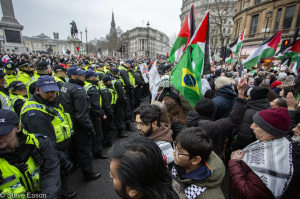
Image: Daboos Hassan / WikiCommons
Palestinian ‘violence’ is not the problem
Kim Wells •Palestinians are within their rights to engage in either armed or unarmed responses to settler-colonial oppression.
After Monday’s massacre in the Gaza strip, in which 60 civilians (including an eight-month-old child) were killed by the Israeli Defense Forces, the occupation and Israeli aggression have come under renewed criticism. Particularly of note was the statement issued by the Labour Party, which was far stronger in its condemnation than many would have expected given the Party’s tendency, prior to Corbyn’s leadership, to shy away from explicit political gestures on questions of foreign policy.
In response, Israel’s apologists, from the most extremist ultra-Zionists to liberal advocates of the “two-state solution” have established a common narrative, which is that Palestinian protesters provoked the violence by attacking the ‘border fence’ separating Gaza from Israel proper. This is astonishing in its brazenness for several reasons.
Leave aside, for instance, the fact that there is video footage showing that this isn’t true. Leave aside the fact that Israel has lied systematically about Palestinian provocation every single time it’s massacred Gazans in recent years. Leave aside also that there exists no Gaza “border” at all, since Gaza is a territory solely controlled by Israel, which murders Gaza’s inhabitants and determines every feature of Gazans’ daily lives to be an unbearable humiliation, even down to determining Gaza’s per capita calorie intake.
Leave all this aside. There is still the simple fact that, even if Palestinian militants had, as implied, started firing at the soldiers on the fence, they would have been entirely within their rights.
After all, it was not Israeli children guarding the perimeter in Gaza; not people in wheelchairs or unarmed women and men waving placards with slogans demanding freedom. The only Israeli presence was that of heavily armed, occupying soldiers. Even the double standards of international law assert that a people under armed occupation have a right to armed resistance. Even the gun-toting militant bogeymen of Israeli fantasy are far more justified in their use of force than the Israeli state has ever been.
There is necessarily a conversation to be had – by Palestinians – about the efficacy of military resistance. It’s a bloody and costly tactic (but then, as Monday’s events show, so is non-violence). Military resistance shouldn’t be glamorised or idealised. But as long as apartheid continues, some Palestinians will be attracted to an armed response, and the resistance movement will be a mixture of armed and unarmed responses. Where armed responses are directed at military targets, they are unquestionably legitimate, independently of whether or not they are strategically wise in any given instance.
On the whole, the commitment of Palestinians to non-violent resistance over the last 70 years of dispossession has been nothing short of astounding. On a daily and weekly basis, Palestinians continue to march peacefully for their rights; these demonstrations are almost entirely ignored by international media and diplomacy, as are the murders, abductions and repression that Israeli forces routinely mete out in response. But, even while we underscore this almost superhuman record of peaceful resistance, the Western pro-Palestine movement must also become more accustomed to defending the Palestinians right to military resistance. If we set Palestinians far-fetched standards for our approval – that they continually and unanimously reject violence, in the face of constant violence – they will never meet them.
Full and unconditional solidarity with Palestinians struggling for their freedom means continuing the struggle for Boycott, Divestment and Sanctions, and continuing to struggle alongside the Palestinian diaspora for their right to return home. It also means solidarity with those Palestinians still resisting occupation in Palestine, whether or not they choose to return Israeli military violence.





0 comments