
The democratic wager: why the Left must support the Syrian Revolution
Nick Evans •Nick Evans Reviews Jules Alford and Andy Wilson (eds.) Khiyana. Daesh, the Left and the Unmaking of the Syrian Revolution. Essays by Muhhamad Idrees Ahmad, Javaad Alipoor, Leila Al-Shami, Mark Boothroyd, Joseph Daher and Shiar Neyo, Sam Charles Hamad, Bodour Hassan, Michael Karadjis, Louis Proyect, Eyal Zisser. London: Unkant, 2016. 278 pp. £9.99.
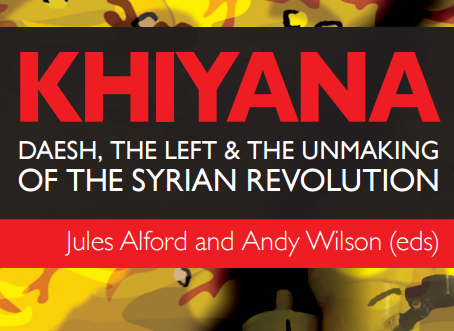
The title of this book means “betrayal”: this is an angry book, and is designed to provoke. The articles collected set out the case against the majority of the international left for its failure to support the Syrian Revolution at best, and active support for counterrevolution at worst. The authors seek to explain the reasons for this betrayal, and to skewer the myths that have justified it.
Mark Boothroyd takes on myths about the Syrian armed resistance. When Cameron made the case for British military intervention against Daesh (ISIS) in autumn 2015, he was mocked for claiming there were 70,000 “moderate” fighters on the ground ready to support the intervention. Precisely the wrong part of Cameron’s claim was attacked. Rather than exposing Cameron’s lie that the Syrian rebels welcomed any imperialist carve-up that would leave Assad in place, most critics replicated Putin’s lie that all of the Syrian rebels are al-Qaeda or Daesh. Mark demolishes both lies in forensic detail.
Equally painstaking is the delineation of the origins, ideology and material basis of Daesh. Contrary to the conspiracy theories, Saudi Arabia does not fund Daesh: Sam Charles Hamad demonstrates why the ideological kinship between the Gulf state and the new proto-state actually underpins their “irreconcilable antagonisms”. The driving force for Daesh is instead located in the sectarian mass murder carried out by the Assad regime, Iran and Russia, while the Syrian rebels are identified as the only force capable of tackling Daesh or its actual cause.
A series of articles aid understanding of the form the counter-revolution has taken. Javaad Alipoor argues that internal contradictions within Khomeinism have been turned outwards through Iran’s sustained and brutal intervention in Syria. Budour Hassan demonstrates why the international Palestinian solidarity movement must break with any support for Hezbollah or Assad. Michael Karadjis and Eyal Zisser analyse the class dynamics within Syria that have determined the changing composition of the Ba’athist regime and its antagonists.
So how did the left manage to get this so wrong? Sam Charles Hamad’s answer invokes Marx: “the ideology of the ruling classes is at all times the ruling ideology”. Critics of US and UK imperialism have often reproduced Islamophobic “war on terror” tropes about the opposition to Assad in Syria. The obsession with the idea that the US seeks “regime change” in Syria has lined up many “anti-imperialists” on the side of the status quo actively supported by Russian and Iranian imperialists and tacitly supported by US and UK imperialists. Too often the left are impressed by the way regimes or parties describe themselves: Leila al-Shami and Shiar Neyo critique the way the Kurdish Democratic Union Party (PYD) has been romanticised, leading to selective solidarity that obscures the common struggle of Syrian Kurds and Arabs in Kobane.
Can the left redeem itself? The introduction to this book urge socialists to take the “democratic wager”. The Syrian Revolution is placed in the context of a wave of uprisings for democracy, beginning with the Green Movement in Iran. The authors analyse how neoliberalism has shaped the class dynamics and political character of these uprisings, and follow Neil Davidson in arguing Trotsky’s concept of “permanent revolution” is now obsolete. If the left wishes to be given any hearing, it must “grasp that between democracy and dictatorship it always sides with democracy“: there are harsh words here for those who misinterpreted the 3 July coup that overthrew Morsi’s democratically elected government in Egypt.
The catalogue of betrayals by left intellectuals, journalists and anti-war organisations itemised here is dispiriting. As Louis Proyect puts it, “It’s a tragedy for the left that so many who came of age in the 1960s like Tariq Ali cannot understand how much the Vietnamese peasant and his Syrian brothers and sisters today have in common.” Through their anger, the authors of this book offer a persuasive account of how this betrayal came about and a demolition of the falsehoods that sustain it.
Meanwhile, for those provoked to take the democratic wager, Robin Yassin-Kassab and Leila al-Shami’s Burning Country: Syrians in Revolution (2016) is an excellent place to learn more about the inspiring examples of self-organisation from below thrown up by the Syrian Revolution.
https://www.youtube.com/watch?v=tSHlQnMc3t4&w=420&h=315
Videos via Al-Hamra’s Syrian Democratic Revolution blog.
**
Khiyana includes a longer version of Mark Boothroyd’s article The Syrian Revolution and the Crisis of the Anti-War Movement, which was originally published at: http://www.rs21test.org.uk/2015/09/10/the-syrian-revolution-and-the-crisis-of-the-anti-war-movement/







8 comments
There is no Syrian revolution.
There is no option apart from supporting Assad.
The ‘left’ ended up supporting ISIS in Syria and Libya, and pretend its a ‘democratic’ revolution.
if there’s no revolution, lets invent one! that seems to be RS21’s view.
There is a Syrian revolution.
Supporting Assad is what has made the torture, rape and murder get steadily worse for the last five years.
It is Gadaffi loyalists who make up ISIS in Libya, and Assad who collaborates with it in Syria, so don’t pretend they and the revolutionaries are anything other than enemies.
If you have no actual argument, why not pretend you have one, seems to be Jake’s view.
[http://notris.blogspot.co.uk/search?q=isis+assad]
“Rather than exposing Cameron’s lie that the Syrian rebels welcomed any imperialist carve-up that would leave Assad in place.”
This isn’t true. I actually listened to the debate, something nobody on the Left seems to have bothered to do. Cameron said we need a negotiated transition to get Assad out of power, and then the moderate rebels, and what remains of the SAA, would be free to fight ISIS. Check Cameron’s opening speech and his replies to interventions in Hansard.
Not only is the notion that “permanent revolution is obsolete” false and reactionary, but I don’t see where the reviewer sees that in the book. What’s more, if it’s so obsolete, why is the theoretical journal of MENA socialists called “permanent revolution”?
Andrew – the introduction to the book explicitly follows Neil Davidson in arguing that the theory of permanent revolution (unlike U&CD) is no longer relevant since “many of the countries concerned are now more or less independent centres of capital accumulation, and there are no substantive bourgeois ‘tasks’ to be fulfilled thereabouts”. Like Neil, the authors reject the idea that fighting for democracy is a a ‘bourgeois task’. As you suggest clearly Bassam Chit would not have agreed, given he established a journal with the same name. I know there is currently a publishing project to translate articles from the journal into English. Hopefully this will be the start of a fruitful dialogue.
Dick – my formulation was clumsy. Cameron did not explicitly argue that the rebel fighters would accept Assad staying in place. In the 2 December debate he said the 70,000 were mainly FSA, that some of them were defectors from the SAA, and that “the Russians… are prepared to talk to these people”. He then said: “there was an enormous gap between Britain, America, France and, indeed, Saudi Arabia on the one hand and Russia on the other hand; we wanted Assad to go instantly and they wanted him to stay, potentially forever. That gap has narrowed, and I think that it will narrow further as the vital talks in Vienna get under way”. Mark Boothroyd’s article “Can the Revolution in Syria Survive and Imperial Carve Up?” illustrates how the US and UK have been attempting to force the Syrians to accept Assad’s participation in a political transition.
http://uk.reuters.com/article/uk-mideast-crisis-syria-britain-idUKKCN0RT22920150929
Ah, yes, the introduction (who is the author, Assad an-Nar?). I had forgotten how truly awful it was.
One can argue whether democratic rights are bourgeois or not. But the Arab Revolutions prove once again that it will either be working-class-led revolutions (including for democracy) or barbarism. And the (tired old) arguments about the supposed decentering of the working class and its alleged powerlessness are dangerous ones for workers everywhere.
Andrew Pollock – These revolutions you speak of never happen though do they, they are a fantasy based of an mythology that should have died with the third international. What we have are struggles for democracy and social justice that can go further into the institution of a new society but can only on the basis of these revolts developing the autonomous capacities of the participants. Permanent Revolution, like Marxism, is a schema that has been invalidated by history.
Andrew Pollack
It’s that kind of stupidity that led fanatics of Orthodoxy like yourself to stand by as Sisi swept away the Egyptian revolution. A revolution starts to unfold and all you can to is carp from the sidelines because the Muslim Brotherhood don’t fit their schema of Permanent Revolution.
I don’t believe there is a Syrian revolution. However, I would like to know which group does RS21/ or the ‘left’ support? whom should we support? by this i mean give me the name of groups, parties etc. that actually exist.
If you are going to say ‘we support the people’ i will take it that you don’t know what group to support, because thats easy to say.
there has never been a Trotskyist revolution and it seems to me that much of the ‘left’ want to read everything as a revolution, even when there is no revolution of any sort. Much of the left imagine that people in Syria whom they have never met and know little about somehow have the same political views as RS21 etc.
I don’t believe there is any Syrian revolution, there is a brutal civil war. I think the Russia/Iran/Hezbullah/Assad axis should be supported. I certainly don’t think Assad is a saint, but it is the only realistic choice.
there is something deeply immoral about inventing up a revolution just to fit in with your theories. this is idealism.