
The First Workers’ Government
James B •145 years ago today a disastrous war among European capitalists produced the first workers’ government in Paris. James B introduces Marx’s analysis on the Commune.
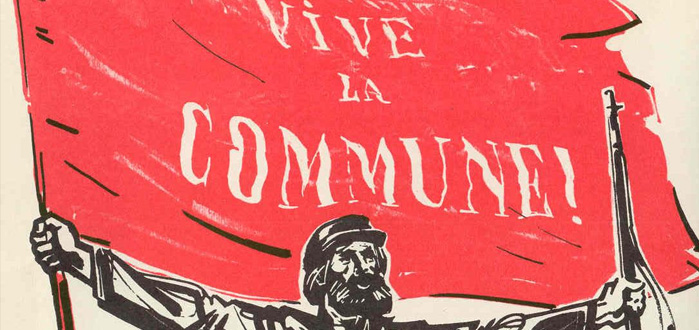
Today marks the 145th anniversary of the foundation of the Paris Commune. In 1870 Emperor Napoleon III led France into a disastrous war with Prussia. Paris, defended by the citizens’ militia of the National Guard, was subjected to a four month siege by the Prussian army. The abdication of the Emperor made way for a Republican government which signed an armistice and agreed to massive reparations.
In this excerpt from his 1891 introduction to Karl Marx’s classic analysis of the Commune, “The Civil War in France” (https://www.marxists.org/archive/marx/works/1871/civil-war-france/) Fredrick Engels briefly describes the immediate events leading to the proclamation of the Commune and its political character.
During the war the Paris workers had confined themselves to demanding the vigorous prosecution of the fight. But now, when peace had come after the capitulation of Paris, now, Thiers, the new head of government, was compelled to realize that the supremacy of the propertied classes – large landowners and capitalists – was in constant danger so long as the workers of Paris had arms in their hands. His first action was to attempt to disarm them. On March 18, he sent troops of the line with orders to rob the National Guard of the artillery belonging to it, which had been constructed during the siege of Paris and had been paid for by public subscription. The attempt failed; Paris mobilized as one man in defence of the guns, and war between Paris and the French government sitting at Versailles was declared. On March 26 the Paris Commune was elected and on March 28 it was proclaimed. The Central Committee of the National Guard, which up to then had carried on the government, handed in its resignation to the National Guard, after it had first decreed the abolition of the scandalous Paris “Morality Police.” On March 30 the Commune abolished conscription and the standing army, and declared that the National Guard, in which all citizens capable of bearing arms were to be enrolled, was to be the sole armed force. It remitted all payments of rent for dwelling houses from October 1870 until April, the amounts already paid to be reckoned to a future rental period, and stopped all sales of articles pledged in the municipal pawnshops. On the same day the foreigners elected to the Commune were confirmed in office, because “the flag of the Commune is the flag of the World Republic.”
On April 1 it was decided that the highest salary received by any employee of the Commune, and therefore also by its members themselves, might not exceed 6,000 francs. On the following day the Commune decreed the separation of the Church from the State, and the abolition of all state payments for religious purposes as well as the transformation of all Church property into national property; as a result of which, on April 8, a decree excluding from the schools all religious symbols, pictures, dogmas, prayers – in a word, “all that belongs to the sphere of the individual’s conscience” – was ordered to be excluded from the schools, and this decree was gradually applied. On the 5th, in reply to the shooting, day after day, of the Commune’s fighters captured by the Versailles troops, a decree was issued for imprisonment of hostages, but it was never carried into effect. On the 6th, the guillotine was brought out by the 137th battalion of the National Guard, and publicly burnt, amid great popular rejoicing. On the 12th, the Commune decided that the Victory Column on the Place Vendôme, which had been cast from guns captured by Napoleon after the war of 1809, should be demolished as a symbol of chauvinism and incitement to national hatred. This decree was carried out on May 16. On April 16 the Commune ordered a statistical tabulation of factories which had been closed down by the manufacturers, and the working out of plans for the carrying on of these factories by workers formerly employed in them, who were to be organized in co-operative societies, and also plans for the organization of these co-operatives in one great union. On the 20th the Commune abolished night work for bakers, and also the workers’ registration cards, which since the Second Empire had been run as a monopoly by police nominees – exploiters of the first rank; the issuing of these registration cards was transferred to the mayors of the 20 arrondissements of Paris. On April 30, the Commune ordered the closing of the pawnshops, on the ground that they were a private exploitation of labor, and were in contradiction with the right of the workers to their instruments of labor and to credit. On May 5 it ordered the demolition of the Chapel of Atonement, which had been built in expiation of the execution of Louis XVI.
Thus, from March 18 onwards the class character of the Paris movement, which had previously been pushed into the background by the fight against the foreign invaders, emerged sharply and clearly. As almost without exception, workers, or recognized representatives of the workers, sat in the Commune, its decision bore a decidedly proletarian character. Either they decreed reforms which the republican bourgeoisie had failed to pass solely out of cowardice, but which provided a necessary basis for the free activity of the working class – such as the realization of the principle that in relation to the state, religion is a purely private matter – or they promulgated decrees which were in the direct interests of the working class and to some extent cut deeply into the old order of society. In a beleaguered city, however, it was possible at most to make a start in the realization of all these measures.
Full introduction:
https://www.marxists.org/archive/marx/works/1871/civil-war-france/intro.htm









0 comments