
Solidarity through football
Charlie W •In the second article of a series Against Modern Football, Charlie W recounts the history of football as a radical sport of the masses and argues for its subversive potential even in the face of FIFA corruption and geopolitical manipulation.
Football is the most popular sport in the world, enjoying a cultural cut-through challenged only by music and film. Its commonly told history, methods of governance, and existence in our popular imagination, however, are dominated by the interests of political and corporate elites. But terraces around the world refuse to let corporate homogenisation swallow up a game that has a long history of radicalism and solidarity.
The roots of the game later developed into Association Football by English private school boys are explicitly radical. As recorded in Mickaël Correia’s The People’s History of Football, they emerged from cross-village games of “la soule”, a Normandy ball sport that revolved around getting a wooden or leather ball into the opponents’ goal using hands, feet, or sticks; and mob scrums in the North and Midlands of England. Landworkers in the fens used mob football to destroy emerging enclosures as early as the 15th century. This tactic migrated towards the cities with England’s increasingly urbanised workers, where games of football were often used as cover for organising riots in Canterbury and London.
The game’s globalisation mirrored the football’s class struggle between rowdy creativity and collective enjoyment on the one side, and Etonian “muscular Christianity” and gentlemanly leisure on the other. Propertied elites followed the tendrils of empire to set up clubs and leagues, infusing them with institutional hierarchies and imperial power. Yet sailors and workers across national lines in the “informal empire”, particularly in Italy, Brazil, Uruguay, and Argentina, were the true generators of football’s universality. In dusty arenas adjacent to docklands, coalfields and factories from Buenos Aires to Accra to Huelva, workers built cross-cultural solidarity away from the watchful eyes of their supervisors, forging an internationalist tradition in grassroots football that lives on today.
Football’s simplicity and its democratic potential in action and organisation offer a means for collective subversion from the bottom up, articulating through play what Eduardo Galeano called ‘unique expressions of the personality of each people’. The bureaucratism and commodification of contemporary capitalism continuously blunts these unique expressions. But those who accuse football of stultifying the revolutionary potential of the masses and directing them towards destructive nationalism ignore the parallel and competing histories of solidarity and radicalism. These histories have been borne through an endless struggle to play: a struggle against racialised and gendered exclusions; a popular football tradition that opens avenues for material solidarity across borders, and a revolutionary nationalism of colonised people who rip football from the hands of their imperial administrators, shattering racial hierarchies to glimpse self-determination.
Antonio Negri, himself organised with AC Milan’s Brigate Rossonere ultras, saw football’s globalisation simultaneously as a precursor to that of capital and labour. But he also saw it as a common activity and language working against the alienating logic of endless accumulation. Thus, transgressive social relations can be built from both within and outside the commodified spectacle, producing organic intellectuals in fan culture (e.g. organised ultras and queer fan groups), autonomous grassroots football spaces who fight capitalist orthodoxies (against the societal exclusion of migrants and trans women), and in the actions of the spectacle’s most heavily invested stakeholders.
In this analysis, we can see Socrates’ Corinthians Democracy movement and the Algerian players who left France’s Ligue 1 to play for the FLN’s touring independence eleven as constituting the same popular impulse. Celtic’s Green Brigade can set up material solidarity with Aida Refugee Camp in Bethlehem – Lajee Celtic providing dignity and pride amidst endless Zionist aggressions – whilst organised fan groups from Athens and Marseille to Casablanca and Vallecas instrumentalise networks to raise funds for victims of the genocide in Gaza and campaign against the normalisation of Israel. At any opportunity, terraces and concourses in South West Asia and North Africa are filled with expressions of solidarity for the people of Palestine, and organised ultras groups play key roles on the street: using their experience to energise and organise popular mobilisations, as they did particularly effectively during the 2011 uprisings in Egypt and Tunisia.
The true offer of solidarity through football is not merely a mirror of wider class struggle or geopolitics. It is the groupings of football lovers who organise for an everyday provision of social life away from exploitation, and for material support across borders. In this vein, footballers and fans can move within the Trojan Horse of organised sport and carry with them the revolutionary weapons of their choice.
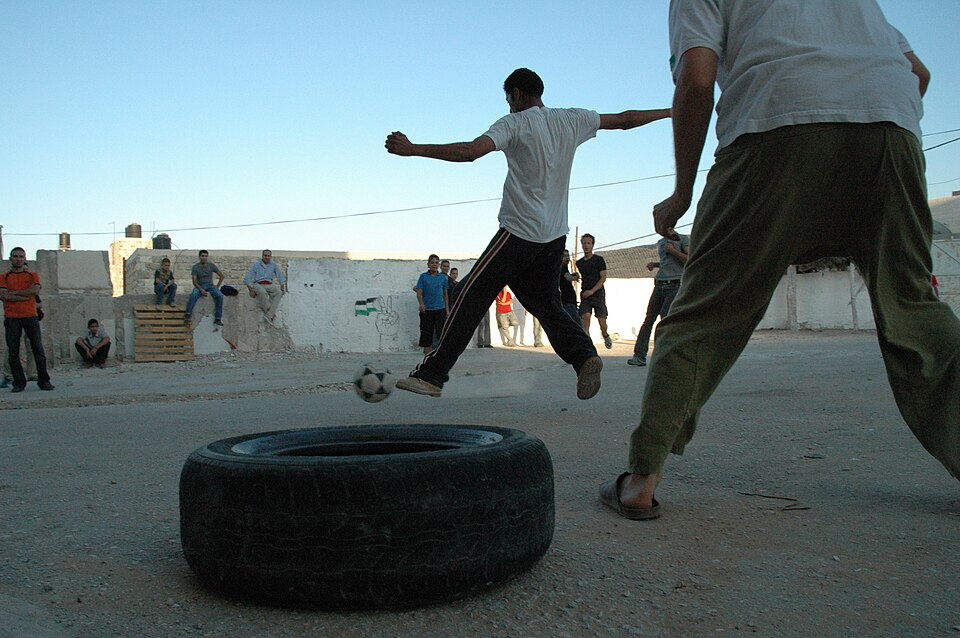
Deep networks of solidarity can emerge from spaces seemingly lost to neoliberal dominance – the DIY mob game fights through the cracks of its plastic. Far from a pacifying and disciplining force of the bourgeoisie, football can be a place for building popular blocs that refuse to exclude marginalised comrades and provide the space for disparate movements to gather, learn, and resist together.
Palestinians gathering for World Cup watch-parties amidst their destroyed houses. Iranian footballers assert their steadfastness against the flailing American empire. They both are part of and resistance against the spectacle of global football in its neoliberal zenith. These contradictions do not render them, nor the game itself, capitalist or counter-revolutionary. Football, like everything else supposedly lost to us, is there to be won.
This is the second part in an ongoing rs21 series of articles, Against Modern Football. You can read the first article here.







0 comments