

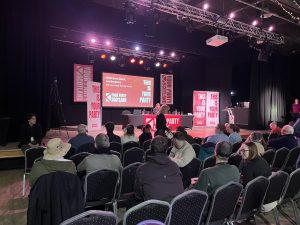
Jeremy Corbyn speaking at a pro-Palestine rally, London, May 2024. Photo by Steve Eason.
Making Gaza the issue in the general election
Jonny Jones •Jonny Jones argues for making Gaza a central issue in the general election as part of starting to build a serious opposition to Starmer’s Labour.
When Rishi Sunak called a snap general election on Wednesday 22 May, for many people, the news came as a relief. After 14 years of Tory austerity, crisis and bigotry, the chance to kick them out of office is a welcome one. It seems fairly certain that Keir Starmer’s Labour Party will win a thumping majority, with polling showing them holding an average poll lead of more than 20 percent over the disintegrating Tories.
On the same day, the Gaza health ministry announced that at least 62 people had been killed and 138 wounded in the previous 24 hours. It would be understandable for people to look at the election as a distraction from the horrors being perpetrated by the Israeli state in Gaza.
However, the election will politicise society in Britain over the next month, and open up many spaces for the movement in solidarity with Palestine to ensure the election doesn’t just become a victory parade for Starmer, and to ensure that our opposition to the establishment’s support for genocide is a major part of the campaign. We should be thinking about how the election can amplify struggles around Gaza, rather than suspend them.
This movement has dominated popular politics in Britain since October. Frequent mass demonstrations have taken place in London and cities and towns across the country. Alongside these, direct actions, sit-ins and occupations have gripped the news and public opinion. The movement has forced shifts in government and opposition policy and brought down a Tory home secretary. As in other countries all across the world, the movement for Palestine has been a high point in organising and mass mobilisation.
It is very clear that public opinion in Britain is on our side. Polling by YouGov in late May found that 73 percent of people in Britain support an immediate ceasefire – including 67 percent of those who voted for the Tories in 2019 – while only 8 percent of people are opposed. Some 55 percent of people support suspending arms sales to Israel. In a clear sign of how out of touch Sunak and Starmer are with public feeling, only 18 percent approved of the government’s response, and just 12 percent approve of Labour’s.
Starmer did not call for a ceasefire until mid-February, over four months into the onslaught – in November he sacked shadow ministers who broke his order to not vote for a ceasefire in parliament. He continues to dodge questions about doing something that could seriously ratchet up pressure on the Israeli state – an arms embargo.
Despite Labour’s commanding lead in the polls, their support is shallow – just two days before the election announcement, YouGov polling found that 54 percent of people disapproved of Starmer’s leadership, compared to just 18 percent who thought he was doing well. The safe Labour seat of Rochdale was lost in a by-election to George Galloway over the issue of Gaza, and independents who support Gaza caused upsets in places like Oldham and Blackburn during May’s local council elections. Analysis by the BBC showed that Labour’s vote share in areas where more than one-in-five residents identified as Muslim had dropped by 21 percent. In response, Labour has declared a number of previously safe seats with high Muslim populations ‘battleground seats’.
Wherever there are credible left alternatives standing against Labour, there is an opportunity to put Gaza front and centre. Jeremy Corbyn’s candidacy in Islington North is one clear example of this, as is Faiza Shaheen in Chingford and Woodford Green, but there will be a number of constituencies around the country where candidates with a local base will be running to the left of Labour or on an explicitly pro-Gaza platform.
Credibility is not just about being able to get a good result, though. Some candidates like George Galloway centre Gaza while making unacceptable attacks on trans people and anti-oppression politics, and playing down climate change. No credible left alternative can be based on such thoroughly reactionary positions.
These campaigns need to be clear eyed – very few will have a chance of winning. Ensuring that those involved in the campaign know this, and have a sense of what they are trying to achieve, is crucial to avoid disappointment over final results.
Labour left candidates who have been keeping their heads down out of fear of deselection need to be put under pressure to keep Palestine at the top of their agenda. We should be inviting candidates to speak at events, sign open letters and respond to the Palestine Solidarity Campaign’s questions to candidates , while remaining uncompromising in our own positions and not allowing the movement to be pulled to the right by overly cautious politicians.
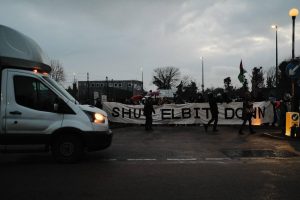
Where there isn’t a candidate of the movement, that doesn’t mean nothing can be done. We can organise protests outside hustings and public appearances that keep Gaza on the agenda. Recently, a protest against arch-Zionist Luke Akehurst being parachuted in as a Labour candidate in North Durham was joined by Labour members who left the “selection” meeting furious at the imposition being made against their wishes. There will be many opportunities for putting candidates on the spot in the month ahead, and local Palestine groups should be calling them wherever it makes sense to do so.
We also need to keep up the rest of the organising we’re doing around Gaza. These organising spaces will also be politicised by the election and open up opportunities to discuss bigger politics, about the need for an alternative to Labour, for solidarity with migrants and trans people being cynically targeted as electoral fodder. In the context of an election campaign, mass protests can make a big splash and keep the issue squarely in the public eye.
The political class in Britain has been shaken by the strength and resilience of the movement for Gaza. It should be a lesson to the left that it is possible to take independent, popular initiatives that accelerate our organising in the midst of an election campaign, rather than winding it down. As the election campaign grinds on, we should take every opportunity to use this moment as a catalyst, continuing to lay down the basis for ongoing solidarity with Palestine in communities and workplaces, and a credible alternative to Starmer’s Labour.
The rs21 pamphlet Israel: the making of a racist state is available to order here.





0 comments