
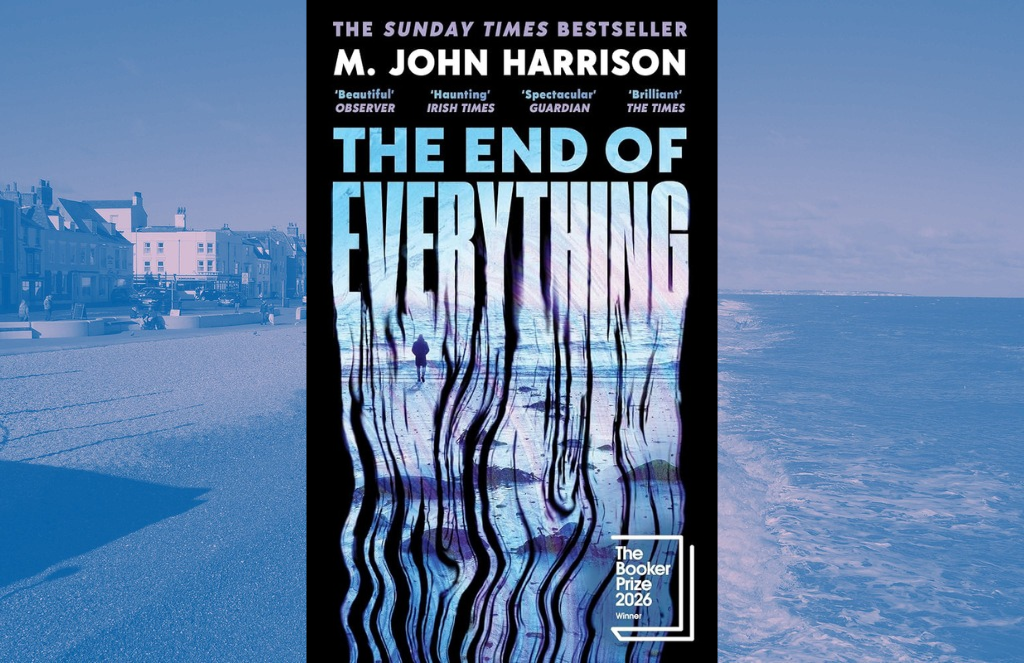
Book Cover Courtesy of Serpent’s Tail By https://serpentstail.com/work/the-end-of-everything/, Fair use, https://en.wikipedia.org/wiki/Special:Redirect/page/83821329
Review | The End of Everything
Thomas Necchi •Thomas Necchi reviews the Booker Prize winning work of weird fiction by M. John Harrison, and argues for more frustrating, genre-blending novels
M. John Harrison has long been known as an iconoclast and writer of the ‘new weird’ in speculative fiction circles. In these milieus he is primarily known for his works such as the Viriconium series and the Kefahuci Tract trilogy, which attacked and challenged the dominant cliches, lazy writing and reactionary politics of science fiction and fantasy. Harrison made his entrance into what is often glibly referred to as ‘genre fiction’ through the New Worlds magazine, the principle publication of the New Wave movement, which sort to apply the techniques and forms of literary modernism and post-modernism to speculative fiction in order to break with the existing trends found in the pulp novels of the day. What this meant was an innovative approach to science fiction and fantasy, where the avant garde met low culture. Michael Moorcock applied the influence of Bertolt Brecht to sword and sorcery, creating Elric of Melniboné, a 60s infused deconstruction of Conan the Barbarian. JG Ballard wrote condensed novels in the serialised form of what would become The Atrocity Exhibition. And it was also here where Harrison would write his earlier stories and essays. In his own words on his influences, Harrison said:
I liked anything bizarre, from being about four years old. I started on Dan Dare and worked up to the Absurdists. At 15 you could catch me with a pile of books that contained an Alfred Bester, a Samuel Beckett, a Charles Williams, the two or three available J. G. Ballards, On the Road by Jack Kerouac, some Keats, some Allen Ginsberg, maybe a Thorne Smith. I’ve always been pick ‘n’ mix: now it’s a philosophy.
Though he took a break towards the 80s, venturing into literary fiction with the exceptional Climbers, he eventually came back, and his more recent works such as the Tract trilogy and his Goldsmith prize winning The Sunken Land Begins to Rise Again have continued the trajectory of his earlier work, albeit in a less angry and more accomplished form.
Recently, however, he has found himself the subject of mainstream attention when he won the Booker prize for his most recent novel, The End of Everything. This post-apocalyptic work, set on what is implied to be the Kent coastline after an incursion by things or creatures known as the iGhetti, was said to be the work by the first ‘bona-fide sci-fi writer’ to win the Booker. To say he was a dark horse amongst the book reading public would have been an understatement, and certainly those readers who frequented BookTok (the appropriate section of the app TikTok) were upset. Writers on the other hand, were almost unanimous in praising Harrison, seeing it as a well deserved win (though as one Booker judge was at pains to make clear, the prize was not being given as a Lifetime achievement award).
So why had The End of Everything upset the online world of readers so much? Part of it most likely had to do with Harrison’s approach to creating his stories. Influenced as he was by literary modernism, Harrison rejected the idea that the worlds presented in stories should be completely explained and mapped out and knowable. In a controversial remark on the concept of ‘worldbuilding’, Harrison argued:
Worldbuilding is dull. Worldbuilding literalises the urge to invent. Worldbuilding gives an unnecessary permission for acts of writing (indeed, for acts of reading). Worldbuilding numbs the reader’s ability to fulfil their part of the bargain, because it believes that it has to do everything around here if anything is going to get done.
Worldbuilding at best gives you the works of Tolkien, though with this comes his imitators taking on his worst aspects. At its worst, you have the patently ridiculous decision by Pottermore to say that Wizards used to shit their pants and magic it away. It demands a totality of knowledge. Whilst to some this might seem like just a different depth of imagination on the part of the writer, this is precisely why Harrison has a problem with it, because of the habits it instils in the reader:
Writing does something else. It not only invites but relies upon reader-participation. Writing and reading are complementary aspects of the same process; much of what appears to be the work of writing is in fact done by the reader in the act of reading. While the writer takes advantage of this, making implications & inviting the reader to do the rest, the worldbuilder–lonely & godlike & in control of (or attempting to be in control of) every piece of footage retrieved from her obsessive creation–induces dependency in the audience, then discovers in the subsequent delirious spiral of self-fulfilling prophecy an excuse to take even more responsibility out of their hands. God’s in her Heaven & all’s right with the “world”.
This anti-worldbuilding approach can be seen throughout Harrison’s oeuvre, in microscopic germ form in The Centauri Device before being applied polemically in Viriconium, where the city changes names depending which story you are reading, alternate versions of the characters come and go, and the world is never mapped as you might find in a work of Tolkien’s. Even in supposedly consistent worlds such as in the Tract trilogy, Harrison forgoes explaining a lot of the world because the characters, being familiar with it already, simply have no reason to do so. But in The End of Everything this same approach to world building takes on a sharp political edge. The iGhetti, whose ground zero was ostensibly London, have no explanation. The end of the world they have initiated happened not with a bang but a whisper, and many people are still trying to make sense of what happened. People keep on living, though it is clear much of society has broken down by the beginning of the story, when Phil Tenent, who is seemingly the main character, finds an artifact on a beach (read: an artificial child which begins to grow and learn).
Several explanations are given for the iGhetti; none of them are ever proven either right or wrong. The people in The End of Everything, Harrison has said elsewhere, suffered from a complete failure of knowledge. Their existing frames of reference simply cannot adjust for the iGhetti’s existence. So confident was man in his understanding of the world that when the end of the world came, he was unable to recognise it as such. So great is the breakdown of knowledge in the novel that the Kent coastline is implied in several places to be a torqued version of itself that bears no relation to the real world of order of it. The characters never comment on it; some of them are beyond trying to make sense of it.
The readers, through these elements, are then put in the same position as the characters. The strength of response to Harrison was likely influenced in part by this, as readers found themselves trying to immerse themselves in a story that simply didn’t work that way, which forced them into a different relationship with the text. And this response, given the themes and subject matter of the book, takes on political implications as well. From a political reading, the iGhetti could be read as several things; climate change, artificial intelligence, neoliberal capitalism (this last one might seem like a stretch within the context of the novel, but Harrison is on record as saying the initial short story where the iGhetti first appeared was inspired by the 2008 crash). The failure of knowledge displayed by the characters and the world they live in is simply a reflection of our own failure of knowledge. The dominant narratives around climate change and AI, those pushed by the mainstream media and governments across the world, are inadequate. Even with the scientific knowledge we have on climate breakdown and global warming, the situation has gotten worse and worse. What is needed is a political framework which can fully understand the causes and driving factors of the crisis.
Part of the reason The End of Everything never explains itself or neatly resolves the story, aside from Harrison’s own literary stances, is because the book itself is about the permanent crisis, polyfaceted, ever accelerating but proceeding just slow enough to boil all us frogs to death. It is not enough for a political framework to state one cause or principle contradiction. Whilst this may very well be true, the time for simple narratives and rhetoric has passed. We must hold to the ‘ruthless criticism of all that exists’, taking care to note that Marx followed up said phrase with the caveat: ‘ruthless both in the sense of not being afraid of the results it arrives at and in the sense of being just as little afraid of conflict with the powers that be.’ The critique of knowledge and of cliched writing are entwined, with Harrison using the subversion of genre and literary expectations to highlight the deficit in our approach to the world. As he wrote in his argument on worldbuilding:
The whole idea of worldbuilding is a bad idea about the world as much as it is a bad idea about fiction. It’s a secularised, narcissised version of the fundamentalist Christian view that the world’s a watch & God’s the watchmaker. It reveals the bad old underpinnings of the humanist stance. It centralises the author, who hands down her mechanical toy to a complaisant audience (which rarely thinks to ask itself if language can deliver on any of the representational promises it is assumed to make), as a little god. And it flatters everyone further into the illusions of anthropocentric demiurgy which have already brought the real world to the edge of ecological disaster.
The End of Everything is written mostly with a tone of despair. But towards the end, in the shimmering of the world, there is a glimmer of hope. Any hope in reality, just as in the novel, cannot be proclaimed confidently. This is perhaps why it caused such a kneejerk reaction, why BookTok ‘librarians’ such as Jack Edwards whined that they couldn’t get into it. It made no attempt to comfort its readers. In Cesar A. Cruz’s famous (now almost cliche) phrase, ‘Art should comfort the disturbed and disturb the comfortable’, it is often the prerogative of many to assume they are the disturbed, when they are in fact the comfortable. Perhaps if it had been conventional, they might have been able to stomach this message. But the lack of certainty was built into the very structure of the novel. Itself an iGhetti, the novel offered no easy answers.
But in a sense, to have received a novel for the current moment that tells no lies and claims no easy hope is a gift. It puts us in the right place to begin our ruthless criticism, to expand our knowledge of the world and our society in order that we might grasp all the parts of the crisis at once. It might lead us to uncomfortable places, but we shouldn’t be afraid. If we push through, we might give ourselves something worth fighting for: the chance to make new worlds.



0 comments