
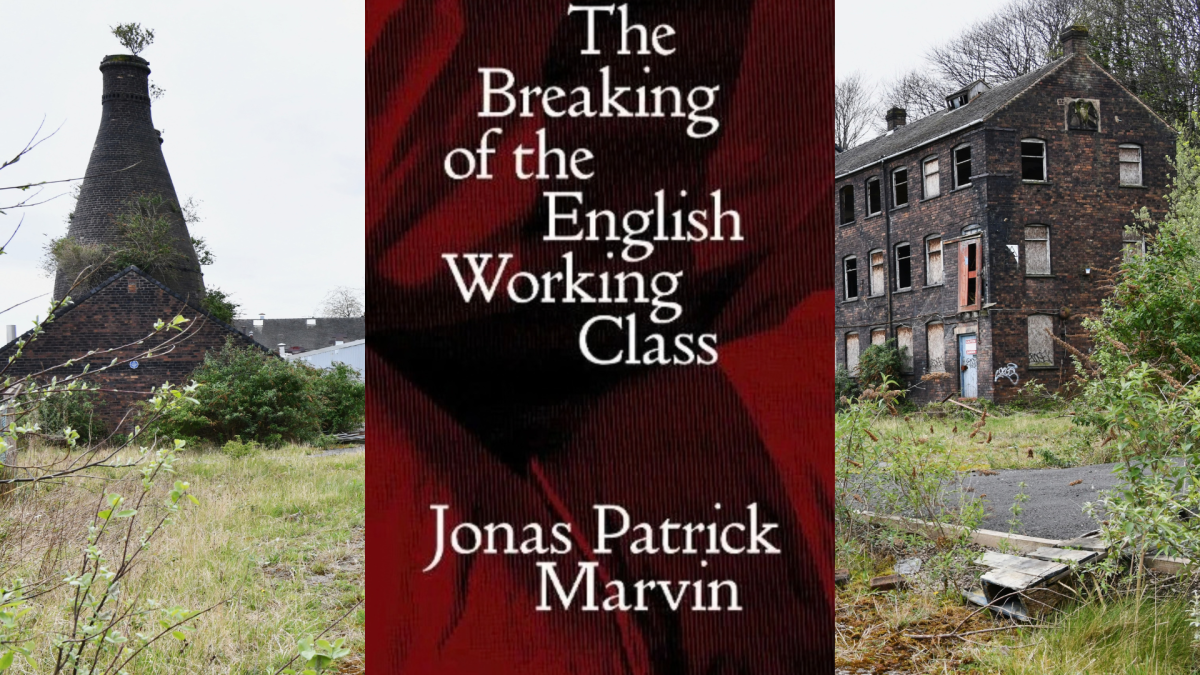
Review | The breaking of the English working class
Rachel Iboraii •Rachel Eborall reviews Jonas Patrick Marvin’s important new book in which he argues that the breaking of the English working class was neither inevitable nor natural.
In the preface to The Making of the English Working Class, the historian E. P. Thompson says:
Making, because it is a study in an active process, which owes as much to agency as to conditioning. The working class did not rise like the sun at an appointed time. It was present at its own making.
In his debut book Jonas Patrick Marvin argues that the breaking of the English working class was neither inevitable nor natural. No rose-tinted glasses here! Our class is poorer, more insecure, and our bodies are broken. In short, we have been battered without much of a fightback. This process wasn’t neglect but the result of a series of deliberate political choices and experiments, including Margaret Thatcher’s confrontation with the trade unions and the privatisation of large parts of public life. These transformations were consolidated under Tony Blair and New Labour, further embedding the economic and social conditions that have reshaped working-class life in contemporary England. This process has led to an abandonment of working-class communities.
Marvin is not an objective observer of class, nor an anthropologist studying it from a distance. By drawing on biographical details, he makes it clear that he has skin in the game. Yet these autobiographical reflections do more than simply add a human dimension to the book. They illuminate class processes and experiences. He reflects on his move from London to Stoke in response to exorbitant housing costs, an experience that will be familiar to many young people attempting to build a life in the capital in the early twenty-first century. At the same time, this journey echoes an earlier migration undertaken by his grandfather, who moved from Ireland to England to find employment. These stories reveal a deeper feature of working-class life: the limited autonomy that many people have over the fundamental decisions that shape their lives.
In this small but powerful book, Jonas Patrick Marvin asks what has happened to the working class in England and how we arrived at a moment in which many working-class people are drawn to Reform and encouraged to see migrants as the source of their problems. He challenges the assumption that unemployment, low pay, insecure work, and unaffordable housing are simply facts of life, arguing instead that they are the result of political decisions that have come to be accepted as natural and inevitable.
Drawing on themes that echo E.P. Thompson’s The Making of the English Working Class, Marvin reminds us that class is not a fixed social category but a historical process, continually shaped through conflict, relationships, and political struggle. Just as Thompson showed that the working class was actively made, Marvin argues that its weakening and fragmentation were also the products of history and struggle.
There is no hand-wringing in this book about the ‘left-behind’ white working class, nor minimisation or an attempt to excuse racism or anti-migrant sentiment that is too prevalent in the working class. Instead, he offers a clear definition of class rooted in the relationship between those who own the means of production and those who do not. Class cannot be understood in isolation from oppression. These experiences are dynamic and inform one another. Marvin also rejects definitions of class that privilege cultural signifiers or celebrate ‘rags-to-riches’ stories as evidence of working-class success. Such accounts obscure the structural realities of class and reduce it to questions of identity, lifestyle, or individual achievement. Marvin challenges narrow and nostalgic accounts of the working class, presenting it instead as a diverse, dynamic and collective force shaped through shared experiences of exploitation, oppression and resistance.
This book is a clear-eyed analysis of the state of the working class – but throughout the book Marvin is clear that our job as Marxists or revolutionaries is not just to analyse the class but to shift it. Marvin highlights the resistance that he has witnessed whilst living in Stoke from Black Lives Matter protests, Palestine solidarity movement, strikes and local campaigns. As hopeful as these campaigns are, they are disconnected and less powerful because of that. They need to be connected and that connection can be made by talking about the future. By talking about the future – a good life that can be imagined, articulated and fought for – we can connect our movements in the present.
The goal is not merely to defend communities that have been abandoned, but to salvage them: to create useful and fulfilling work, food that nourishes both body and soul, and physical spaces that are social and foster solidarity. As socialists, we must immerse ourselves in our communities, fight alongside our neighbours, and help to imagine and articulate the possibility of a future good life.


0 comments