

Universities: what has happened to the Secretary of State dispute?
Grant Buttars •Grant Buttars provides a view from inside the UCU’s Higher Education Committee.
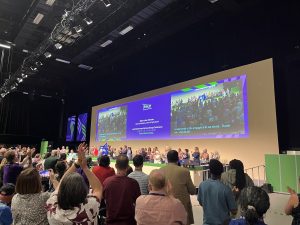
In May 2025, against a backdrop of threats of mass redundancies across a HE sector already ravaged by decades of pay erosion, precarity and inequality, delegates at UCU’s Higher Education Sector Conference (HESC) enthusiastically backed a motion about launching a dispute with the Secretary of State for Education (SoS), not as an alternative to disputes with our employers but as a parallel and complementary strategy. Amongst other things, this approach would cut across the employers’ bogus affordability narrative, demanding that the Government ensure the sector is properly and fairly funded.
So enthusiastic was the support for it that the UCU General Secretary (GS) appeared on Radio 4 in support of it, saying:
What we are saying is that the government has the ability to intervene in this sector and to issue instructions, Labour at the moment is sitting on the sidelines, watching a deepening crisis unfold. The model that we have is cannibalising the sector.
As we approach the 12 month anniversary of this decision, what has happened, or more importantly what has not happened and why?
Chronology
UCU’s Higher Education Committee (HEC) is supposed to meet at least five times per year, with the addition of additional special meetings as required. It is made up of 40 elected members with annual elections of 50% of that number for 2-year terms. It is chaired by the Vice President (HE) or President Elect (from HE) and will include either the President or Immediate Past President, depending where we are in the 4-year Presidential cycle.
The first opportunity to discuss the SoS dispute was at the meeting of 4 July, where in recognition of the urgency to have this and related motions put into action, I and another HEC member, tabled a motion to get things moving. It called for a joined up strategy to be developed, additional meetings of HEC over the summer to take necessary decisions, discussion with other trade unions and student unions and regular branch updates.
It was not heard because the meeting ran out of time before reaching it on the agenda. The Chair indicated an intention to de-prioritise motions from HEC members in relation to other business. Attempts to reorder the agenda to take urgent business earlier failed.
Instead, we were given a discussion paper on the matter, authored by the Chair, with ‘points for consideration’ rather than firm actions and any substantive decision was deferred to a later meeting. There was reference to legal advice which did not align with that procured by the authors of motion HE14. No decisions were taken.
Because of the summer break, there was not another full HEC meeting until 10 October. At the October meeting, a proposal was tabled in the name of the Chair to abandon the SoS dispute for legal reasons. HEC voted overwhelmingly not to be bounced into such a decision, instead remitting until the next meeting to allow for proper discussion. This was tactically better than risk the proposal passing and the SoS dispute being shelved.
The most useful way to understand the power dynamic and arithmetic on the UCU HEC is around the question of bureaucratic power, specifically who tends to support and defend it and who seeks to instruct and, where necessary, challenge it. UCU Left and the independent left together do the latter whereas UCU Commons and fellow-travellers do the former. At present, those of us taking the latter approach do not have a majority (by a small margin) and the arithmetic in the room on the day (not everyone attends every meeting) often dictates a need to rally behind the least bad instead of the best option, as was the case here.
Because of the industrial sensitivity of the legal advice, HEC members were sworn to confidentiality until minutes had been finalised. Yet, we are 4 months later and members have been told nothing. Confidentiality of sensitive information is legitimate. Preventing elected members communicating with and being accountable to members is not.
A special meeting of HEC was called for 10 December, to make whatever decisions that were required following the close of the pay ballot. It would have been possible to discuss the SoS dispute there, had the meeting been called with such a remit. However this did not happen and then the meeting itself was cancelled by the Chair.
The next full HEC meeting is on 6 March. There was another short special meeting on 11 February but solely on the topic of the joint unions’ claim at the New Joint Negotiating Committee for Higher Education Staff (New JNCHES).
Explainer: New JNCHES is the negotiating framework where the joint trade unions in the sector (UCU, EIS, UNISON, Unite, and GMB) meet with UCEA (representing the employers) to negotiate pay and conditions on an annual cycle. UCU’s negotiators comprise the 3 HE Officers plus negotiators elected directly at Congress annually, supported by the Head of HE. Negotiators are instructed by HEC. In the absence of any such instruction from HEC in relation to the SoS dispute, its relationship with JNCHES negotiations has not been determined.
So in any meaningful sense, no progress has been made on something that achieved huge support and that was agreed 9 months ago, but why?
UCU decision making
First of all, this can’t be looked at in isolation. There are countless examples over many years where what is agreed at Congress or Sector Conferences is ignored, actively obstructed or implemented in a way that has the same effect. While sometimes this is the result of what happens at the National Executive Committee (NEC) / HEC, too often it has come from above. The Marking and Assessment Boycott was called off in 2023 and strike action was called off on a Friday evening in Feb 2023 with no HEC involvement. Even HEC decisions are not honoured properly. The General Secretary has even attacked HEC publicly, such as in December 2022 over indefinite action. On numerous occasions, we’ve also seen delays on balloting or the calling of action lead to good points of leverage being missed.
The failure to meet the 50% turnout threshold in the recent ballot can also be laid at HEC being ignored. It was agreed there and negotiators repeated that jobs protection should lead in the campaign, yet it was barely mentioned in the campaign at all. This failure also now impacts on the SoS dispute as the result suggests members are happy enough with UCEA’s offer in the 2025/6 round not to want to take action.
At one level HEC has failed and members are rightly asking questions of those of us on HEC. Why are so many Congress and Sector decisions not implemented or implemented in a way that makes no sense? Why are NEC/HEC decisions not shared with members in any meaningful way? Where does responsibility lie? How are those in elected roles held accountable?
At another, NEC, HEC (and our democratic structures more generally) are designed to fail.
This is a known pattern. Anybody on the left who stands for elected office in the union will be aware of this. Even when the left has had a majority, this has still happened. So what is the role of a socialist in standing for office in an organisation that functions in this way, where the democratic will of members and their representatives is continually thwarted?
In 1894, the Scottish-born Irish Socialist, James Connolly, wrote,
… the election of a Socialist to any public body at present, is only valuable in so far as it is the return of a disturber of the political peace.
It’s a great slogan and one I have used before in the context of my approach to this question but what does it mean in practice?
We should not be there to simply work within the tramlines of the rules, especially when the interpretation and application of these rules is to prevent us exercising our responsibilities. We should be causing trouble and frequently do but mostly invisible to members.
Yet, sometimes I think all we manage to achieve is mitigating the worst of what would happen otherwise. Yes, we have our ‘wins’ but they are only ever partial. Our purpose can only be to make it a little harder for the bureaucracy and its supporters to do what they do while we build from below.
Accountability
In the meantime, how can those of us who stand for elected office be made more accountable? There was a missed opportunity in 2024 with a motion that was on Congress agenda but not heard due to time. It would have obliged us to both canvas opinion from and provide written reports to our constituencies. At the moment, we have no easy way of communicating with members.
I publish my own voting record but the failure of UCU to publish minutes on the union website renders what I share lacking in context. It is policy that minutes appear there so this is yet another example of agreed policy not being followed. Undoubtedly the ongoing dispute with UCU staff who are members of Unite over a toxic working environment and victimisation has reduced the capacity for tasks such as this but that only serves as a contributing factor, not a justification. The long-running and unresolved nature of this dispute also speaks volumes as to how UCU functions (or fails to function).
At the moment, there is no mass organisation of members within our union. There are pockets of cooperation but we are fragmented. Part of this reflects the fragmentation of the left more generally and many of the fault lines are the same. We have two Rank and File groups, UCU Left, UCU Solidarity Movement plus an array of other groupings. There are different levels and types of activity within each and overlap in terms of the people involved, but no real effort to join things up. Undoubtedly part of this stems from exhaustion but there is clearly also a reluctance to come out of self-reinforcing echo chambers.
The link between the rank and file and those in elected positions is also largely non-existent. Individual groupings may have internal processes but these are not visible to the wider membership. As such, even those standing for election with the best of intentions can easily become isolated and, more importantly, rootless.
One idea that could be explored is some sort of pledge that those seeking office sign up to. However, that would need to be part of a bigger effort to build from below. Those of us who stand for office need to be rooted in that effort and neither become nor be perceived as part of the problem.
Trade Unions are inherently contradictory. As Ian Allinson points out in Workers Can Win,
They are organisations of resistance to employers but we also use unions to agree the terms of our exploitation with management.
The union machinery is geared to the latter. Activists build the former.
What Next for the SoS Dispute?
HEC has been told that it will be discussing the dispute at the meeting on 6 March.
Authors of the original motion and their supporters have sent HEC members a briefing document which is welcome. Like the motion itself it doesn’t, nor should it be expected to, cover everything and work needs to be undertaken with the utmost urgency to ensure the motion is implemented in line with the decision made by delegates last May, including ensuring it remains a complementary to other action and is not recast as an alternative strategy.
This will require the commitment of appropriate staff and resources. To that end, the next HEC meeting must make (and not be obstructed from making) some concrete decisions, with necessary motions tabled and heard. HEC members must also be free to report back to their constituencies immediately.
Realising that resource will of course be much easier without the long-running dispute with staff. The toxic working environment should have no place in a trade union and the lack of resolution to this dispute weakens our hand in every negotiating space.
If there is no visible progress by the time of Sector Conference in May, members should, through their delegates, be expressing their outrage in the appropriate way.




1 comment
Very insightful and explains the inaction of the union putting politely labels to one side we are not functioning as unions should do. A lot of shouting but no action
Grant I will share this with the branch cheers