

The escalating crisis in English schools
Steven Ribble •Steven Ribble shows how austerity is destroying the education system – and how teachers can fight back
When I started teaching there was an eleven-year-old student who everyone in the school knew. They had complex emotional needs. They could not sit still for more than a couple of minutes. They found being in a noisy school with over a thousand other students in classes of 30-plus incredibly difficult to process. A teaching assistant was assigned to them for every lesson. They never made it through a full day.
After six months, they were transferred to an Alternative Provision scheme. They practised outdoor skills, played sports, and learned how to manage their emotions and build friendships. They returned to our school and now happily participate in its life and build meaningful friendships with other students.
Last year there was a new student who presented with similar behaviours. At a meeting where staff were discussing how best to support them, someone mentioned the Alternative Provision, and how much it had helped that previous student. Our SENDCo told us it had closed. Even if it hadn’t, they said, the school no longer had the money to pay for it.
This is what the twin crises of the SEND system and school funding look like from day to day. Workers trying to support more students with more complex needs with fewer and fewer resources. The consequences of these twin failures are felt first and foremost by vulnerable children and those that care for them.
Origins
Children sitting their GCSEs this year have only known austerity. They were born in the year that elected the Tory-Lib Dem coalition. They started primary school the year that Cameron won his majority. Their transition to secondary school was marred by the COVID-19 Pandemic.
These children have never known SureStart centres or youth clubs. They have grown up going to foodbanks, or have friends who do. They have suffered under the cruel two child benefit cap. One in five of them have spent more than half their childhood in poverty.
This generation had their childhood stolen by austerity. It is no surprise that when their living standards, their social safety net, and their parents’ jobs have been degraded that more and more children find themselves traumatised and unable to cope.
Austerity in schools manifested in three different ways. First, 70 per cent of schools have experienced cuts to their budgets. In over 1,000 schools, these cuts amounted to more than a million pounds per school. This means fewer staff, bigger class sizes, worse equipment, and less provision and support for vulnerable children.
Second, staff pay has plummeted. According to the government’s own figures, average teacher pay in real terms has fallen by more than 18 per cent since 2010. The government’s proposed 6.5 per cent pay rise over three years is little more than a slap in the face.
Third, the state school system has been increasingly privatised through Multi-Academy Trusts (MATs). Academisation has removed control of schools from Local Authorities, as flawed as they are, and placed them in the hands of unaccountable and unknowable private individuals. MATs have engaged in a campaign of ‘top-slicing’ where typically 5-8 per cent of each school’s budget is removed to fund the central team. Some MATs take even more. It was discovered that UBAT in Brighton was taking over 20 per cent. This works well for the CEOs of these MATs, who can pocket six-figure salaries.
Those schools that haven’t been privatised remain under the auspices of local councils. The crisis in local government funding has been widely reported with increasing numbers of councils facing bankruptcy. The IFS pointed out that by 2024 council funding was on average 18 per cent lower per person than in 2010. This directly impacts those schools that remained under local authority (LA) control, mainly primary schools.
However, every school is hit by these cuts. MATs rely on LAs for provision of local services such as the internet, and crucially SEND funding. Cuts in local government have not been uniform and this is felt acutely in education. The Educational Health Care Plan (EHCP) system is the clearest example. EHCPs are documents that provide vulnerable children with statutory rights to education provision based on their need. This means things like funding, adjusted timetables, targeted interventions, dedicated support staff etc.
If you talk to people who work in this sector you will hear horror stories. Children moving from one local authority where their EHCP is worth £10,000 to the school, to another where it is worth £0. Councils pursuing ‘immediate rejection policies’ for all applications, and then spending £100 million to fight the appeals. Introducing yearly caps on the number EHCPs that can be issued. All of these cases are rooted in a lack of funding and the increasing needs of children and young people. These are the practical consequences of austerity.
The government’s response is yet more austerity. They plan to remove EHCPs for large numbers of students. As flawed as the system is, their removal will cause more children to be failed by our education system and fall into lives of destitution and poverty. These reforms are intended to take place over the next decade but will be felt immediately in the fear and dread they create for the families and loved ones of vulnerable children, who no longer know if they will be supported in their education.
Escalation
What this means is that every year, every cohort that enters school has more children with more complex needs. Schools and local authorities have fewer resources to hand out and more children in need. Over the course of their time in school, the needs of these children are not met and so they deteriorate. They become more complex and difficult to manage in classroom settings, as class sizes increase year on year.
Instead of breaking the cycle of austerity, the government’s education reforms will escalate the crisis. In September, three different funding pressures will hit schools hard.
First, another year means a new cohort with more students with more complex needs than the last year. That means more need for TAs, more need for alternative provision, more need for in class support and adjustments. These all take money, and for the teachers of these students, it also takes more time.
Second, the pay rises awarded to support staff and teachers from September are unfunded. Schools will have to find the money from their existing budgets to pay for these pay rises. With funding tied to pupil numbers, this increases the pressure on schools to increase their class sizes, which in turn increases the workloads of all education workers.
Third, inflation, which is likely to increase over the summer months, increases the general costs of running schools. It increases the cost of electricity, gas for heating, water, food for school dinners, repairs and replacements of equipment. All of these will be hit and the school budgets for each of them are likely to be exhausted long before the end of the year.
In some ways this is a continuation of previous years: the slow degradation of the education system, the increase in workload, the repeated failing of the most vulnerable children. In others it is an escalation. The last time schools dealt with an inflation shock, in 2022, it did not hit in September. This time it will. The last time schools covered the cost of unfunded pay awards, several Multi-Academy Trusts had not fallen apart over questions of funding before the pay award went into effect. This time they have. The last time the complexity of student needs increased this was not accompanied with vocal proposals to gut support for those children. This time it is.
Rebellion
In response to this crisis, the NEU is for the first time balloting all of its members, both teachers and support staff, to strike. If successful, this would be the first national strike by all workers in education in English history.
To win, this strike must go beyond immediate sectional campaigns over funding and pay awards for different groups of education workers. It must become a national campaign for a new settlement in education. One that undoes the damage done by austerity. One that builds a SEND system that supports all vulnerable children.
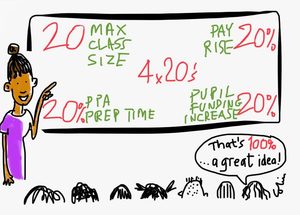
rs21 members have previously sketched out the potential core demands of this campaign, the four-twenties: a maximum class size of 20; 20 per cent Planning, Preparation, and Assessment (PPA) time; a 20 per cent pay rise; and a 20 per cent increase in per-pupil funding.
We must link the immediate fight over the dreadful pay deal to the wider crisis in the education system. Failure to do so will leave us isolated and back where we started: in underfunded schools with increasing class sizes and vulnerable children in crisis without support.
The solution to the twin crises in English education is a break with austerity and the creation of a new economic settlement that places human need over private greed. The path there lies unavoidably through the organisation and mobilisation of education workers in a campaign to build an education system for all.

0 comments