

Via Wikimedia Commons
Justice over profit – organising in the legal sector
Lois JC and Franck Magennis •Lois JC and Franck Magennis, founding members of Legal Sector Workers United, explain the need for militant rank-and-file trade union organising in the legal sector.
In 2019, paralegals, solicitors and barristers across the UK founded the Legal Sector Workers United (LSWU) branch of the United Voices of the World (UVW) union. The branch was formed to combat endemic workplace problems in the legal industry.
The law is often seen as a privileged arena. However, the industry has staggering wage inequality. Paralegals often earn less than the London Living Wage of £10.55 per hour, while equity partners in the same firms can take home as much as £2 million annually. Junior barristers face similar structural inequality, earning as little as £12,000 per year, well below the minimum wage, while the senior bar counts millionaires among its ranks.
Workers in the legal sector share many common grievances, including burnout caused by high levels of stress and pressure, unrealistic targets, long hours with unpaid overtime, and low pay, especially among junior and administrative staff. Despite sharing many common interests, historical attempts at industrial action have been beset by deeply entrenched divisions between barristers and solicitors.
LSWU is a unified trade union campaign representing all workers in the legal sector including cleaners, security guards, receptionists, interns, personal assistants, legal administrative staff, paralegals, trainee solicitors, pupil barristers, practising solicitors and barristers. Our comprehensive and inclusive approach is particularly important in a sector characterised by hierarchy and conservatism.
Government cuts to Legal Aid mean that access to justice is being denied to those involved in civil proceedings, including housing, family and immigration matters. In addition, the Government’s systematic defunding of criminal Legal Aid has left workers in the legal sector working punishing hours for little pay. The goal is that a unified trade union can help bring a final end to austerity in the legal sector.
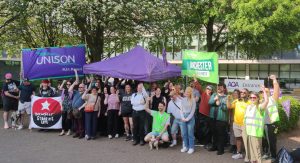
Our choice of trade union reflects an underlying organising strategy: by affiliating with UVW, LSWU has communicated our explicit intention to organise from the ground up, starting with the most precarious workers. UVW was already in dispute at the Ministry of Justice (MoJ) where its members – the Ministry’s security guards, receptionists and cleaners – walked out on strike for a total of six days demanding the real London Living Wage and equality of terms and conditions with civil servants. Following the death of a cleaner, Emanuel Gomes, in April 2019 a fundraiser for his family to repatriate his body raised over £25,000. UVW members put pressure on the MoJ to pay all cleaners, security guards and other outsourced staff full sick pay for any Coronavirus related sick leave – and the workers won. While Unite and GMB have some presence in legal workplaces, we opted instead for the tactical agility and political radicalism of the member-and-migrant-led UVW.

Via @LSWUnited on Twitter
Since the Covid-19 pandemic led to lockdown in March 2020, our membership has rapidly increased. Some firms left their workers in the dark, with lack of communication as to furloughing and redundancies. Some firms expected workers to continue going into the office despite working from home being a possibility, and there was a clear pattern of firms imposing the strains and burdens of the pandemic on the lowest paid, least secure workers who are more likely to be women and people of colour. In the face of this, hundreds of workers joined an independent mass movement of legal workers to demand a profession that prioritises justice over profit. Our members have organised in firms for the first time – successfully demanding that management top up the pay of furloughed workers to 100% and winning the ability to work from home.
A complex patchwork of membership associations already operates in the legal sector. While those organisations are not trade unions, many have played a vital role in agitating for the interests of their members. LSWU has been proactive in communicating and coordinating with those organisations, joining campaigns for an end to immigration detention and supporting the #strikeforjustice movement to defend criminal practitioners. Most recently, LSWU has publicly supported members who have been arrested on Kill the Bill protests, and taken a stand against the Police, Crime, Sentencing and Courts Bill.
Attempts to improve pay and conditions in legal workplaces have hitherto overemphasised the demands of qualified lawyers. LSWU aims to shift the focus to the demands of paralegals, cleaning and security staff, and other workers whose often ‘unseen’ labour and legitimate and longstanding grievances have been overlooked for too long.
For years, if not decades, the legal sector has been crying out for a robust campaign to organise those who work in it. With the arrival of LSWU, that need is finally being met. Legal sector workers interested in joining can do so here or alternatively, text or call UVW on 07884 553443 / 07734 351792 to find out more.




0 comments