

Photo: Sherrl Yanowitz
SOAS is shut down in protest at union rep’s suspension, cuts and marketisation
Nilüfer Erdem •Nilüfer Erdem and Will Searby report from SOAS where students and workers have shut down the campus in central London in response to management suspending Unison rep Sandy Nicoll and £6.5million of cuts.
Valerie Amos, former advisor to Tony Blair and current interim director at SOAS, has accused students and staff of bullying and intimidating behaviour. She did this just before suspending a trade union activist, Sandy Nicoll.
Sandy, the Unison branch secretary at SOAS and a member of staff in the IT department, was campaigning against £6.5 million worth of cuts due to take place at the university and against hyper-securitisation.
The irony and contradiction here is palpable. Over the past few days a peaceful, creative and playful occupation has been subject to escalating aggression and underhanded tactics by management.
An extra £2,400 per day has been spent on hiring security to guard the doors of the occupation to intimidate protesters. Students concerned about the marketisation of education and government policies such as Prevent being implemented through university channels, have been subject to bullying and intimidation. This has been happening at an institution renowned and sought after by students and academics across the globe because of its critical and liberal orientation.
Two days ago SOAS attempted to limit access to the occupation by dramatically increasing the security presence. This was met with overwhelming opposition by the student and staff body, who turned up in their hundreds to show solidarity with the occupiers, and with staff facing a future of redundancy and precarity.
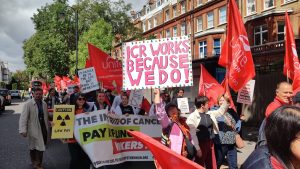
Sandy Nicoll was suspended after this action in a clear attempt to intimidate workers and students and to attack confidence in collective action. The events of today, including a wildcat strike, spontaneous picketing, and an extraordinary display of solidarity from staff and students, demonstrate the strength of worker organisation at SOAS, and a clear spirit of conscious defiance to the tactics of intimidation.
The solidarity evident today is obviously a direct consequence of the years of worker militancy at SOAS. The Justice for Cleaners campaign, active in different guises from as early as 2005, has played an enormous role in the protests and organisation on campus, and an active and engaged UCU branch, as well as the Fractionals For Fair Pay campaign, have consistently stood with staff threatened by cuts.
But the organisation at SOAS has its roots far beyond the work of the formal union structures, and a radically engaged student body, campaigning in solidarity with cleaners and academic staff, demonstrate the potential for student strategy to reach well beyond the experience of students simply as the consumers of education.
Juan Carlos Piedra, an Ecuadorian cleaner and organiser in the Justice for Cleaners campaign, said: “If we allow management to sack Sandy there is a big risk to the whole university, it will affect everyone. When I saw SOAS students doing this it’s a good support for Justice for Cleaners. Students inspire us to make these campaigns in other universities.”
Interestingly, arguing with students on the picket line, the objections most often raised are about “democracy” and “choice” – the right to scab over the right to strike. This isn’t surprising, but it invites some compelling comparisons with the Government’s justifications for the Trade Union Bill, where supposed concerns for the democratic voices of union members are used as a trump card in an attempt to crush the resistance of organised labour.
The obvious response is that the decision to withdraw our labour power is always our own, and always more democratic than the unaccountable decisions of management, whose chief interest is the devaluation of the cost of labour. Our response to disgruntled students has consistently been that classes will resume when management cease their disruption, and decide that education is more important than their vendetta against collective organising.
The atmosphere today is uplifting, and reflects an institution familiar with the experience of fighting for workers’ rights. The sound-systems are playing communist songs, Bella Ciao and Bandiera Rossa, to the 300 or so agitators who have been here since 8am, standing on the picket line or serving free tea and coffee to striking workers, while the director wanders around, evidently uncomfortable on the campus she supposedly manages.
On the steps Sandy and other activists made speeches into the megaphone. The Trade Union Bill was naturally a common topic – a UCU representative from London Met was very clear on his position – “If they won’t allow us ballots, well sod the ballots; we’ll walk out anyway!”
It’s a refreshing and novel experience to hear the messages of solidarity from members of the shadow cabinet on demonstrations like this, and this morning the shadow chancellor sent his support.
Cleaners and union reps consistently pointed to the fact that this demonstration goes well beyond the issue of Sandy’s reinstatement, and for an example of the kind of solidarity that’s going to become necessary over the next few years in the labour movement we could do a lot worse than turn to SOAS today.
This is all part and parcel with the neoliberal onslaught against organising and protesting for our rights. According to this discourse there are no rights. Through the accumulation of our human capital as individuals we will reap rewards, we will invest our way into comfort, security and freedom.
At least this is what they want us to believe. The 300 person strong impromptu display of solidarity for Sandy Nicholl and the complete shut down of the campus proves that despite all efforts by the government, by the management and all those businesses leeching off the carcass of the welfare state, there remains a potential of mass resistance.
Take action
- Sign the petition for Sandy to be reinstated
- Send a message of solidarity to unison@soas.ac.uk






0 comments