
France’s schools revolt: the youth’s Yellow Vests movement?
Juan Chingo •Originating in schools in working-class neighbourhoods, the school student mobilisation in France is starting to express the discontent of an entire generation. Juan Chingo from Révolution Permanente argues that the impact of the movement will depend on its ability to organise and find active allies within the university student movement and, above all, within the labour movement.
There are times when seemingly basic demands acquire an explosive force because they encapsulate a vast array of experiences. Demanding more teachers, well-maintained classrooms, sufficient staff, and reasonable schedules could have been the starting point for a limited school conflict. However, when these demands spread from one school to another, when those making them recognise themselves in the indignation of young people they have never met, and when the state responds with brutal repression, the mobilisation raises a deeper question: how long can a generation accept the degraded living conditions and future imposed upon it?
The secondary school student revolt spreading across France invites us to consider the possibility of a mobilisation that affects an entire generation. It would be premature to attribute a fully developed programme to it or to announce its outcome. But its initial dynamic brings together immediate demands, a lived experience of inequality, and a still-dispersed questioning of the existing order. It is in this combination that its political power lies. Comparison with the Yellow Vests helps to illuminate this configuration. Not because it concerns the same social issue or because the dynamic that began on 17 November 2018 is about to be repeated identically. But because it allows us to identify a common mechanism of spillover: a protest that arises from the grassroots, around concrete material issues, and through which a discontent that no organisation had been able to unite begins to be expressed.
When the margins take initiative
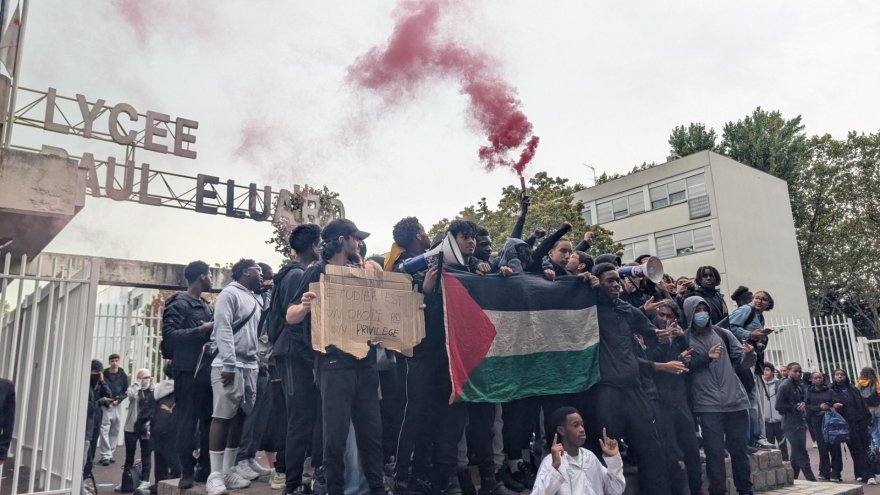
The origin of the mobilisation in the underprivileged secondary schools of the Parisian suburbs proved decisive. As Ulysse Rabaté points out, the protest made visible a “particular experience of inequality” lived in the schools of Seine-Saint-Denis and Val-de-Marne, where the movement began. Usually treated as a problem to be managed, and afflicted by state racism, these young people emerged as the protagonists of a struggle for education, and political initiative arose from communities whose capacity to act independently is generally denied.
At the heart of the anger lies a promise of “equality” that clashes with the reality of material conditions. What does it mean to demand the same academic effort from all young people when there is a shortage of teachers, buildings are deteriorating, and resources to support students are insufficient in some schools? How can failure be attributed to individual behavior when learning conditions are so unequal?
The issue extends beyond the confines of a single school. Indeed, school is one of the places where children from working-class families experience the contradiction between the promises of social mobility and the obstacles they encounter in achieving them. When this contradiction ceases to be experienced as a private difficulty and begins to be expressed collectively, what seemed to be a personal failure appears as a shared injustice.
The way these young people present themselves is also important, as Rabaté further notes: “The codes of their neighbourhoods shape the aesthetics of this mobilisation, from the words they speak to their clothing.” Cultural codes, ways of expressing themselves, and social media all become resources for the mobilisation. A strong sense of belonging to their neighbourhoods is a unifying force that allows them to make their voices heard.
In this context, the movement’s expansion to schools in city centers, whether on 29 September in Bordeaux, 30 September in Rennes, or this Thursday in Paris, takes on particular significance. Initial observations of the movement suggest that solidarity with young people from working-class neighbourhoods (banlieues) and the rejection of repression transcend social differences between secondary schools. If this trend continues, it will make it harder for the state to confine the protest and its methods to young people from working-class neighbourhoods, portrayed as alien to the rest of society.
Discontent goes beyond education demands
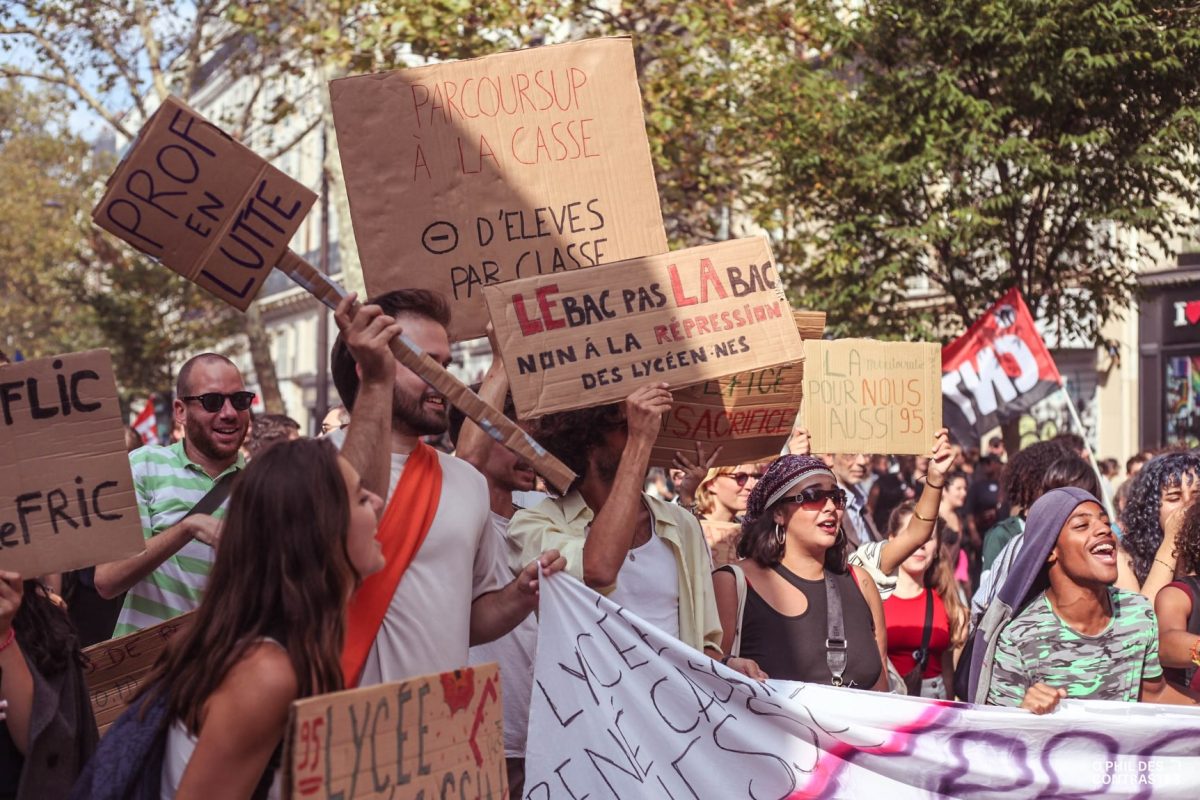
The absence of a single reform to oppose distinguishes this movement from other major youth struggles. While common demands exist, such as the widespread rejection of the 8am to 6pm school day or the issue of study conditions, their combination varies from one school to another. This diversity can complicate unification, but at the same time, it also allows many young people to find their own reasons for joining the movement. This characteristic echoes the experience of the Yellow Vests, where the multiplicity of demands expressed an accumulation of grievances that could no longer be addressed through conventional channels.
In recent days, each school has joined the mobilisation due to its own specific difficulties, but the scale of the blockades demonstrates that a common condition does indeed exist. The lack of teachers reflects the abandonment of public services, while the schedules and discipline reflect the inability to make decisions about one’s own life, and the academic selection process reflects uncertainty about the future. As in 2018, the protest began to bring together what, until then, had been experienced separately, and the concrete demands paved the way for a more general questioning of the conditions of existence.
The testimonies gathered by Le Monde this Thursday 1 October, express this broadening of perspectives. They note, for example: “At the Faidherbe secondary school in Lille, this eleventh-grade student watches large garbage cans burning in the middle of the street alongside her school. Of course, there are the ‘deteriorating working conditions, overcrowded classrooms, and the building in need of repairs,’ but very quickly, another unease emerges. Soon to be 17, Fanny lists the anxieties that weigh on her daily life: ‘Climate disasters, AI that will take all the jobs, the risk of National Rally (Rassemblement National) winning the elections…’ She acknowledges that she is ‘rather privileged with two parents who work and earn a decent living, but that doesn’t change the future that awaits us. It’s no wonder some people are losing their minds.’”
Similarly, at many blockades, support for Palestine is strongly expressed; a sign held up on 25 September proclaimed: “They are rearming the country, they are disarming our future.” Finally, protests are being planned for 17 October against fuel prices, championed by young workers from working-class neighbourhoods, and many secondary school students are now talking about it. These examples demonstrate that even though school-related demands are clearly a driving force behind student anger, it doesn’t end there. A profound unease pervades various segments of the youth population.
The specificity of the revolt could lie in this tension: young people demand to be able to study with dignity, but they are beginning to question the idea that studying and working hard will guarantee a better life. Secondary school concentrates this contradiction, because it is in secondary school that part of the future of young people is decided. Meanwhile, Macron’s promises of progress through individual effort are deeply discredited, as neoliberalism has shown its authoritarian and repressive face in recent years, particularly against young people in working-class neighbourhoods.
All of these elements allow us to understand the intensity of the protest, without considering its political radicalism as fixed. In fact, indignation can coexist with institutional expectations, local demands, and contradictory ideas. The evolution of the movement will depend on the responses of those in power, the links that the mobilisation forges with other exploited and oppressed sectors, and the collective experiences it manages to build.
Repression amplifies the conflict
In this context, the violent and massive police response, with 1,949 arrests this Thursday alone, introduces a new shared experience. Added to educational inequality is the state repression against those who attempt to fight back. The denunciation of violent interventions in front of schools, arrests, and injured students not only affects the consciousness of those mobilised, but goes far beyond this sector.
The defence of the right to mobilise has therefore taken center stage in recent days. The immediate objective of the repression is to disperse, intimidate, and discourage participation, but it also serves a political function. It diverts the debate toward the question of the protesters’ behavior. Instead of blaming the youth for the decline in education, as is typical, the government is now demanding that the activists justify their methods, relying on racist stereotypes, as seen with the fake news about “acid attacks” disseminated by Sébastien Lecornu.
Accusations of manipulation by La France Insoumise (LFI) or the “far left” are part of the same strategy. They assume that teenagers, despite being clearly capable of describing what is happening in their schools, lack the capacity to decide to mobilise. This argument serves to discredit their voices and transform the social conflict into a dispute between the government and its opponents. However, while intimidation can be effective and repression can weaken a movement, especially if its participants find themselves isolated, it can also strengthen solidarity and transform a school-related demand into a confrontation on the grounds of democratic rights.
This is a crucial issue. Hence the need to prevent a division from taking root between students whose struggle is deemed “legitimate” and young people from working-class neighbourhoods or “rioters” who could be repressed with impunity. The defence of mobilised secondary school students must extend to all schools and continue after the demonstrations: by supporting families, offering legal assistance, and publicly and collectively denouncing the sanctions. At the same time, the closure of hundreds of schools to break the movement constitutes another form of repression that must be combated, and in which teachers could play a key role by refusing to provide remote learning, as the teachers at the René Cassin secondary school in Gonesse did.
‘Hands off the school students!’ The university student movement must respond
Despite the similarities, there is a significant difference between this movement and the Yellow Vests. The autonomous nature of the school student mobilisation does not translate into hostility toward any partisan intervention. Ulysse Rabaté notes that some political representatives are welcomed as useful allies. This is the case, for example, with Louis Boyard or the mayor of Saint-Denis, Bally Bagayoko, but also with Révolution Permanente, whether it be Anasse Kazib, Elsa Marcel, or Christian Porta in Saint-Avold. This openness may reflect a desire to find allies, as evidenced by the sympathy students feel for their teachers’ support.
This support must now be broadened through the active involvement of university students. The scenes of jubilation during the encounter between secondary school students from Paul Éluard and students from Paris 8 University in the streets of Saint-Denis represent a first step, as do the initial signs of student mobilisation, with a call from Rennes 2 University to shut down the university and join the school students, and similar actions at Paris Cité University and the La Chapelle campus of Paris 1 University. Furthermore, student involvement can provide experience, offer spaces to gather, and allow for the development of organisational tools with school students through assemblies and democratic coordination. Political and union organisations should contribute to strengthening these tools and make proposals in this vein, as is the case with Poing Levé (Raised Fist).
The strategic necessity of supporting the labour movement
Another issue lies with the labour movement. This Thursday, workers from various companies in Le Havre formed a human chain in front of the Lycée François-Ier to protect students from the police. This event illustrates the kind of alliance that could shift the balance of power. Thus, beyond its local impact, this gesture opens up a strategic perspective. Young people are no longer alone when organised sectors of the workforce consider the defence of the youth a part of their mission.
This solidarity also has a material basis. The educational conditions of working-class children and the working conditions of education staff depend on shared resources, staffing levels, and budgetary decisions. Teachers and teaching assistants, who pioneered this human chain practice at Paul Eluard School, know firsthand what the students are denouncing. Parents are suffering the consequences of the deteriorating school system, alongside difficulties related to employment, housing, and public services. But a common ground does not automatically lead to a common struggle.
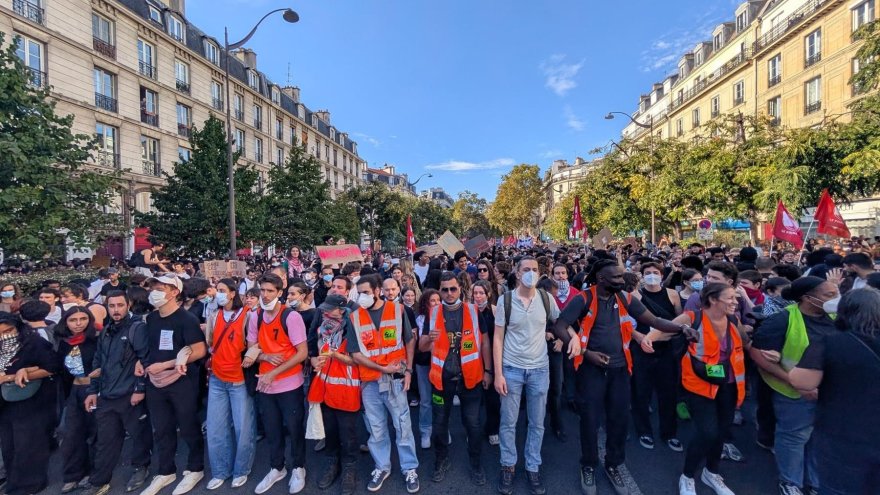
For solidarity to advance the struggle, it must translate into a presence outside schools and universities, with joint assemblies, links with unions in other sectors, and collectively decided actions. Protecting students from the police should be the beginning of a more lasting relationship. The call by the Fist of the North for a week of action starting 5 October and the intention of several youth organisations to organise a demonstration by school and university students on 6 October could, for example, be an opportunity to organise worker delegations to begin actively participating in the movement.
The mobilisation against the CPE (First Employment Contract), whose twentieth anniversary is being marked this year, offers an important precedent. At that time, the mobilisation of school and university students, the assemblies and student coordination, combined with the participation of workers in strikes and demonstrations, created a balance of power that forced the Villepin government to withdraw the measure. This experience shows what can change when youth revolt finds an active echo within the labour movement.
In front of the gates of the Faidherbe school in Lille this Thursday, a banner proclaimed: “You try to pull a fast one on us, we’ll give you May ’68.” This challenge opens up a perspective that we must help build: ensuring that the youth revolt finds the strength of the workers’ movement. Especially since the initiative of young people could restore confidence to sectors that have experienced defeats or mobilisations in recent years whose results have rarely lived up to expectations.
From the initial surge to organising the counter-offensive
The movement possesses an obvious initial strength: it is spreading spontaneously nationwide, even in Belgium. This characteristic makes it difficult to contain, but it also presents a problem. The connections between students that allow them to launch a blockade are not enough to coordinate hundreds of schools, develop common demands, or prepare a plan to go on the offensive. Social media accelerates the circulation of experiences, but only organisation allows for discussion and decision-making. In this sense, coordination built from assemblies could unite common demands, concerning, for example, educational resources, the end of Parcoursup (the French university admissions platform), or the fight against repression, without erasing the specific demands of each school.
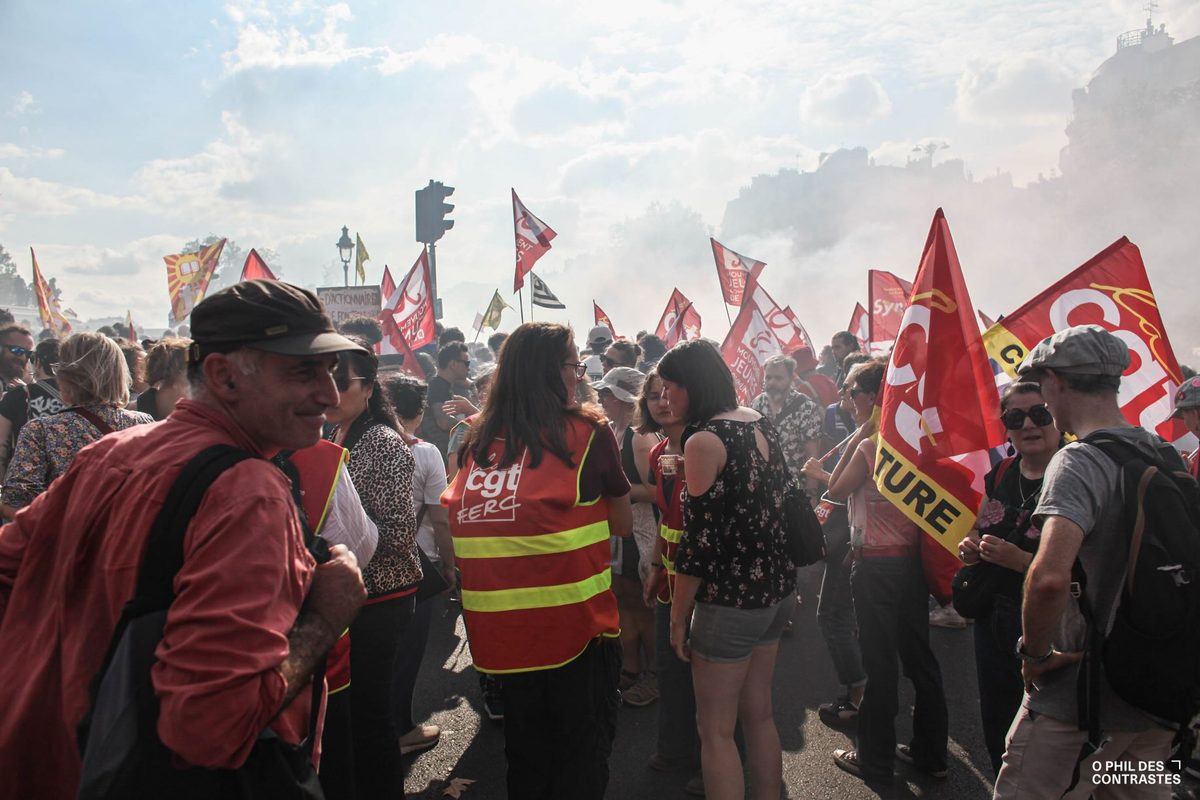
For the revolutionary activists of Révolution Permanente and Le Poing Levé (The Raised Fist) and all their supporters, the challenge lies in contributing to this perspective from concrete points of support. Wherever there are connections between students, educational staff, and workers from other sectors, it is necessary to promote initiatives that serve as examples and can be replicated.
The crucial question is whether the indignation spreading through secondary schools today can be transformed into organisation and lasting solidarity, while also extending to new layers of the exploited and oppressed. The chains of workers outside the school gates carry within them a strategic perspective: that the defence of youth will become a common struggle against the policies that are damaging their education, their parents’ working conditions, and everyone’s future. The challenge, therefore, lies in transforming this initial solidarity into an organised force capable of launching a counter-offensive.
Update 7 October: The secondary school students’ revolt is gaining ground and shaking the foundations of Macron’s final months in office
More than 450,000 people mobilised across the country on 6 October, marking a significant step forward. It demonstrates that repression and media propaganda have neither broken the students’ resolve nor isolated their movement. On the contrary, students, parents, teachers and trade unionists rallied alongside them on Tuesday, and the attempt to criminalise their struggle was shattered by a mobilisation that broadened its demands and gained new support, with 62 per cent of the population believing the movement to be justified, according to an Ipsos poll.
The meeting convened by Macron with some of his ministers on Tuesday evening demonstrates the government’s anxiety in the face of a revolt it is unable to contain. We must seize this moment to go on the offensive: unite the strength of the youth with that of the workers, broaden the mobilisation and build the social confrontation capable of defeating the government and its attacks.
For more updates, head to the Révolution Permanente website.




0 comments