
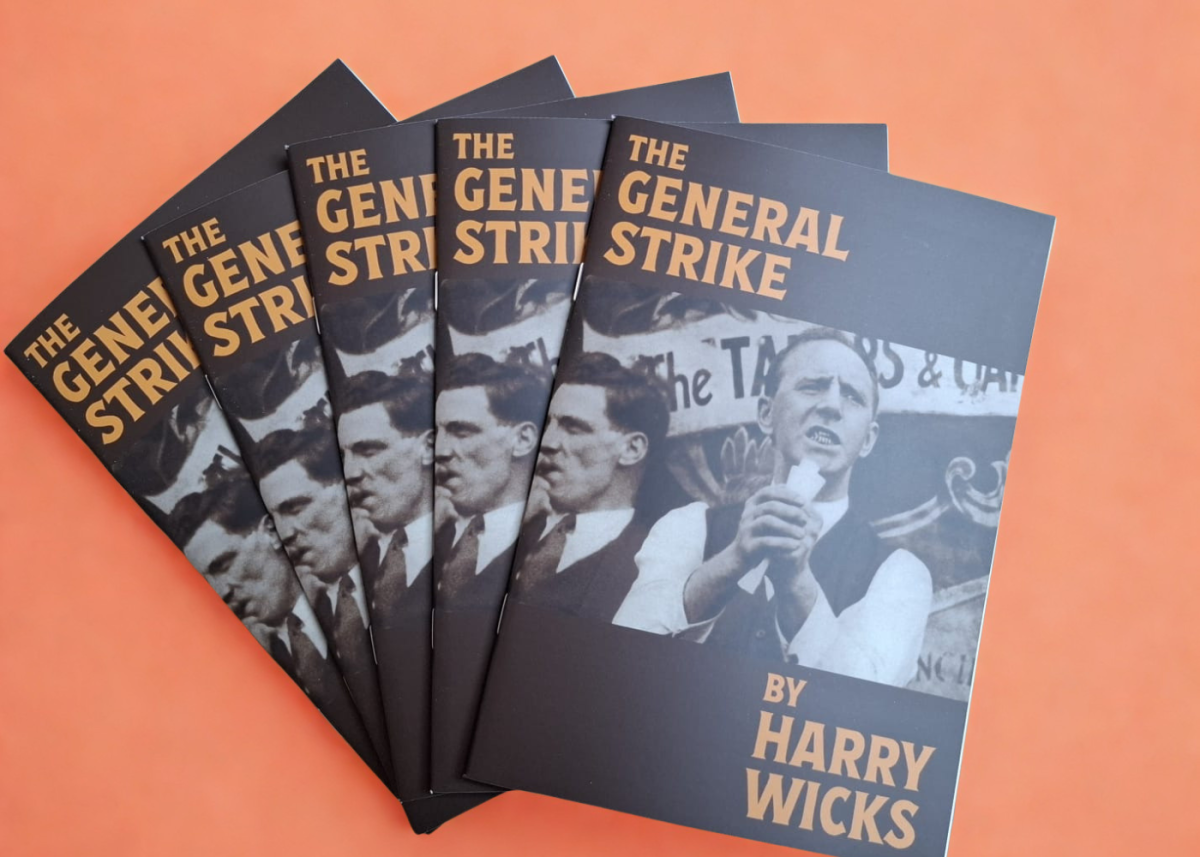
Review | Harry Wicks: The General Strike
Sylvia M •Sylvia M reviews the new edition of Harry Wicks’ pamphlet on the General Strike, and finds a timely reminder that the betrayals of working-class leadership are as familiar today as they were a century ago
Amidst the many publications, events and discussions throughout the UK for the centenary of the 1926 General Strike, one pamphlet from Revolutionary History details a first-hand account by Harry Wicks. First published in 1976 in Workers News, the re-publication of ‘The General Strike’ offers us an opportunity to read Wicks’ own tale of the strike.
In this short pamphlet, Wicks familiarises readers with the feelings and frustrations of workers and trade union organisers amidst the right-wing trade union leadership and the Labour Party’s betrayal of ‘Black Friday’ in 1921. Wicks recalls the upsurge in revolutionary fervour following this, particularly in Battersea. It is here that Wicks begins to reminisce on the events and organising around him, his tone optimistic even in the shadow of the first betrayal. From workers queuing to hear the speeches of Communist MP Shapurji Saklatvala, Marxist classes from the Plebs League, to the discussions of the Communist Party of Great Britain’s (CPGB) newspaper, Weekly Worker, amongst members of the National Union of General and Municipal Workers (NUGMW). Out of this, the National Minority Movement (NMM) emerged, founded by the CPGB, with its inaugural meeting at Battersea Town Hall in 1924.
Wicks takes us through the rise in workers’ confidence following the formation of the NMM as workers faced a Conservative government led by Stanley Baldwin that Wicks describes as pursuing a ‘strategy [that] was perfected to bring the trade unions to their knees and the wages of all the workers down.’ Even amidst the Government concessions, declared as ‘Red Friday’ in 1925, the NMM reasserted that workers must ‘prepare to fight.’
Something intriguing from this period of preparation is how consciousness shifts rapidly, as the Scarborough Congress of 1925 demonstrates. Delegates applauded and passed motions supporting anticolonial movements in the Global South. According to Wicks, ‘never before had a British Trade Union Congress expressed itself so militantly on international politics.’ For Wicks, however, such motions were ‘superficial’. When it came to domestic trade union strategy, the same delegates would ‘retreat to their parochial and craft positions’, despite the NMM’s increased influence in bringing communist consciousness into the movement.
As we get closer to the General Strike, Wicks describes the establishment of Councils of Action, as the right-wing leadership of the trade unions and Labour Party began preparing against the left-wing forces, primarily from the CPGB and the NMM. Setbacks before the strike include the Labour Party’s exclusion of communist members following the October 1925 conference and subsequent government raids on leading CPGB and NMM members under the Incitement to Mutiny Act of 1797.
Wicks describes the overwhelming feeling on May Day 1926 as triumphant, an ‘undreamed-of enthusiasm,’ that, however, quickly becomes tragic as we are also made aware of the backdoor plans between TUC president, Arthur Pugh, and Conservative PM, Stanley Baldwin, to prevent a General Strike. Reading this testimony today, it is remarkable how millions of workers demonstrated such tenacity and solidarity amidst the reaction from the government, including the rollout of the Emergency Powers Act, giving the police ‘the rights to arrest without warrant, enter any place, by force if necessary and seize or detain anything they liked.’
Yet, after nine days, on 12th May, the strike was over. Wicks summarises this shock by quoting Rajani Palme Dutt, who called it ‘a thunderclap without warning.’ Such was the shock that the initial reaction from workers to the news to stand down was one of victory, ‘no one thought in terms of defeat.’ Despite this surrender, Wicks celebrates the strength of workers who fought back from the imposition of the most humiliating conditions: ‘a bitter and angry working class, now aware of the qualities of their leadership, fought on against the harsh terms of employment then being offered.’
Despite the brevity of the pamphlet, Wicks manages to provide a first-hand account that is informative and also reveals some of the emotions fermenting in the trade union movement up to the General Strike. His descriptions of revolutionary activity in Battersea and the jubilant feelings on May Day 1926 resonate the most. Crucial to this re-publication is also a glossary which provides much-needed context to the numerous names of individuals and organisations. For many readers, this will be a good starting point for exploring the publications on the general strike this year will offer.
Reflecting on these testimonies in the 21st century, revolutionaries can begin to notice the similarities at the time, including right-wing leadership and its capitulations – either in the trade union movement or in attempts at a new party formation – against the wishes of an increasingly bitter and resentful working class. What also stands out in this pamphlet is the acknowledgement of workers’ defence against the fascists in 1926, something of crucial importance today given the rise of Reform and resistance against far-right street presence across the UK.
May 2026 is a month of reflection on our revolutionary histories. We take lessons from the past and think about how we can relate to these histories. Aside from the brief mention of ‘women from London’s rag trade,’ the diversity of the working class is not acknowledged by Wicks. As such, it is something for all revolutionaries to consider in any labour history: who is missing? That is not strictly because of the realities of working-class composition in 1926, but also how this in turn reflects how trade unions today envisage themselves amongst workers and oppressed people in 2026. When the working class is more diverse than ever, is that reflected in the people attending the numerous events, debates and discussions throughout May on the centenary of the General Strike?
When done correctly, inclusive of all working class and oppressed people, encounters with labour history can provide Marxism a ‘kind of nourishment – or dialectical tension’, as Raphael Samuel writes. This pamphlet is part of the nourishment Marxists need — a reminder of how similarly workers and oppressed people are affected across key moments of revolutionary history.



0 comments