
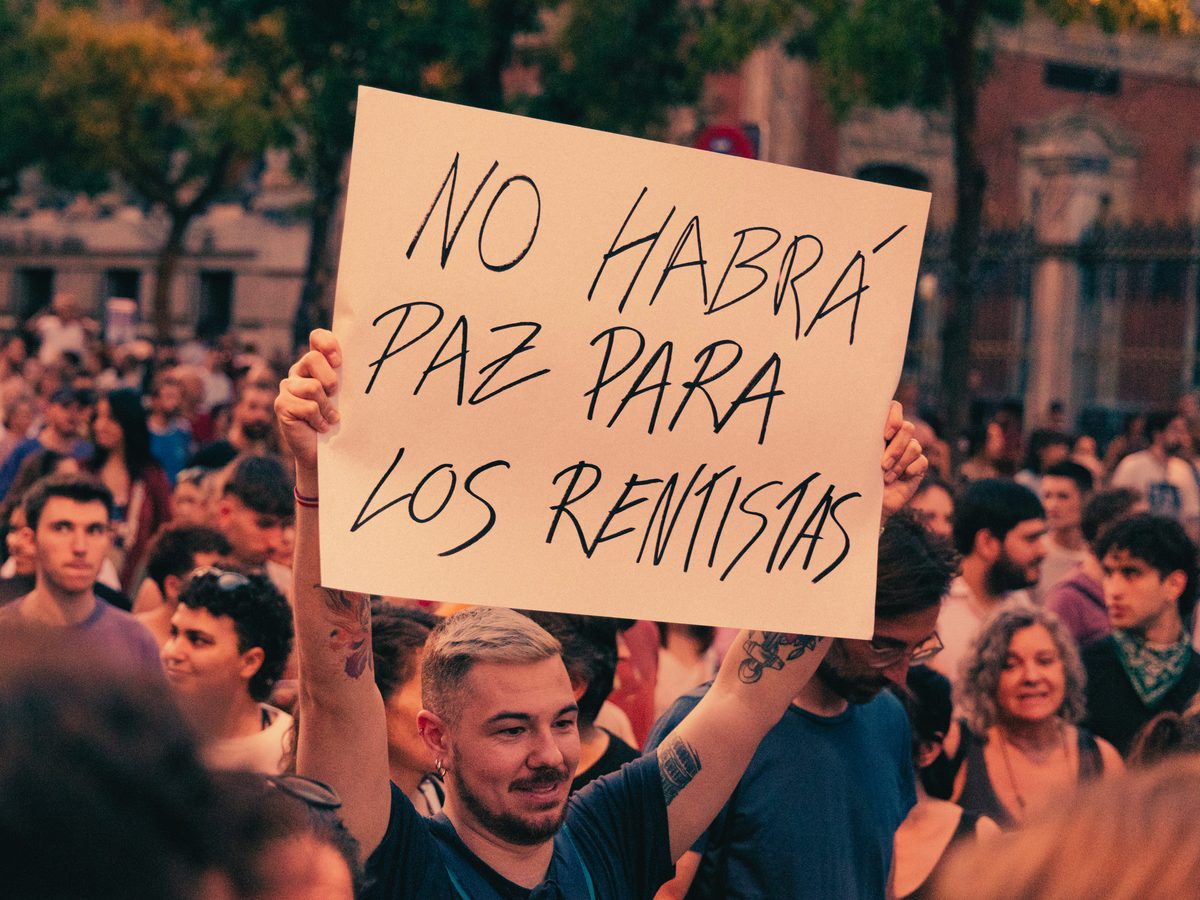
Sign translates to: ‘There will be no peace for the landlords’
We’re staying: Spain’s housing movement and general strike
Mara •Mara provides a brief overview of the Spanish housing crisis, the working class who bear the brunt of it, and the tenant unions resisting the parasitic rentier system
Today, on November 11th 2026, there will be a one day general strike over housing called by all the major unions in Spain. The strike and election were called after mass mobilisations demanding action on housing following the eviction of 87 year old Maricarmen in Madrid. When his bill to resolve the crisis failed to pass, Partido Socialista Obrero Español (PSOE) leader and prime minister Pedro Sanchez called a snap election on 29th November.
María del Carmen Abascal, now known around the country and the world as Mariacarmen, had been a member of Madrid Tenants Union for some years and had lived in her home since she was a teenager. She was served with eviction papers after a property company bought her home and raised the rent from €500 to €2500. The Madrid Tenants Union mobilised to resist, fighting off three eviction attempts. On the fourth attempt, the company succeeded by using force and Maricarmen was taken out of her house on a stretcher. In response a protest camp was set up in the neighbourhood of Sol. Although an agreement was reached that allowed her to return home, Maricarmen died in hospital a few days later, causing a wave of protests nationally and the setting up of more protest camps in other cities.
The PSOE government proposed a set of housing reforms in response to the protesters’ demands. These were then rejected in parliament by the right wing parties PP and Vox, and the Catalan party Junts, after which Sanchez called the election. With the right wing parties pushing a strong anti immigrant line after the recent situation in Ceuta, it looks like Sanchez called the election now as having housing as a major issue may help push back the right.
The Sindicato de Inquilinos Madrid, Madrid Tenants Union, was set up in 2017 along with Sindicat de Llogateres in Barcelona and more unions in Malaga, Zaragoza and Ibiza. There was then a further wave of tenants’ unions set up in other cities and the formation of a Confederation to co-ordinate activities. Most of the funding is from membership fees of €10 a month.
The unions have run a national campaign ‘Nos Quedamos’ (We’re Staying) against evictions, their main tactic being to employ a block strategy. In apartment blocks with all flats owned by a single landlord, they go door to door and recruit tenants into a shared struggle against the landlord. They have regular members meetings in local neighbourhoods and also meetings for tenants who have the same landlord. As well as eviction resistances they have organised successful rent strikes.
Spain has a higher proportion of rented properties owned by large landlords compared to Britain, where the private rented sector is dominated by small landlords. This makes some strategies like block organising more feasible. From 2008 onwards there have been militant and widespread housing movements, involving homeowners and squatters as well as tenants. In 2009 the PAH was formed in Barcelona, Plataforma Afectados de Hipoteca (Platform for People Affected by Mortgages) defending those who were in mortgage arrears and at risk of foreclosure. There were also the corralas, empty blocks of flats collectively squatted by evicted families.
One of the root causes of the housing crisis is the fact that rents and house prices have risen much faster than wages; the rent of a one bedroom flat would for a lot of workers take up their entire income. After the 2008 financial crash, which meant mass repossessions and unsold buildings, investors moved into the Spanish rental market. Finance and construction are both critical in the Spanish economy, with the 2008 crash meaning job losses in construction especially and huge numbers of people at risk of losing their homes. PAH, and in recent years the tenants’ unions, were very strong at attracting people in the housing crisis to local meetings where people could speak together about their situation and support each other.
The general strike, supported by all the major unions, marks a turning point: it is the first general strike over housing in Europe since Italy in 1969. Many people affected by the housing crisis are young people who are also often in precarious employment. An interesting aspect of the housing movement is its intergenerational solidarity, as young and elderly people support each other, with hundreds turning out to stop the eviction of Maricarmen.
The housing movement is also notable for the presence of women in active roles and as speakers. One reason Maricarmen was evicted was because the original tenancy agreement was signed only by her father, who then died, but not her mother, as under the Franco regime married women did not sign documents, and the property company were able to use this to deny Abascal protection as a longstanding tenant. So Maricarmen was suffering from the effects of Franco era sexism 50 years after he died.
The right currently are on the ascendant and may win the election but the housing movement has the potential to challenge them. Housing is a key issue for working class people across the board in Spain. The movement has been able to address people’s material conditions collectively by challenging landlords, multinational companies and the government. The strength of Wednesday’ general strike will be an important factor for how things develop next in Spain.




0 comments