
Issues and tasks for socialists in Unite the Union
rs21 members in Unite •As Unite’s sector conferences take place rs21 members in Unite reflect on some of the key issues.
Unite’s sector conferences take place this week (9 November). Here each industrial grouping or sector, plus the Community organisation for members not in paid employment, discusses its strategy and sets its policy. Whilst standing orders generally attempt to limit conferences to sector-specific discussions and policies, the backdrop of the conferences is the situation in the wider trade union and labour movement and there will be opportunities for broader discussions. Here below we comment on some of the major issues around which we can organise broadly in the upcoming months.
Palestine solidarity
Work by activists, including those working in the arms industry, pushed Unite’s Executive Council (EC) at the 2025 Policy Conference to publish a good statement on Palestine (summary of Policy Conference decisions, p. 39). It commits the union to supporting those who want to build campaigns of Boycott, Divestment and Sanctions (BDS) in their workplaces. So far, only the Scottish region has pursued this, with a meeting of 40 workplace reps held at the end of August. Amongst the proposals were an education programme for reps on how to take BDS into workplaces and the formation of a working group to pursue this work in the long term. Activists should use this example to ask every region and nation for facilities to organise similar events and groups. A significant number of members want to take action over the genocide, and we have the remit to organise them in order that they can develop their own strategies for BDS.
Rules Conference
Rules Conference will be held in the summer of 2027. This is where the rule book of the union can be modified; the main subject for debate will be disaffiliation from the Labour Party (Rule 22). We agree with disaffiliation but we need to recognise that calls for it are coming from the right as well as the left. We also say that claims to be ‘non-political’ inevitably end in perpetuating the status quo or going along with the loudest voices. We should replace Labour affiliation with a framework in which Unite can support candidates from those who sign up to support a democratically-agreed list of principles and policies to which we can hold them accountable. Local hustings should decide which candidates to back from this list.
Unite’s democracy suffered during 2022-2026 when the EC majority was opposed to Sharon Graham’s leadership. Minutes of EC meetings went unpublished from 2023 onwards, meaning that members didn’t know what discussions were taking place which left EC members effectively unaccountable. We need to change the rule that allows for each committee to decide whether its minutes should be made available, in order to prevent such a situation happening again.
In the recent General Secretary election candidates needed to receive 119 or more branch and workplace nominations to be on the ballot paper (Rule 16.13). This rule makes it almost impossible for lay members to stand, while senior Unite employees or those with support from a section of the union’s paid apparatus have access to data and resources to reach so many branches. This high bar was brought in after Ian Allinson’s grassroots socialist campaign in 2017 where he won 13.2 per cent of the vote. Supporters of lay member democracy need to work to roll back this rule. We should also push to change our election system from first past the post to single transferable vote, which would encourage a more diverse set of candidates.
Opposing the Right
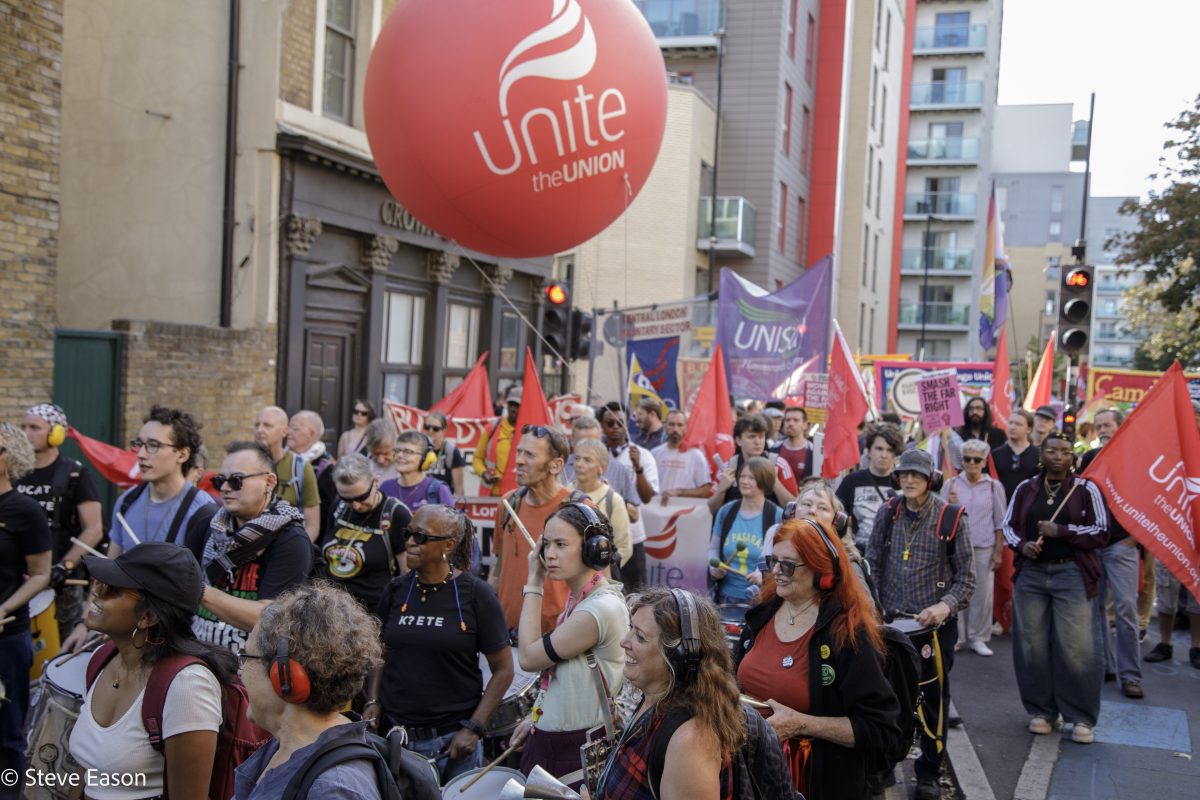
The Unite bloc on the Cable Street 90th anniversary march on 4 October was the largest trade union contingent, led by Sharon Graham and perhaps 300 in number. The bloc was far larger than, for example, that attending the Together Alliance demonstration in March. Dock workers were one of the groups which came together to oppose Moseley’s Blackshirts in 1936 so it was right that Unite, which represents dockers today, took a prominent role in marking the occasion. Graham’s speech at the rally spoke of a ‘working class emergency’ which cannot be solved by Labour politicians alone, but required change driven ‘from below’.
It’s well understood within the union that a segment of members have turned to Reform – often, but not solely, former Tory supporters – and have become convincedly anti-migrant and Islamophobic. Unite’s response to this is taking a number of forms. The union is making some efforts to equip members with the confidence and arguments they need to tackle right-wing ideas. The Respectful Conversations About Difficult Subjects training that reps have been offered, despite the weak title, does provide such a framework. It acknowledges that this work is likely to require one-on-one discussions over time. The Unite for a Workers Economy project forms the ‘political wing’ of the leadership, putting out a message of class solidarity and pointing to the ties between Farage and the most predatory, anti-worker bosses. These are good initiatives but not on the scale we need and insufficiently ‘joined up’. Workplaces and branches should also facilitate discussions on the talking points the far right feed off to undercut them on our terrain.
Employment Rights Act
From the end of October unions have been able to make requests to employers for access to their workforce for organising and to facilitate collective bargaining. Access can be in person, electronic or however an employer usually communicates with workers. This is a massive opportunity for the trade union movement to rebuild itself, if we rise to the occasion. Branches are passing motions calling for adequate resources to be put into this effort, and Unite’s Executive Council received a briefing on the provisions at its recent meeting. We now need a comprehensive plan of action, which gives training and a role to our activists: the scale of the job means it can’t be done by officers and organisers alone.
It’s clear that many employers are moving to undermine genuine organising efforts using the provisions by signing ‘sweetheart’ deals with pliant unions. Prospect at Meta (Facebook) and USDAW at John Lewis/Waitrose are just two examples, the latter ‘recognition’ deal excluding negotiations over pay, hours and holidays! Wherever we are organising and have membership we need to notify the TUC so that at least we can use Principle 3 of its Disputes, Principles and Procedures to object to other affiliated unions squeezing us out.
The rank and file group Troublemakers At Work have produced a briefing on the new e-balloting and access provisions.
Defending trans rights as a union issue
Last year, conference passed a policy reaffirming Unite’s position in defence of trans rights, namely to ‘affirm and acknowledge the rights of all women regardless of their sex assigned at birth’ (summary of Policy Conference decisions, p. 33). This motion was agreed in the wake of draft EHRC guidance published last year which would exclude trans people from facilities and services on the basis of sex assigned at birth. A version of this guidance has now been introduced as a statutory Code of Practice, constituting an unprecedented rollback of trans rights which invalidates the basis of the Gender Recognition Act 2004. It follows a barrage of bigoted attacks and scapegoating of trans people since 2018, when trans people already disproportionately experience homelessness, unemployment and harassment at work.
Unite has been noticeably muted on this issue, despite other unions such as UNISON publicly campaigning against the Code of Practice and for a change to the law. A joint statement was released by the Women’s and LGBT+ committee however this was not promoted widely by Unite, and though a survey was released to gather feedback from members impacted by the Code the outcome of this and follow-up action from it has not materialised. This caution may in part be due to concern about potential legal claims. But Unite rightly did not shy away from legal risks when throwing its weight behind the Birmingham bin strikes, and this wouldn’t prevent us from campaigning to change the law. This reflects a deeper issue within Unite of ducking political and social issues, weakening solidarity across the working class to fight for justice and freedom for all.
Only recently, the LGBT+ national conference was dissolved because delegates voted to not accept the positions of the Standing Order Committee, which prematurely ruled at least six motions out of order on spurious grounds, stifling debate on these key issues. At least one motion on trans rights to a sector conference also seems to have disappeared from the agenda without transparent communication to the RISC (Regional Industrial Sector Committee) which submitted it.
Industrial and political issues are indivisible from each other: the segregationist Code of Practice is not only an affront to the dignity of trans workers and communities but is unworkable, forcing workers to police access to services and sowing division. Unite must take a moral and political stand against trans oppression, standing by any member who refuses to enforce exclusions to services and campaigning for a change in the law. An injury to one is an injury to all!
Financial mismanagement
In August, the Certification Officer finally issued its report into mismanagement under Len McCluskey. Though the report didn’t find wilful neglect, it is damning for Len McCluskey, Howard Beckett and Unite’s auditors, who didn’t understand their responsibilities. Howard Beckett’s ‘abdication of oversight of the finance function was near-total’.
The report doesn’t cover all aspects of the Birmingham project, but its finding that Unite had no system for managing conflicts of interest where transactions were with individuals or organisations connected with the union or its senior staff seems highly relevant. McCluskey and Beckett knew that it was worth far less than what had been spent by 2019 but didn’t promptly tell the auditors or EC, which is described as ‘a first-order control failure with direct and serious real-world consequences’. There was no risk register, procurement policy or proper financial controls, and ‘At least one payment (well before the relevant period) of approximately £100,000 was made to the contractor ultimately engaged as the main contractor for the Birmingham Project without any invoice at all’. Tax checks on Flanagans (the main hotel contractor) weren’t carried out, making the union potentially liable. McCluskey got an interest free loan of £400,000 and it is suggested that the EC was only informed after the fact.
The deficiencies identified as significant covered the following areas: expenditure controls, including the authorisation and approval of payments and journals; cash and bank controls, including bank signatories and reconciliation processes; asset management and impairment review; payroll controls; IT and systems controls, including access governance and system-based financial controls; budgeting, forecasting and risk oversight; procurement and contractual controls; income entitlement and debt collection; and governance and oversight, including the resourcing and expertise of the finance function and the EC’s capacity to oversee financial matters.
McCluskey and Beckett misled the EC. Attempts by some EC members, particularly Helen McFarlane, to ask questions once Len McCluskey finally told the EC about issues with the Birmingham hotel mean that the EC is not criticised as strongly. However, there are recommendations to prevent the EC being so reliant on the General Secretary and head of finance to draw issues to their attention and to prevent the F&GPC (Finance & General Purposes Committee) being so ‘rubber stampy’.
Strengthening democratic lay member control of our union is vital, alongside putting in place competent governance.
Click here to download and/or read the rs21 leaflet produced for the 2026 sector conferences.
0 comments