

Image: Steve Eason
Britain’s political shakeup
Jonny Jones •
After two weeks of disarray, the Tory party seemed to have achieved a degree of stability. It’s no surprise that, in the face of such an enormous political and economic challenge, the first party of British capitalism would try quickly to regain its balance. But the divisions in the party are deep, and Theresa May’s premiership faces significant challenges.
While the party will attempt to negotiate Brexit on the best terms possible for British capital, it does so while divided on what those terms are, and it seems unlikely that incorporating key Leave campaigners into her cabinet will be able to paper over the cracks indefinitely. Some Tories will be desperate to maintain membership of the European Economic Area and access to the single market; but that entails free movement of EU citizens, which is anathema to the hard right. May will feel confident to attempt to renegotiate, but EU leaders who may face their own referendums in countries such as Sweden, Denmark and the Netherlands, and potentially France, will not be keen to give ground on these positions. Comparisons with Thatcher are lazy and misplaced. Thatcher’s lowest majority was 43 (in 1979), with 144 in 1984 and 102 in 1987. May will have a working majority of 16, and that to deliver a centrist platform that might end up depending on a section of the Labour ‘rebel’ MPs.
Meanwhile, the weeks ahead will provide a challenge and an opportunity for the Corbyn camp. Restrictions on who can vote were passed at the end of the NEC meeting, meaning the hundreds of thousands of members who have joined Labour since January will be disenfranchised. This gerrymandering is likely to be challenged vociferously, and provides yet another avenue for campaigning. John McDonnell, Corbyn’s ally and shadow chancellor, said, “We will use leadership election to sign up even more members and to prepare ground for a possible General Election”.
Owen Smith, of Labour’s soft-left, has come forward as a second challenger – who knows how many unity candidates will come forward in the days ahead, pledging to unite the party, the country, and who knows, maybe even ABBA, or general relativity with quantum theory. What we do know is that Corbyn goes into this election the clear favourite. Indeed, right-wing Labour MPs are already talking to Tories about a potential split to form a centrist formation.
Against the background of the Brexit vote, Corbyn’s campaign is well placed to both oppose the racism whipped up the Leave campaign – which has led to an increase of 42 percent in reported hate crimes during the week before and after the referendum, the worst on record – but also to relate to the anti-establishment sentiment that formed a central part of people’s opposition to the status quo. Corbyn will be under pressure to concede on freedom of movement, from figures as diverse as Unite union General Secretary Len McCluskey and Paul Mason. But Corbyn’s instinct to defend free movement by rooting it in the need for stronger worker’s organization and union recruitment among migrants can enthuse his base far more than any accommodation to a perceived new realism can. This base includes many of the junior doctors who led an inspiring wave of strikes and have rejected the government’s new contracts, and many teachers who went on strike saying that austerity, not immigration, was to blame for rising class sizes.
The crisis over Brexit and renegotiations, of when to trigger Article 50 to leave the EU, or whether to do so at all, is a crisis for the ruling class that is not going away. The coup against Corbyn is more than just an attack on the left; it is an attempt by the right of the party to reassert the credibility of Labour as a reliable party of capitalist stability in the midst of that crisis. The volatility of the situation means that the crystal balls that predicted victories for Boris or the Blairites are best left to gather dust in the cupboard.
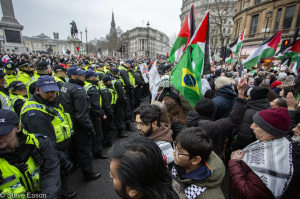
The radical left was divided over the question of the referendum for understandable and principled reasons, and we will continue to be a relatively small player in events in the months ahead. But by building initiatives like the migrant solidarity demo in London on the day after the referendum and the march against austerity and racism on Saturday July 16, and by connecting the campaign in defence of Corbyn up with solidarity with migrants, and opposition to austerity and the political establishment, we can find common purpose around class issues that can at least begin to chart a new direction for struggles in Britain.
This is an edited version of an article which first appeared in the US Socialist Worker




1 comment
Reblogged this on dainagregory.