
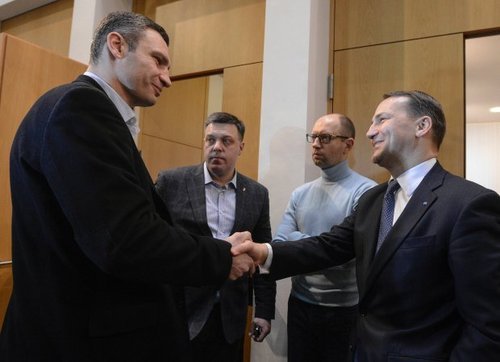
Klitschko and Yatseniuk shaking hands with Poland’s foreign minister Sikorski – picture via wyborcza.pl
Where next for Ukraine?
Jan Ladzinski •As the major news services shut down their live coverage of events in the Ukraine, the battle for the country’s future might be just beginning.
The EU achieved an unexpected victory during Friday’s negotiations, forcing the opposition leaders into a deal with Yanukovych which would allow the president to remain in power until the end of this year. The Polish foreign minister Sikorski threatened the opposition saying that they should sign the agreement or else they “will be all dead.”
If the deal had materialised on the ground, the opposition would have become wholly dependent on the Western support when facing Yanukovych’s remaining influence over the country, and would have diminished popular mobilisation. However, the agreement fell when Klitschko was shouted down in Euromaidan as he presented the crowd with its conditions. Instead, the Right Sector fascists proposed an ultimatum for the president to stand down by Saturday morning.
Yanukovych did not take his chances. He disappeared the following day and the parliament assumed full responsibility for governing the country with participation of deserters from the Party of Regions. Meanwhile, police forces also vanished from Kiev with many of the former protesters becoming a makeshift militia. Perhaps the biggest sensation was the occupation of presidential residence which was immediately opened to the public. Scores of ordinary Ukrainians have visited, wishing to see not only the lavish house and the grounds but also Yanukovych’s private zoo.
Despite the apparent peace in Kiev, protests could resurface soon. Even the release of Yulia Tymoshenko and her appearance on Euromaidan on Saturday, a day after the woeful reception of Klitschko, could not spark enthusiasm among the gathered people. On Sunday, Ukrainian Pravda, published an article discouraging the former prime minister from running for presidency on the account of her involvement in corruption and links with Russia. On the same day, activists from the Automaidan group declared that they remain an opposition group and will continue watching the new government.
It appears that the thousands of people who mobilised and organised against the government over the past months are reluctant to accept the new leadership outright. It was their presence and determination, rather than the emergence of a few hundred armed Right Sector militants, that ultimately prevented the regime form crushing the protests. Now they might prove more difficult to control and direct than ever. As an rs21 member recently reported, many of them resent the wealth amassed by the oligarchs. A glimpse into Yanukovych’s luxurious lifestyle might intensify these sentiments, especially if the new government fails to improve the lives of ordinary Ukrainians. Failure is almost certain due to the commitment of mainstream leaders to capitalist dogmas. For the countries of the global periphery these dogmas mean a dependence on unreliable financial aid from abroad.
A failure to satisfy popular expectations might prove decisive in Ukraine’s future. The economic interests of the masses are likely to prevail over time. The former opposition, including nationalist Svoboda, could easily become discredited over its inability to facilitate sufficient changes in the country. The people already know their strength and have the organisational experience to mean the discontent can be quickly transformed into a mass protest.
Such protest could provide an opportunity for new political forces to emerge. The Right Sector and other right-of-Svoboda groups might benefit from it, and the still marginal left in the Ukraine faces an enormous task in overcoming their influence. However, as the immediate demands for ousting Yanukovych are satisfied and focus shifts towards economic grievances of the population, the left might prove better at filling the vacuum left by the liberal and centre opposition. A left-wing programme for the Ukraine, such as the ten points manifesto published by Left East, provides a better answer to economic problems facing the population than the nationalist and anti-Russian slogans of the far-right.




0 comments