
More of the same won’t save education: why extra funding is only a partial victory
rs21 educators •Educators in rs21 say this year’s pay rise from the government isn’t enough, argue for more industrial action, and put forward the case for the 4:20s: concrete demands that truly deal with the crisis in education
On Wednesday 16 September, NEU General Secretary Daniel Kebede announced that the government had met the limited demand to fund this year’s educator pay rise (currently 3.3 per cent for support staff and 3.5 per cent for teachers). This is a welcome win given the new government’s adoption of austerity logic. But, when we look beyond the headline, it is clear that this deal is nothing but a temporary sticking plaster.
The funding for this has come from a re-evaluation of the Local Government Pension Scheme. Following the Covid pandemic, employer contributions to public sector pension schemes were increased, leaving the schemes themselves richer. The government has decided to lower the employer contributions and it is this lower contribution that is providing the money for this year’s pay increase.
It is obviously welcome that we have won funding for this rise. Previously, the government had refused to consider any extra money for schools. Before summer, when the Teacher Pension Scheme reduction in contributions was announced, the government clawed all the extra money back. So this is a victory and a victory won by the credible threat of national school strikes.
But the victory is partial and we need to ask the question of where this partial victory leaves us. Yes, this year’s pay increase is funded, but it is unclear if that funding will be in place going forward (these could be cuts deferred rather than avoided). And it’s worth saying that the pay offer on the table was incredibly low in itself ‒ it does nothing to restore educators’ pay to 2010 levels, and doesn’t even touch the sides of key price increases (the ONS found that food prices had increased by 30.1 per cent since 2022).
Most importantly, this fully funded pay increase does nothing to fix the multiple crises faced in education: recruitment, retention, class sizes, workload, privatisation, SEND. Instead, it means that we still have to live the effects of those crises day to day while, for one year, the government hasn’t made them worse with an unfunded pay deal.
That is the real issue here. The national strike campaign was never about just more money in our pockets; it was about putting forward a vision of education that met the needs of our communities. One that was properly funded, properly resourced and afforded the political priority it needs. This funding deal does none of that: it doesn’t redistribute wealth away from the ultra rich and into our communities, it doesn’t give education a more prominent place than arms spending and it doesn’t do anything to address the crises that educators and young people have to face every day. Instead, it is a one off accountancy trick from a new government experiencing a temporary bounce to offer some crumbs to educators. Our General Secretary seems to have been seduced by this trick.
For the NEU, this will compound the problem that has been developing in the union since the 2023 strikes. Those strikes ended in a sell out by centrist elements in the union leadership. Since then, members have been constantly asked to vote in ballots and prepare for action, only for that action to disappear at the slightest concession from the government. NEU propaganda repeatedly evokes the spectre of education crises and then accepts deals that do nothing to address these crises. This inevitably leads to a cynicism amongst jaded educators: is the NEU really a vehicle for solving their everyday problems?
Responsibility for this has to lie with those tendencies within our union, including with our Executive and our General Secretary, who are constantly negative about the prospect of action to shift the situation in education. They view members as passive, self-interested and satisfied with being bought off with crumbs. The reality is we’ve never had a national strike under the General Secretaryship of Daniel Kebede ‒ someone elected as a ‘left’ trade union leader.
On top of this, the centrist elements in our leadership have consistently created democratic issues within our union: our national policy clearly calls for work on pay restoration for all educators. Instead, Conference decisions have been flagrantly ignored over the last few years ‒ in terms of pay, we are constantly sold short of the demand of pay restoration; in terms of a deal for all educators, our leadership consistently ignores our support staff members and very explicit instructions from Conference to ballot and organise them.
So how do we find a way out of this quagmire? Clearly, the strategy of accommodating the government’s austerity agenda isn’t working. Our current strategy has slowed the decline in education but it owes more to limited crisis management than delivering a system that is fit for purpose. Instead, we need to popularise and campaign for a vision of education that meets the needs of educators and children.
That is where our 4:20s come in: concrete demands that are achievable and transformative. But these demands will require confrontation with the government ‒ not accommodation. We can’t deliver transformative change in our schools unless we win the public argument about redistributing wealth and investing in education ‒ industrial confrontation, in the form of strikes, is the best way to achieve this. We hope that the Executive will vote to continue the ballot and strike action; the alternative would be to yet again squander the energy we’ve campaigned for so far for a deal that is just more of the same.
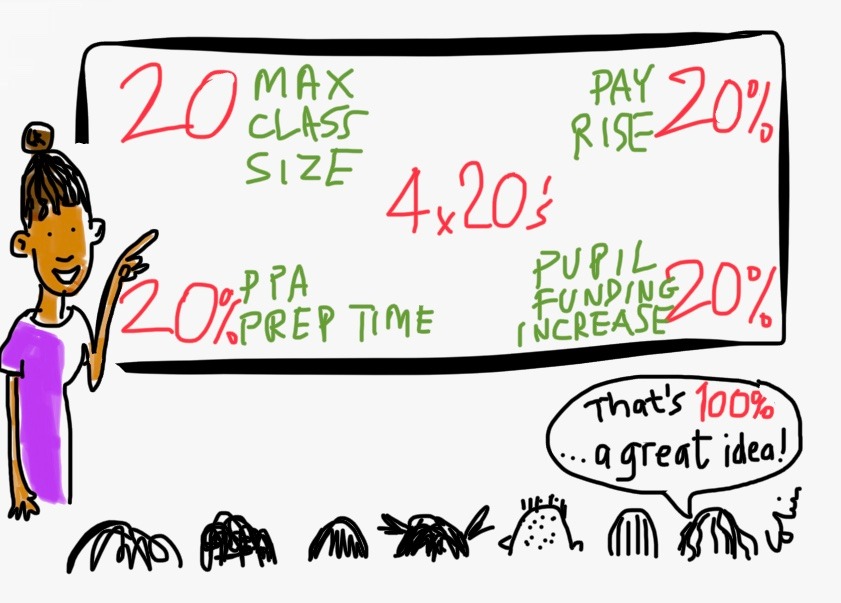
The 4:20s
Pay – a 20 per cent uplift for all
Pay in education is far too low. For teachers, pay simply doesn’t compete with industry pay, where educators can often earn more money for less work. The situation is even worse for support staff, whose professionalism isn’t recognised in the current pay structures, despite their crucial role in keeping the education system working. Pay is one of the key factors in both the recruitment crisis and the retention crisis ‒ the government needs to address this with a fully funded, restorative pay award immediately.
Workload – 20 per cent PPA time
Workload is often cited as one of the biggest challenges facing educators. Our job, as it is currently organised, requires long hours of working in the evening and weekends, let alone our time in school. On top of that, the physical toll and emotional labour required to do the job well often leave educators burnt out. Most workload ‘solutions’ focus on tweaks to meeting schedules and marking policies or, even worse, the automation of our jobs by superficial AI replacements. None of these really touch the sides of the workload crisis but a guaranteed 20 per cent PPA time would make a significant difference. This principle should also be extended to support staff, who need at least 20 per cent of time as non-contact time to complete the important recording and administrative tasks that they complete.
A maximum class size of 20
The other driver of workload is both the sheer amount of children in a class and the rising complexity of need for many children. Facing the funding crisis, schools have often packed in pupils to help ease funding pressures. This drives workload up and results in a worse educational experience for the child. A maximum class size of 20 would relieve workload pressure and allow space and time for the needs of individual children to be met. This demand is also one that helps unite us with parents and children, who all want the best educational experience possible.
A 20 per cent increase in per pupil funding
The measures outlined above need paying for specifically but schools also need more money in their budgets to be able to deliver initiatives to support children. The current funding model, one that cuts schools to the bone and constantly relabels the same money as funds for new policies, helps no-one. Schools need the flexibility to be able to meet the needs of their cohort and individual children; that means a serious increase in the amount of money in the system. A 20 per cent increase in per pupil funding ‒ the equivalent of one day extra funding per pupil per week ‒ would help to solve this problem.
The 4:20s: deliverable solutions
The above four demands, that we call the 4:20s, are an attempt to craft concrete solutions that meet the crises facing educators. Some in the union movement will argue that they are too bold ‒ but these are people who have bought into the unimaginative and unrealistic machinery of circular, yearly pay bargaining. They focus not on what is needed but on what modest demand can be actioned in a short time frame. We desperately need to challenge such thinking. Equally, the government will claim that these transformatory demands are undeliverable because of caps on spending or artificial fiscal ‘rules.’ Government austerity, and its 50-year assault on public services, have not improved the public finances at all. Instead, their unwillingness to properly fund crucial services such as education compounds the challenges facing our society. At the same time, these fiscal ‘rules’ go out of the window when it comes to spending money on arms manufacturing or proxy wars or bailing out their billionaire friends. We must insist that the wealth generated by our communities is used to support those communities, rather than be allowed to enrich the concentrated wealth of billionaires.






0 comments