
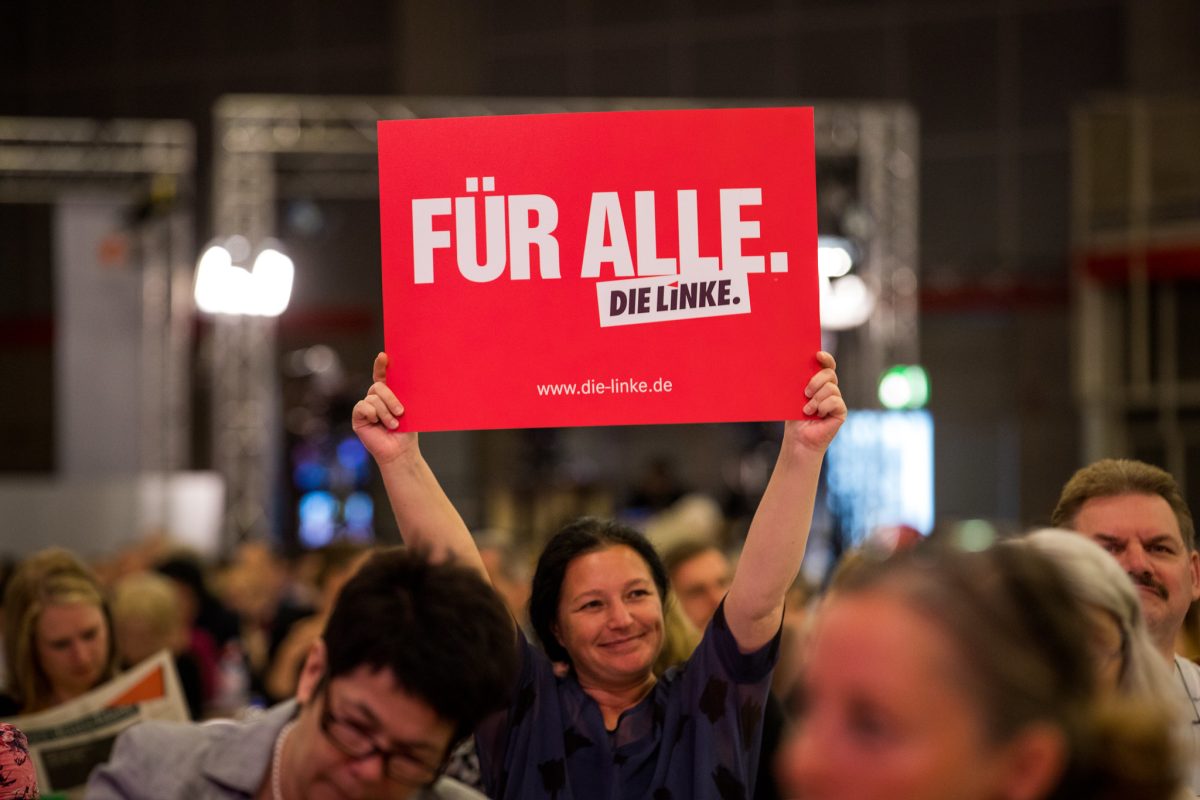
The charms and pitfalls of extreme pluralism – Lessons from Die Linke
Tristan Colum •Tristan Colum, revolutionary socialist in Die Linke, reports on the party’s extreme pluralism, and why broad left parties so often become the rearguard of the struggles they claim to lead.
Die Linke has established itself as the main left-wing force in Germany over the past two decades. After a period of serious internal crisis following 2019, the party has seen a partial recovery. The causes and limits of this recovery deserve careful examination, particularly for those on the left in other countries grappling with questions of political unity and organisational form.
This essay draws on the direct experience of Die Linke’s internal politics to assess the model of a broad left multi-tendency party: its genuine achievements, its structural weaknesses, and the specific conditions that allowed it to stabilise after nearly collapsing. The argument is not that Die Linke has failed. It has not, and its survival as a coherent left-wing force in Germany is a real accomplishment. But the party’s history offers hard lessons about what extreme pluralism actually produces in practice.
A Brief History
The seeds for Die Linke’s formation were sown in the early 2000s, from a broad front comprising three fractions of the German left. Firstly, there was the rump membership and activists of the old Stalinist SED, leftover after the fall of the GDR; secondly, a fraction of left-wing social democrats who split from the SPD following its turn to neoliberalism in the 1990s and 2000s; and thirdly – crucially for the activist base – the integration of most of the post-1970s radical left parties, marxist sects, and social movement activists.
The obvious rationale for unifying under a common party umbrella was that to have an organisation able to act on the national level for left-wing politics and working-class interests, it was necessary to group together. This resulted in a party constitution defined by formally very democratic structures for the membership, and at the same time, what is called a ‘pluralist’ set-up of party organisation. All party factions were able to retain official tendencies and caucuses within the party. Die Linke is a party in which getting elected to high party offices and taking part in debates at every level is relatively easy. Officially recognised caucuses act independently and get subsidised via the central party’s finances. Caucuses are also able to elect their own delegates to congresses.
Unification took place officially in 2006/07 and was carried by a wave of election victories under two charismatic leaders: Oskar Lafontaine from the SPD’s left trade union wing and Gregor Gysi from the post-Stalinist SED. During this phase, internal party affairs worked quite well. The party had been built on the back of real social struggles of the 1990s and 2000s – anti-Hartz IV mobilisations (protests against the SPD government’s welfare cuts), the peace movement in the wake of the Iraq and Afghanistan wars, trade union battles – and this shared political formation gave the membership enough common ground to act as a relatively unified body. Riding a wave of electoral success, the party was able to translate this unity into a coherent ‘anti-neoliberal, anti-militarist’ strategy, which found a ready audience in the wake of the 2008 financial crisis.
The Limits of Pluralism
Problems emerged once the party’s early electoral momentum stalled around 2012/13. With election results flatlining, the first weakness of the pluralist party became apparent: strategic ambiguity, and often, corrosive and overly public debates over opposing political positions.
The party factions incorporate revolutionary socialists and social movement activists on one side, and municipal politicians and reformist social democrats on the other. This causes a continuous contradiction not just in programmatic terms but also on the practical, strategic and tactical level. Theoretically, pluralism and the synergy of ‘street and parliament’ can work as a unifying internal concept – especially while advancing successfully. However, it begins to fall apart when faced with the problem that, eventually, one form of politics must take precedence over the other.
Both wings of the party might agree on the practical objective at hand (the rent question, unemployment policies, etc.). The movement activist’s objective is to develop polarising conflicts with the state and the capitalist class to secure even reformist change. But the reformist politician and trade union bureaucrat eagerly develops a negotiated settlement with employers, other parties, or state institutions. In the first instance, these strategies overlap because grassroots movements can gain more prominence by utilising the communication and access privileges of politicians and shop stewards, and the latter gain bargaining leverage via the movement. But the interests diverge once the party has either established institutional positions or campaigns have been successful in generating meaningful political pressure.
One such example was a rent campaign in Mannheim, a sizeable industrial city in the South of Germany. The youth wing of the party, in coordination with other local left-wing groups and organised tenants, ran a campaign attacking the nominally left-wing mayor and local property developers, making clear their responsibility for the ongoing gentrification of working-class areas. Almost immediately, the local municipal MPs and the reformist-dominated city branch sprang into action, distancing themselves from and trying to undermine the campaign. This was not because they were ill-intentioned, but rather because the coalitionist reformist strategy advanced at the city level relied at least on being ‘on speaking terms’ with the city bureaucracy, the Social Democrats, and the Greens. After all, so the argument goes, this careful diplomacy has achievements to show, such as financing for local swimming baths or discounted transport tickets for poor and elderly people. But what this illustrates is that divergent flavours of socialism manifest themselves in practical political terms as well as theoretical ones.
In Die Linke, these tensions are not resolved by the internal party structure. In effect, pluralism plays out as the locally more dominant fraction enacting its strategy and boycotting or undermining actions by the opposing fraction. This is also one of the reasons why party leadership on nearly all levels of the organisation is, as a rule, immersed in compromise formulas. The leadership selected cannot enact even the most basic kind of collective action. In this worst of all worlds, the party congress passes resolutions that half of the organisation breaches or dismisses, or elects comrades onto the leadership who a large part of the party simply ignores.
Structural Failure of Leadership
This strikes at an important rule of party organisation: it must be able to act coherently, or it cannot act at all. The structure of pairing transparent democracy with absolute pluralism leads to contradictory action by the party’s base, and almost no action by the leadership. This is the result even if the leadership enacts correct policies, as was the case under the left-wing trade unionist Bernd Riexinger, whose attempt to bring the party more decisively into working-class struggles led to constant paralysis and internal conflict.
In Die Linke, it is very clear that a party structure is not just a formal process, but also a community directed at common goals and actions. While this is proclaimed by the party’s programme and in principle agreed on by every type of member, it had, for about a decade, been nearly impossible to achieve. Factionalism and a continuous latent power struggle within the party undermine any common platform for action. This is not just a matter of bad will or moral corruption, although the reformist wing consistently dragged the party towards disastrous positions, such as a pro-NATO stance. But for such a left unity party to be worthwhile, the focus has to be on developing the party into a force, not on manoeuvring for power within its structures.
The ‘democratic-pluralist’ structure also produces a characteristic type of leadership failure. Die Linke leaders up to 2023 were often rhetorical embarrassments. Not because they were incapable of making a good argument, but because the party handed them nothing worth arguing for. A leadership that is formally accountable to every faction simultaneously, and a strong factional organisation pulling in opposite directions, produces resolutions and positions that are lowest-common-denominator compromises: well-meaning in their phrasing, empty in their content.
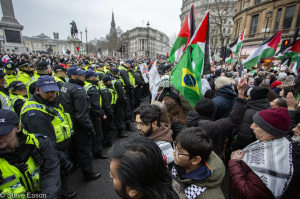
It also turns the party into the rearguard of every struggle. On Palestine, Die Linke has managed the remarkable feat of being on the wrong side of both history and electoral calculation. Opposition to the arming of the genocide increasingly commands majority support in Germany, and overwhelming support among the working class. The party could not get there. After all, it had to signal respectability to appease the reformist wing’s coalitionist ambitions. Instead, the party managed to let two years and one national election slip by before it was able to agree on co-sponsoring a single demonstration opposing the genocide. This kind of leadership failure is the result of the motto that it is ‘better to do nothing than to do the wrong thing’ – which is itself the flip side of the attitude among party members that ‘if I don’t get my way, I’m off’. Both tendencies reinforce each other to produce paralysis.
What Works, and Why
My experience is that this paralysis is not just the fault of the reformists, but also in part due to wrong priorities set by the revolutionary wing. For a long time, most revolutionary activists centred their efforts on winning over other party members or left-wing activists within the party. While from the point of view of liberal debate, this is a noble cause, it is one of the most futile exercises. Most activists or party militants already have an entrenched view of which flavour of red they support, and while having intellectual sparring matches with them can be intellectually satisfying, the results are very meagre.
The communists who have been most successful in tipping the balance of forces in a multi-tendency organisation have been groups focused on building out the party’s strength using a revolutionary-realist strategy. Other left-wingers are swayed more easily by seeing a successful campaign run or a strong local organisation built than by purely abstract arguments. This is not to denigrate theory, but rather to say that theory must be put to the test and measured by success, or it will shrivel into a purely academic exercise.
The reversal of Die Linke’s fortunes after 2023 bore this out. It was not the product of any single factor. The departure of the Wagenknecht faction was necessary but not sufficient. Wagenknecht and her allies had for years combined a socially conservative, anti-migration politics with an opportunistic use of the party’s anti-war tradition. This combination blocked left advances while discrediting them in the eyes of a broader public. Their exit cleared a real obstacle. At the same time, the weakening of the reformist wing opened space for more decisive political positioning than the party had managed in years. But what actually converted this opening into organisational momentum was more material: the sustained doorknocking campaigns and direct voter contact under the new leadership, which rebuilt a local presence in working-class areas where Die Linke had become invisible. It was the combination of structural change and concrete collective action that stopped the decline.
A year on, however, familiar patterns are reasserting themselves. The old East German reformist current, never fully displaced, has begun repositioning. Its main effect, as before, is to stifle any development of Die Linke toward an anti-imperialist stance. The party risks repeating the cycle it has only just escaped.




0 comments