
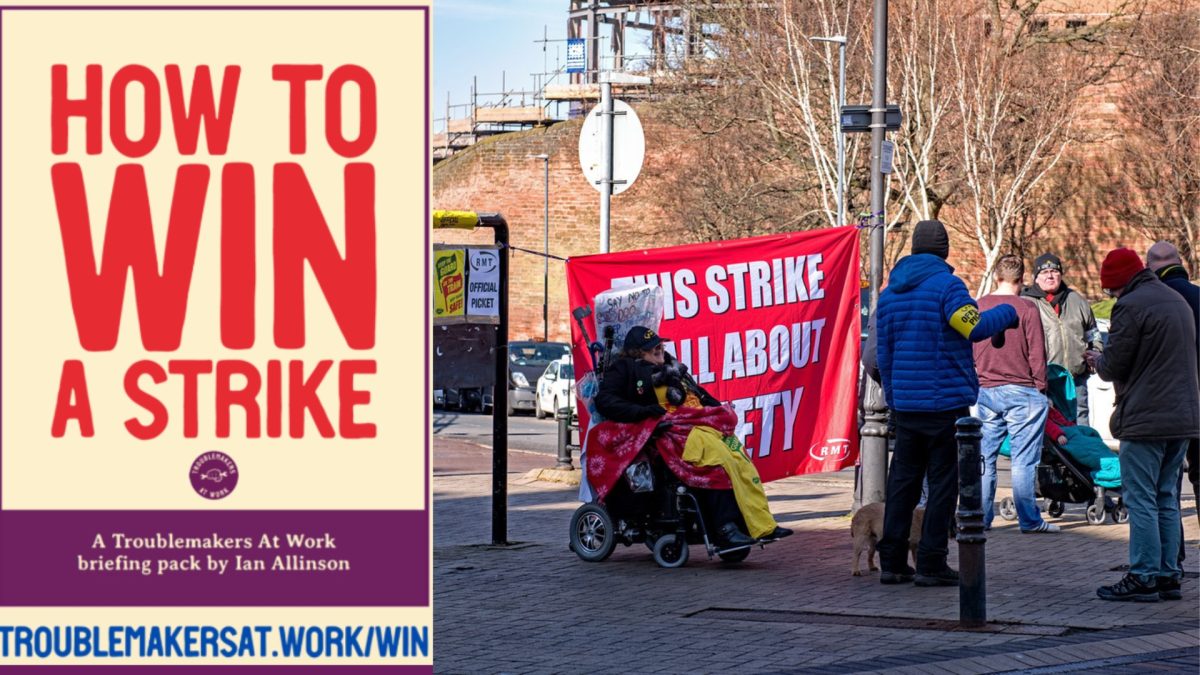
Review | How to win a strike
Mark C •Mark C reviews the new pamphlet from Troublemakers at Work.
Ian Allinson’s latest pamphlet, How to Win a Strike, is a rough guide for activists and striking workers. It comes at a critical juncture as the British trade union movement attempts to overcome decades of defeat and retreat.
Ian will be well known to regular readers of this website. He is a Manchester based activist, prominent member of rs21 and the author of Workers Can Win: A Guide to Organising at Work. In his latest pamphlet, he argues that a strike is a special type of protest. Strikes have the ability to disrupt the production of goods and services, the flow of profits and the ‘smooth running of society’. Strikes can also bring workers together and give them a sense of their own power.
How to Win a Strike is published by Troublemakers At Work, a group of rank-and-file activists that is organised democratically and without affiliation to any political groups or unions. As such, the pamphlet is able to tackle subjects not usually covered by official union literature. For example, Allinson includes guidance around dealing with the union bureaucracy, unlawful forms of activism, organising with and where necessary without the support of the union bureaucracy, and organising in multi-union workplaces.
Allinson explains how a strike depends on power dynamics and the balance of political and economic forces, as opposed to the rhetorical skills or powers of persuasion of individual representatives. This leads to a number of important conclusions around mass organising, keeping workers on board, frequent and ongoing communication between workers, forming mass strike committees, and maximising involvement at all stages in a workplace dispute. Those workers who are involved in drawing up clear and democratically agreed strike demands, for example, are more likely to make the sacrifices necessary to win.
In planning a strike, Ian talks about ‘credibly threatening’ a ‘disruption cost’ (the cost to the employer caused by the strikes) and explains that this disruption cost needs to be greater than the ‘concession cost’ (the cost to the employer of conceding to the strike). A short strike of one or two days might demonstrate anger among workers, but it is unlikely to be successful because there is usually little real disruption cost. Employers can easily ride it out. Ian therefore suggests ‘escalating strikes’ (intensifying the action over time) and even ‘continuous strikes’ (striking indefinitely until the dispute is resolved). Importantly, however, the disruption costs need to be credible and workers need to be on side.
How to Win a Strike is written in Ian’s usual clear and accessible style. It is free of theoretical and technical jargon, and stuffed full with practical advice, check-lists, and ‘what if’ scenarios. The pamphlet is likely to be useful to workplace activists of all levels of experience and none, in unionised and non-unionised workplaces, and across different types of workplace environments. It deserves to be printed out, shared and discussed on every picket line.
The pamphlet will be available in March 2026. You can (pre)-order a hard copy version, an epub or a downloadable PDF from the Troublemakers website.



0 comments